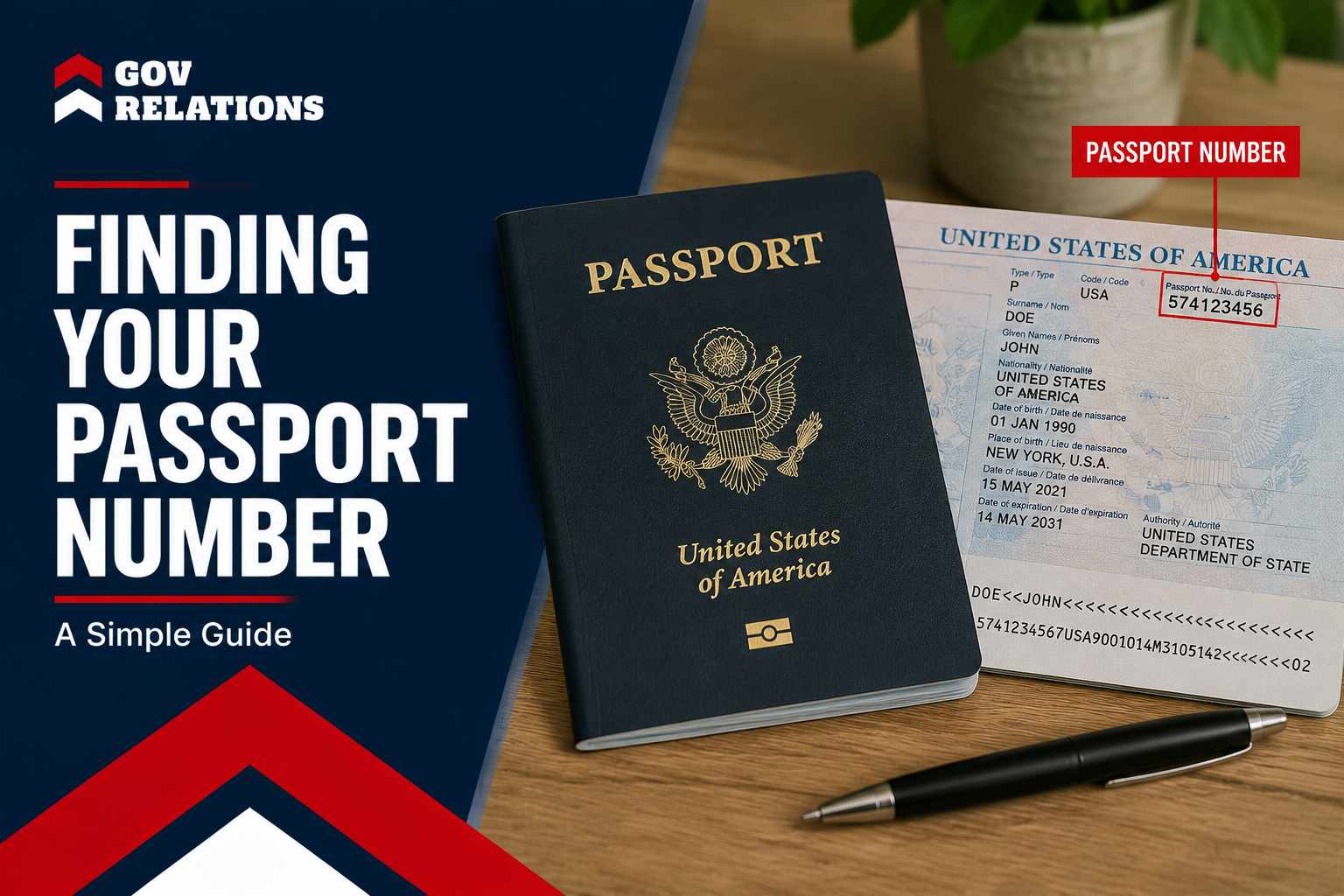
Your passport number is printed on the photo page of your passport, in the top corner next to your photo, and again in the two lines of code at the bottom of that page. That one spot answers the question for almost everyone. The harder part is knowing which number is the passport number, what to do when the passport is not in front of you, and how to avoid the scam sites that target people searching for this exact information.
This matters more than it used to. Identity theft remains a major issue in the United States. The Federal Trade Commission received approximately 1.1 million identity theft reports in 2024, and your passport number is exactly the kind of detail criminals want. This guide shows you where to find your number, how the format works in different countries, what to do if your passport is gone, and how to keep the number out of the wrong hands.
Key Takeaways
- Check the photo page first: Your passport number sits in the top corner of the photo page and again in the code at the bottom of that same page.
- Passport number is not the book number: The passport number is your travel ID. The passport book number is an internal tracking code that many countries do not use at all.
- Formats vary by country: A US passport number is one letter plus eight digits. A UK number is nine digits. India uses one letter plus seven digits.
- No public lookup database exists: Governments do not let you look up your own passport number online. If the document is lost, you must request records in writing.
- US record requests take 12 to 16 weeks: The State Department can send copies of your passport records, but the wait makes this useless for urgent travel.
- Scammers target this search: No real government program charges a fee or contacts you out of the blue to hand over a passport number. Treat any such offer as fraud.
Passport Number or Passport Book Number: Which One Do You Need?
The passport number is the unique alphanumeric code that identifies your specific passport, and it is the number requested on flight bookings, visa applications, and customs forms. The passport book number is a separate internal control code that some governments use to track the physical booklet. They are not the same, and confusing them causes rejected forms.
Here is the rule that clears up most of the confusion. When a form asks for your passport number, it wants the number printed beside your photo and name. When a form asks for a passport book number, and your country does not issue one, you leave the field blank or write “N/A.” The United States and Canada are among the countries that have used a book number. Many others never have.
If you cannot find a book number on a US passport, you are not missing it. Newer US passport books often do not display a separate inventory control number at all, so a blank field is the correct answer rather than a problem to solve.
Where Is the Passport Number Printed on the Document?
The passport number appears in two places on the photo page: the visual area where your details are printed, and the machine-readable code at the bottom. International standards from the International Civil Aviation Organization (ICAO) keep these two locations consistent across nearly every modern passport, so once you know the pattern, you can read any country’s passport.
The Visual Inspection Zone (the part you read normally)
The visual inspection zone is the upper section of the photo page that holds your name, photo, date of birth, and passport number in plain print. In most passports, the number sits in the top right corner of this page. US, Indian, and Australian passports all place it in the top right of the biographical page, and UK passports print a nine-digit number on the first page.
The Machine-Readable Zone (the two lines of code)
The machine-readable zone is the block of two lines at the very bottom of the photo page, filled with letters, numbers, and chevron symbols. A passport booklet uses the Type 3 format: two lines of 44 characters each, printed in a special font that scanners read at the border. Your passport number is encoded at the start of the second line.
One current change is worth knowing. Under the updated ICAO Doc 9303 standard, effective January 1, 2026, the document-type code at the start of the machine-readable zone is moving to a standardized two-letter format, such as “PP” for an ordinary passport. The reporting on this shift, covered by IATA, notes that all countries must issue the new codes by 2028, with older one-letter passports phased out by 2038. Your passport number itself does not change.
Laser Perforations (a hidden third copy)
Many passports also drill the passport number straight through the pages as tiny perforated holes, a security feature that is hard to forge. The US Next Generation Passport, issued since 2021, carries a perforated alphanumeric number (one letter followed by eight digits) on every page. UK passports perforate the nine-digit number from page 1 to the back cover. If the print is worn, you can often still read the number from these holes.
What Does a Passport Number Look Like in Each Country?
Passport number formats are set by the issuing country within ICAO guidelines, so the length and the mix of letters and digits change from one nation to the next. Knowing your country’s pattern helps you confirm you are reading the right number and not, for example, a visa number or a national ID number. The table below shows common formats.
| Country | Standard Format | Example |
|---|---|---|
| United States | 1 letter + 8 digits | A12345678 |
| United Kingdom | 9 digits | 123456789 |
| Canada | 2 letters + 6 digits | AB123456 |
| Australia | 1 or 2 letters + 7 digits | N1234567 |
| India | 1 letter + 7 digits | Z1234567 |
| Mexico | 9 characters (alphanumeric) | G12345678 |
| Singapore | 1 letter + 7 digits + 1 letter | E1234567A |
How to Find Your Passport Number Without the Physical Document
When the passport is not in front of you, finding the number is harder by design, because governments do not publish lookup tools that would let anyone pull a passport number. You still have a few legitimate options, and they work in this order from fastest to slowest.
- Check your saved photos and files. If you ever photographed your photo page, the number is right there. Search your phone’s photo library and any cloud storage for an image of the page.
- Look in your airline and travel accounts. Frequent flyer profiles, booking sites, and corporate travel systems often store passport details from past trips. Log in and check your saved traveler information.
- Check old visa or government application portals. If you applied for a visa or an immigration benefit, the portal you used may still show the passport number you entered.
- Ask a trusted person who has a copy. Many people leave a copy of their passport with a spouse, parent, or employer for emergencies. That copy holds the number.
- Request your records from the government, in writing. This is the last resort because it is slow. In the United States, you can request copies of your passport records under the Privacy ActA federal law that governs the collection, maintenance, use, and dissemination of personally identif... of 1974.
That last option deserves a warning about timing. According to the US Department of State, a written records request needs your personal details, a clear copy of both sides of a valid photo ID, and a signature in front of a notary or on a penalty-of-perjury statement. There is no fee for a regular copy, but current processing time is 12 to 16 weeks. That makes it useless for a trip next week, which is why backing up your number ahead of time matters so much.
Key Terms You Will See on Your Passport
A few terms get mixed up constantly, and mixing them up is what leads to rejected forms and wasted time. Here is what each one means in plain language.
Passport number: Your travel ID number, used for flights, visas, and customs. Found on the photo page. This is the number almost every form wants.
Passport book number: An internal code some governments use to track the physical booklet. Not used by every country. Leave it blank if your passport does not show one.
Visual inspection zone (VIZ): The printed area of the photo page that you read normally: name, photo, date of birth, and passport number.
Machine-readable zone (MRZ): The two lines of code at the bottom of the photo page that scanners read. Your passport number is encoded in the second line.
Check digit: A single calculated number inside the machine-readable zone. If the passport number is altered, the check digit no longer matches and a scanner flags the document.
How Border Systems Confirm Your Number Is Real
Your passport number is not stored in just one place on the document, and that redundancy is a deliberate anti-fraud design. When an officer or an e-gate checks your passport, the system cross-references the printed number in the visual zone, the encoded number in the machine-readable zone, and, on an electronic passport, the number stored on the RFID chip inside the cover.
As the identity-verification firm Regula Forensics explains, modern checks never rely on the machine-readable zone alone, because that printed text is not encrypted. Instead, the encoded data is matched against the visual print and against the chip. If the three copies of your passport number do not agree, the document is treated as a possible forgery. This is also why a worn or mistyped number can slow you down at a border even when nothing is actually wrong.
For you, the practical takeaway is simple. When you copy your passport number onto a form, copy it character for character, including any leading letter. A single wrong character can fail an automated check and cost you time you did not plan for.
⚠ Scam Warning: Fake Passport Lookup Sites Are Common
People searching for a lost passport number are a target for fraud, and the timing of the search makes it worse, because someone who is stressed and in a hurry is easier to fool. Before you trust any site or offer, run through these checks.
- No government runs a public passport-number lookup. Any site that claims it can pull your passport number from a database by name is not legitimate. Real record requests are slow, written, and verified.
- The real process is free or low-cost. A regular US passport record copy has no fee. Any site charging a large “processing fee” to retrieve your number is preying on urgency.
- Official US passport sites end in .gov. The real source is travel.state.gov. A site that uses the words “passport” or “government” in the address but does not end in .gov is not the government.
- No real agency contacts you first to offer your number. Any unsolicited call, text, or email offering to recover your passport number is a scam. Do not reply and do not click the links.
If you receive a fraudulent offer like this, do not engage with it. Report it to the Federal Trade Commission at ReportFraud.ftc.gov. Identity theft losses keep climbing, and reporting helps investigators track the schemes that target travelers.
How to Make Sure You Never Lose Your Number Again
The people who never have to scramble for a passport number are the ones who saved it before they needed it. Three habits cover almost every situation.
- Photograph the photo page the day your passport arrives. Store the image in an encrypted phone vault or a password-protected file, not your camera roll. This single step solves the problem for years.
- Keep the number separate from the passport. When you travel, store a copy somewhere other than where the passport is, so losing one does not mean losing both.
- Report a lost or stolen passport right away. Reporting it immediately to your national authority limits the damage if someone tries to misuse the number for identity theft.
If you also handle other official paperwork for yourself or a family member, the same habit applies across the board. Keeping clean copies of the documents and numbers tied to your benefits and applications saves the same scramble later.
Your Passport Number Is Simple - But Security Around It Is Not
For most people, looking up a passport number takes ten seconds: open the photo page and read the number in the top corner. The real work is everything around it. Know that the passport number is not the book number, confirm you are reading your country’s correct format, and understand that no legitimate service can pull the number from a database for you on demand.
As of 2026, with identity theft at record levels and scam sites circling anyone who searches for this information, the safest move is the simple one. Photograph your photo page today, store it somewhere encrypted, and you will never have to look up your passport number under pressure again.
If you keep records for other government programs and benefits too, gather those documents the same way using our program resources, so the next form you fill out takes minutes instead of a frantic afternoon.
For a practical guide on related passport requirements, especially when dealing with minors and signatures, see our detailed breakdown on passport signatures for minors.
Frequently Asked Questions
Is my passport number the same as my passport book number?
No. The passport number is your travel ID, printed beside your photo and used on flights and visa forms. The passport book number is a separate internal tracking code that some countries use, and many do not. When a form asks for a book number, and your passport does not show one, leave it blank or write “N/A.”
Can I look up my passport number online for free?
Not through any government database. No country lets you pull your own passport number online by entering your name, because that would be an open door to identity theft. The only legitimate online sources are accounts where you have already saved it, such as an airline profile or a past visa application. Any site claiming a free instant lookup is a red flag.
How long does it take to get my passport number from the US government?
Plan on 12 to 16 weeks. The US Department of State accepts written requests for passport records under the Privacy Act of 1974, with no fee for a regular copy, but the processing time means this option does not help for travel in the near future. Back up your number ahead of time so you never depend on this route.
Where exactly is the passport number on a US passport?
It is in the top right corner of the photo page, printed as one letter followed by eight digits. The same number is encoded in the machine-readable code at the bottom of that page, and on Next Generation Passports, it is also perforated as small holes through every page of the book.
What should I do if my passport is lost or stolen?
Report it to your national passport authority immediately to reduce the risk of identity theft, then apply for a replacement. If you saved a photo of the photo page, you already have the number you will need for forms. If not, you may have to request your records or recover the number from a travel account that stored it.
Does the new 2026 passport code change affect my number?
No. The ICAO change that took effect on January 1, 2026, standardizes the two-letter document-type code at the start of the machine-readable zone, such as “PP” for an ordinary passport. That code describes the document type, not your identity. Your actual passport number stays the same.