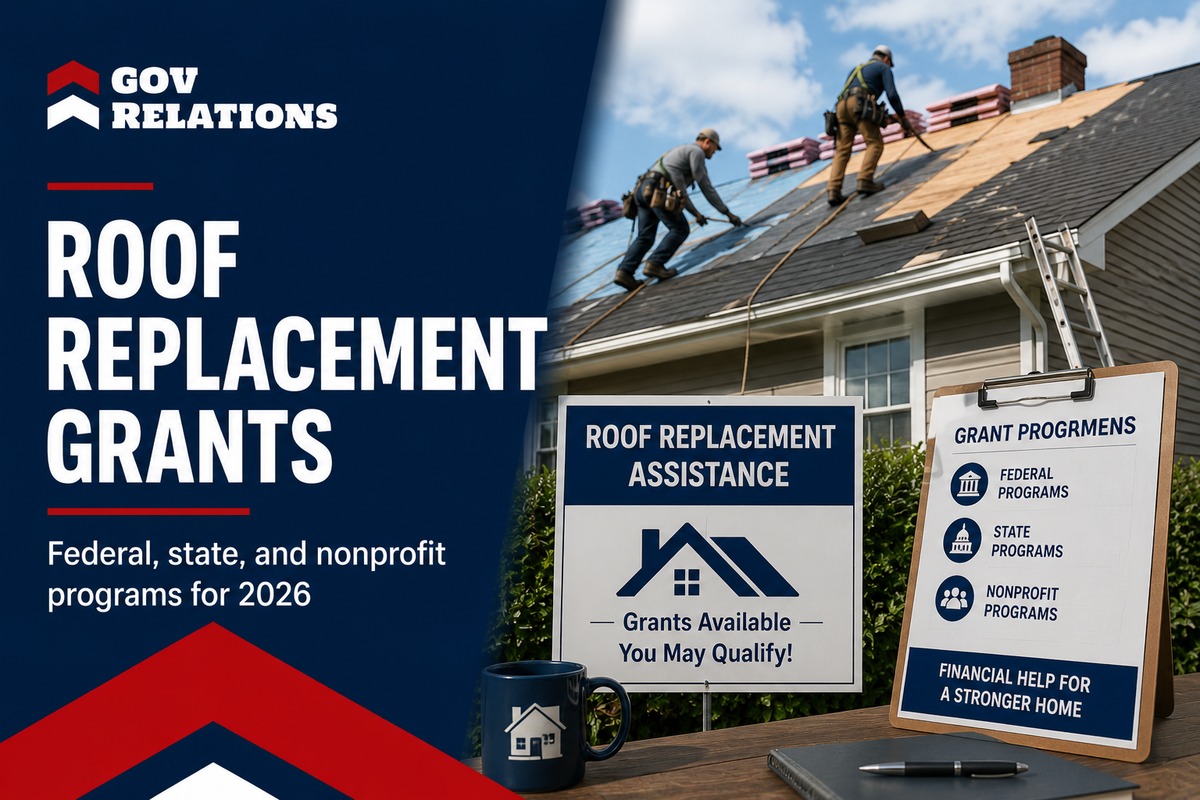
Free roof replacement grants are funded by federal programs like USDA Section 504, HUD CDBG (Community Development Block GrantA lump sum of money granted by the federal government to a state or local authority to support broad...), and FEMA disaster aid, plus state storm-hardening programs and nonprofits like Habitat for Humanity and Rebuilding Together. Most awards go to very low-income homeowners, seniors aged 62 and older, or disaster survivors whose homes are not fully covered by insurance.
In 2026, the average US roof replacement costs about $9,500, with full projects reaching $47,000 for premium materials or larger homes, according to NerdWallet. For households on fixed incomes, a failing roof is more than a repair bill. It is a safety problem that gets worse every week it goes unfixed.
This guide lists every legitimate free roof replacement grants program by name, shows you who qualifies, walks through the application step by step, and explains how to spot a fake grantA sum of money given by a government or other organization for a particular purpose, usually without... offer before it costs you anything.
Key Takeaways
- Grants vs. loans: USDA Section 504 offers grants up to $10,000 for homeowners aged 62 and older, plus loans up to $40,000 at 1% interest for any eligible very low-income owner.
- Average 2026 cost: A US roof replacement averages $9,500 and can climb to $47,000, so even a partial grant can prevent a household debt crisis.
- Income rule: Most federal roof grants require household income at or below 50% of your county Area Median Income, also called the very low-income limit.
- State storm grants: Alabama, Florida, Louisiana, North Carolina, and South Carolina offer up to $10,000 toward FORTIFIED roof upgrades, often without strict income limits.
- Approval timelineA schedule outlining the key activities, milestones, and deadlines throughout the project's duration...: Most applicants wait three to six months for approval, and popular state grantFunding provided by state governments to support various programs, projects, and initiatives. funds often run out within weeks of opening each year.
- Scam check: A real federal program never charges an application fee, and the official application URL always ends in .gov, never .com or .org.
What Are Free Roof Replacement Grants?
A free roof replacement grant is money provided by a federal agency, state program, or nonprofit organization that pays for some or all of a homeowner's roof repair without requiring repayment. Grants are different from loans because the money is yours to keep, as long as you meet the program rules and stay in the home for the required period.
The funding for these grants comes from three main sources. Federal taxpayer programs run by the USDA (US Department of Agriculture), HUD (US Department of Housing and Urban DevelopmentEligibility for projects aimed at revitalizing urban areas and addressing urban-specific challenges....), and FEMA (Federal Emergency Management Agency) cover most of the assistance available nationwide. State insurance authority programs in coastal and storm-prone states fund roof hardening to stronger building standards. National nonprofits like Habitat for Humanity and Rebuilding Together coordinate volunteer labor and donated materials for qualifying households.
The word "free" can be misleading. Most grants only cover part of the cost. A full free roof replacement is rare and usually limited to seniors, disaster survivors, or homeowners with verified disabilities living below the very low-income threshold. Many programs combine a small grant with a low-interest loanA sum of money borrowed that is expected to be paid back with interest. to bridge the rest of the cost. Knowing this in advance prevents the disappointment of applying for a single program that was never going to cover the full bill.
Who Qualifies for Free Roof Replacement Grants?
You qualify for a free roof replacement grant if your household income is at or below 50% of your county Area Median Income (AMI), you own and occupy the home as your primary residence, and you meet at least one additional condition. Common qualifying conditions include being aged 62 or older, having a documented disability, living in a federally declared disaster area, or owning a home in a coastal state that runs a storm-hardening program.
Eligibility rules differ by program. Federal income-based grants like USDA Section 504 and the HUD CDBG program look at your income, your homeownership status, and sometimes whether your home is in a rural area. FEMA disaster grants apply only when a presidentially declared disaster has damaged your primary residence and insurance does not fully cover the loss. State storm-hardening grants often have no income limit at all, but they require an existing wind insurance policy or a home in a designated coastal zone.
If a disability is the reason you cannot afford the repair, two sets of programs can apply at the same time. You may qualify for general government assistance through gov-relations.com, and you may also qualify for additional disability benefits and legal protections covered in detail on our partner site.
Federal Programs That Cover Roof Replacement
Four federal programs make up the bulk of free roof replacement assistance in the United States. The table below shows how each one works at a glance.
| Program | Max Grant Amount | Who Qualifies | How It Works |
|---|---|---|---|
| USDA Section 504 Home Repair | $10,000 grant ($15,000 in disaster areas) | Very low-income homeowners aged 62+ in rural areas (under 35,000 population) | Grants for safety hazards; loans up to $40,000 at 1% interest can be combined for $50,000 total |
| HUD CDBG and HOME | Varies by city or county | Low-income homeowners (typically under 80% AMI) in participating cities | Federal funds passed through to local rehab programs; eligibility set locally |
| FEMA Individual Assistance | Varies (set per disaster) | Homeowners in presidentially declared disaster areas without sufficient insurance | Repair grants and hazard mitigation funds for damage caused by a covered disaster |
| HUD Title I and 203(k) | Loan only (no grant) | Homeowners or buyers with acceptable credit; not income restricted | Insured loans up to $25,000 (Title I) or up to $75,000 added to a mortgage (203(k) Limited) |
USDA Section 504 Home Repair Loans and Grants
Section 504 is the most well-known federal program for free roof replacement. The USDA Rural DevelopmentCriteria focused on improving the quality of life and economic well-being of people living in rural ... office runs it for very low-income homeowners in rural areas. Grants of up to $10,000 are available for homeowners aged 62 and older to remove health and safety hazards, which include a leaking or structurally failing roof. Loans of up to $40,000 at a fixed 1% interest rate over 20 years are available to any eligible homeowner, regardless of age. The two can be combined for up to $50,000 in total assistance, or $55,000 in a presidentially declared disaster area.
A separate Materials Pilot Program is currently in effect through December 2026, which speeds up contractor payments and reduces administrative delays on Section 504 projects. If you have applied to this program before and ran into payment bottlenecks, it is worth re-applying under the new pilot rules.
HUD Community Development Block Grants and HOME
HUD distributes CDBG and HOME program funds to states, cities, and counties, which then run their own homeowner rehabilitation programs. Grant amounts, income limits, and waitlists vary by local jurisdiction. The federal rule is that homeowners must usually be at or below 80% of the Area Median Income and occupy the property as their main residence. To find a CDBG-funded roof repair program in your area, contact your city or county housing department or call 211.
FEMA Individual Assistance for Disaster-Damaged Roofs
If a hurricane, tornado, wildfire, or severe storm has damaged your home, FEMA Individual Assistance can pay for repairs that insurance does not cover. This program only opens after the President declares a disaster for your county, so it is not a year-round option. The amount varies per disaster, but typically covers the cost of returning the home to safe, sanitary, and functional condition. Hazard mitigation funds may also be available to upgrade your roof to a stronger standard, so the same damage does not happen again.
HUD Title I and 203(k) Loans
These are loan programs, not grants, but they belong in this guide because they fill the gap when a grant alone is not enough. HUD Title I insures up to $25,000 for property improvements on a single-family home, with the terms negotiated between you and a HUD-approved lender. The 203(k) Rehabilitation Mortgage lets you finance both the home purchase or refinance and the cost of repairs in a single loan, with the Limited 203(k) allowing up to $75,000 for repairs, including roofing. Neither program requires a very low-income status, but both require acceptable credit.
State Storm-Hardening and FORTIFIED Roof Grants
Five Gulf and Atlantic states currently run grant programs that pay homeowners to upgrade their roofs to the FORTIFIED standard set by the Insurance Institute for Business and Home Safety. These grants are some of the best free roof replacement options available because most do not have income limits, and the maximum awardA general term for funds provided to an individual or organization to support a specific purpose or ... is up to $10,000.
| State | Program Name | Max Grant | Key Detail |
|---|---|---|---|
| Alabama | Strengthen Alabama Homes | $10,000 | No income limits; wind insurance required |
| Florida | My Safe Florida Home | $10,000 | Matching grantA grant that requires the recipient to raise an equal amount of funds from other sources.; low-income owners may receive a full grant with no match |
| Louisiana | Louisiana Fortify Homes Program | $10,000 | Funds the upgrade to the FORTIFIED Roof standard |
| North Carolina | Strengthen Your Roof | $10,000 | Outer Banks and Barrier Islands policyholders only |
| South Carolina | SC Safe Home | $3,000 to $10,000 | Strengthens homes against hurricanes and high wind events |
These funds open and close each year. Check the program website during the first quarter of the year and submit your application as soon as the window opens because slots fill quickly.
Nonprofits That Provide Free Roof Repairs and Replacements
When a federal grant is not enough or funds have run out, two national nonprofits often step in with free or near-free roof work for qualifying households.
Habitat for Humanity Home Preservation
The Habitat for Humanity Home Preservation program offers critical home repair services including roof repairs, weatherization, and accessibility upgrades. Eligibility is set by your local Habitat affiliate, but most prioritize low-income homeowners, seniors, and veterans. Homeowners are often asked to contribute "sweat equity" hours or repay the cost over time through an interest-free loan.
Rebuilding Together
Rebuilding Together is a national nonprofit that provides critical home repairs at no cost to qualifying homeowners. Roof replacements, accessibility upgrades, and disaster recovery work are all covered. Apply through your local Rebuilding Together affiliate. The program typically serves low-income homeowners, seniors, individuals with disabilities, and veterans.
Weatherization Assistance Program
The Weatherization Assistance Program (WAP) run by the US Department of Energy is not a roof replacement program, but it can cover minor roof repairs when a leak threatens to undo other weatherization work like attic insulation. WAP does not pay for full roof replacements, but it is worth a separate application because many households qualify for it on top of a federal repair grant.
How to Apply for a Free Roof Replacement Grant
The application process for almost every program follows the same six steps. Working through them in order saves time, prevents missed paperwork, and stops you from applying for a program you do not qualify for.
- Identify which program applies to your situation. Match your situation against the eligibility rules above. A rural senior aged 62 or older should start with USDA Section 504. A disaster survivor should start with FEMA. A coastal homeowner should check their state storm-hardening program. A low-income urban homeowner should call their city or county housing department for CDBG options.
- Confirm your eligibility before you start the application. Use the program's online eligibility tool or call the local office. The USDA has a property eligibility tool to confirm your address is in a rural area, and an income worksheet to confirm you are under the very low-income limit.
- Gather your documents. See the next section for the full list. Having documents ready cuts the application time in half.
- Submit the application. Most programs accept applications by mail or in person at a local office. FEMA accepts disaster applications online. State storm-hardening programs typically have an annual application window that opens online.
- Schedule the inspection. Almost every program requires an in-home inspection before approving a roof grant. The inspector verifies the damage, confirms the work is needed for health and safety, and provides a cost estimate.
- Get approval and start the work. Once your application is approved, the agency assigns or approves a contractor, the work is scheduled, and the grant pays the contractor directly. Most homeowners report a 3 to 6 month timeline from application to finished roof.
Documents You Need Before You Apply
Every roof grant program asks for some version of the same documents. Pull these together before you start any application so you can complete it in one sitting.
- Proof of identity: A government-issued photo ID and your Social Security card.
- Proof of homeownership: The recorded deed, a current mortgage statement, or a property tax bill in your name.
- Proof of primary residence: A recent utility bill or voter registration showing the home address.
- Income verificationDocumentation proving the income levels of the beneficiaries, often required for grants targeting lo...: The most recent year's tax return, W-2s, two months of pay stubs, or an award letterAn official notification from the grantor indicating that the grant has been approved and outlining ... for Social Security, SSDI (Social Security Disability Insurance), or other benefits.
- Proof of need: At least one contractor estimate, photos of the roof damage, and a home inspection report if you have one.
- Insurance information: Your homeowner's insurance declarations page. State storm-hardening grants and FEMA both require this.
Scam Warning: How to Tell a Real Roof Grant From a Fake One
Searches for free roof replacement grants pull in scam offers as often as legitimate ones. Before you fill out any application or pay any "processing fee," check the offer against these four signals.
- Real programs are always free to apply for. Any website or person charging a fee to file your roof grant application is not part of any federal, state, or nonprofit program.
- The official URL always ends in .gov. USDA, HUD, FEMA, and state insurance authorities use .gov addresses. A site ending in .com that uses a federal program name in the URL is not a government website, even if it looks like one.
- Government agencies do not cold-call you with grant offers. If you receive an unsolicited phone call, text, or email saying you have been pre-approved for a roof replacement grant you never applied for, it is a scam.
- No government grant requires a credit card. A real grant pays the contractor or pays you. It never asks for your credit card, debit card, or bank account information to release the funds.
If you receive a suspicious grant offer by phone, text, or email, do not respond and do not click any links. Report it to the Federal Trade Commission at ReportFraud.ftc.gov.
For more on identifying scam home repair offers, our low cost roofing guide covers what to watch for when comparing contractor financing offers.
Roof Replacement Grants: What to Do Next (2026)
As of 2026, every homeowner who needs a roof replacement has at least one legitimate program worth applying to. Very low-income seniors should start with USDA Section 504. Disaster survivors should file with FEMA. Coastal homeowners should check their state FORTIFIED roof program. Anyone who does not fit those categories should call 211 and ask for "home repair assistance" to be connected to local CDBG-funded programs and nonprofit affiliates.
The fastest path through every program is to confirm eligibility before you apply, gather your documents in advance, and verify that the URL you are applying through ends in .gov. Apply early in the year because state and federal funding often runs out within months of opening.
For a full breakdown of every federal and state home repair program available right now, including roof, plumbing, electrical, and accessibility grants, see our complete pillar guide to government assistance for roof replacement. It maps every active program in one place so you can find the right one for your situation in minutes.
Frequently Asked Questions
Is there really a free roof replacement program?
Yes, several real free roof replacement programs exist, but most are targeted at very low-income seniors, disaster survivors, homeowners with disabilities, or owners of homes in coastal storm-prone states. The USDA Section 504 grant, FEMA Individual Assistance, and state FORTIFIED roof programs are the most common sources of free roof work. Other programs cover only part of the cost and combine a grant with a low-interest loan.
Can I get a free roof replacement if I am not a senior?
Yes, in some cases. USDA Section 504 grants of up to $10,000 are restricted to homeowners aged 62 and older, but Section 504 loans of up to $40,000 at 1% interest are available to any very low-income owner. FEMA disaster grants, state FORTIFIED roof programs, and nonprofits like Habitat for Humanity and Rebuilding Together do not have age limits and serve homeowners of all ages who meet the income and damage requirements.
How long does it take to get approved for a USDA Section 504 grant?
Most USDA Section 504 applicants wait three to six months from application to finished roof work. The timeline depends on how quickly you submit your documents, how soon the inspection is scheduled, and whether funding is available at your local Rural Development office. Disaster-area applications can move faster. Applying early in the federal fiscal year, which starts October 1, often results in faster approval.
What happens if my application is denied?
Read the denial letter carefully. Many denials come from a missing document, an outdated form, or funding that has run out for the year. You can usually fix a paperwork issue and reapply, ask to stay on file for the next funding cycleThe periodic schedule of grant application deadlines, review, and award notifications., or file a written appeal. Some denials are overturned on appeal.
Are free roof replacement grants taxable?
In most cases, no. Home repair grants for a primary residence are usually treated as nontaxable assistance. Forgiven portions of a loan may have different tax treatment, so confirm with a tax professional if you receive a combined loan and grant package. The IRS does not currently count Section 504, CDBG, or FEMA repair grants as taxable income for the homeowner.
Does homeowner's insurance cover a roof replacement instead of a grant?
Sometimes. Most homeowner's insurance policies pay for roof damage caused by a covered event like a storm or fire, minus the deductible. Insurance does not cover wear and tear or gradual leaks. Check your policy declarations page and call your insurer before applying for a grant. If the cause of damage is covered, an insurance claim is usually faster than a grant application. If insurance does not cover the loss, that is exactly the gap that federal and state grants are designed to fill.