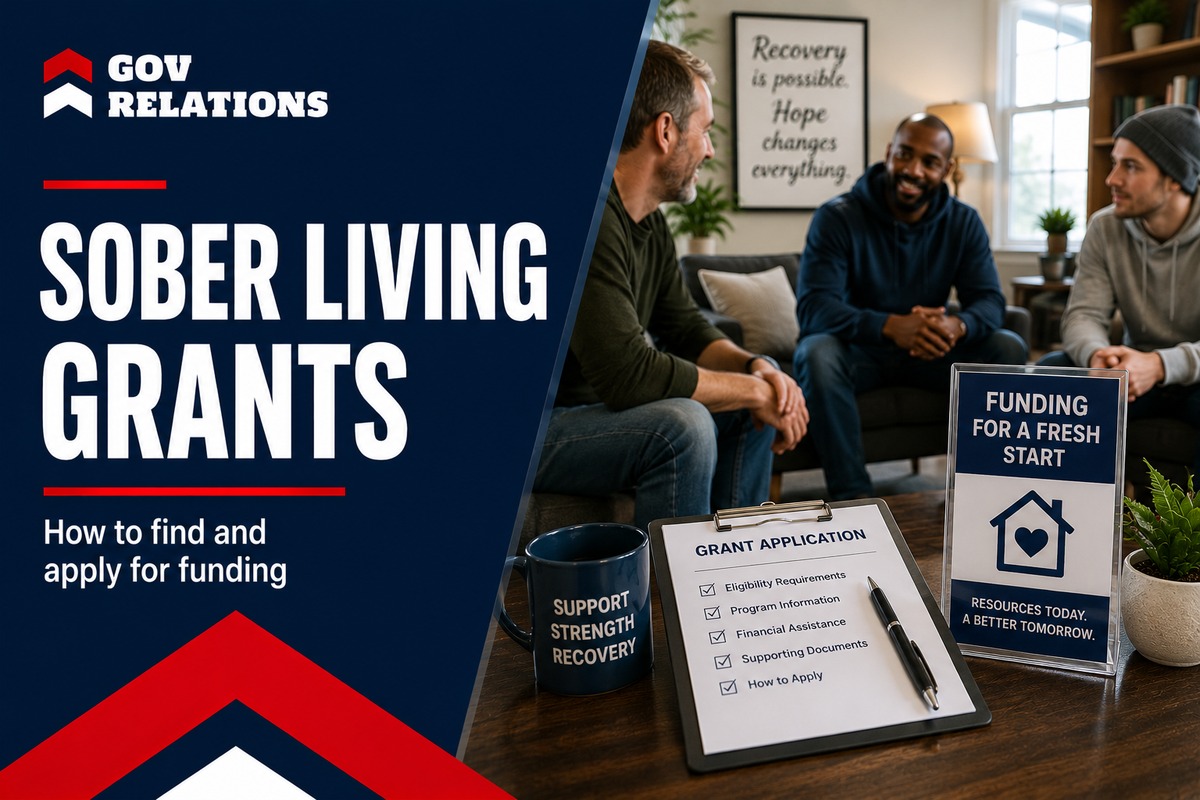
Government grants for sober living homes exist at the federal, state, and local levels, but almost none of them work the way new operators expect. Most public dollars fund system capacity buildingActivities aimed at strengthening the skills, competencies, and abilities of the project team or ben..., transitional housing, and certified recovery residences rather than covering the day-to-day operating costs of a single home. In September 2025, the U.S. Department of Health and Human Services allocated more than $1.5 billion in State Opioid Response and Tribal Opioid Response grants, and a portion of that funding now flows to recovery housing through state agenciesState-level government departments that offer funding for local projects, programs, and initiatives ... and certified providers.
This guide explains every major grant program available in 2026, who qualifies, how the money actually moves, and how to spot the fraudulent "free grant" offers that target this space.
Key Takeaways
- Grants fund the system, not the home: Government grants for sober living homes typically support capacity building and certified networks, not daily rent or payroll.
- Federal funding is concentrated: SAMHSA awarded $1.48 billion in State Opioid Response grants in FY25, plus $45 million dedicated to young adult recovery housing.
- HUD runs two major programs: The Recovery Housing Program and the $3.9 billion Continuum of Care program, both of which fund transitional recovery housing through states or local boards.
- Certification opens funding doors: NARR-certified residences gain access to state subsidies, opioid settlement funds, and treatment center referrals that uncertified homes cannot reach.
- 501(c)(3) status is the price of admission: Federal and most state grants require a nonprofit applicantThe individual or organization submitting the grant proposal and responsible for implementing the pr... or a formal fiscal sponsor arrangement.
- Scams target this space: Any offer promising a "free $50,000 government grant" with an application fee is fraudulent. Real grants do not work that way.
Who Qualifies for Government Grants for Sober Living Homes?
To qualify for most government grants for sober living homes, your organization must be a registered 501(c)(3) nonprofit or operate under a fiscal sponsor that holds that status. For-profit recovery housing operators are largely excluded from federal grantA sum of money given by a government or other organization for a particular purpose, usually without... programs directly, though they can partner with nonprofits or establish a separate nonprofit arm to access funding.
The second qualification layer is certification. As of January 1, 2025, Ohio requires every recovery residence to be certified by Ohio Recovery Housing or Oxford House to receive state funding, accept referrals, or even advertise as a sober living home. Other states are moving in the same direction. National Alliance for Recovery Residences (NARR) certification is increasingly the threshold for state subsidies, opioid settlement dollars, and referral partnerships with treatment centers and drug courts.
The third layer is location. The federal Recovery Housing Program (RHP) only flows to 25 states and the District of Columbia, based on a formula tied to overdose mortality rates. If your state did not qualify for RHP funding, that specific federal stream is not available to you, though state-administered alternatives may still apply through opioid settlement allocations or general revenue funds.
How Do Federal Grants for Sober Living Homes Actually Work?
Federal grants for sober living homes do not function like a monthly subsidyFinancial assistance granted by a government to support a specific economic activity or sector, redu.... They are competitive, time-limited awards tied to specific deliverablesSpecific, measurable outputs or products that the project is expected to produce within a set timefr..., and they almost never cover an independent operator's rent, utilities, or payroll directly. Public funding, when it flows, is structured to expand the system's overall capacity to serve people in recovery rather than to underwrite a single home's business model.
In practice, the money moves through three layers:
- The federal government allocates funds to a state agency (a Single State Agency for behavioral health, or a state housing authority).
- The state agency runs its own application process, often accepting applications only from certified providers or established networks.
- The certified provider distributes vouchers, per-bed subsidies, or capacity-building dollars to individual homes that meet quality standards.
This is why new operators who expect a federal grant to function like a Section 8 voucher are often disappointed. The dollars are real, but the path from federal allocation to a specific recovery home runs through layers of state administration, certification, and reporting.
Federal Grant Programs to Apply For in 2026
Several federal agenciesGovernment departments that provide funding for various programs and projects, including research, e... administer grants that reach recovery housing. Each has a different funding mechanism, an eligible applicant pool, and an application path.
Substance Abuse and Mental Health Services Administration (SAMHSA)
SAMHSA runs the largest federal funding streams that touch recovery housing. The agency operates inside the U.S. Department of Health and Human Services.
- State Opioid Response (SOR) Grants: SAMHSA awarded $1.48 billion in FY25 SOR continuation funding to all 50 states, the District of Columbia, and U.S. territories. States can use portions of these funds to subsidize recovery housing, especially for residents on medications for opioid use disorder. The largest single 2025 awardA general term for funds provided to an individual or organization to support a specific purpose or ... went to the California Department of Health Care Services at $105.6 million.
- Young Adult Recovery Housing Supplement: In September 2025, SAMHSA awarded more than $45 million in supplemental SOR funding specifically to develop or expand recovery housing for adults aged 18 to 24 with opioid or stimulant use disorders.
- Substance Abuse PreventionEligibility for projects aimed at preventing substance abuse and supporting recovery efforts. and Treatment Block GrantA lump sum of money granted by the federal government to a state or local authority to support broad... (SABG): SAMHSA distributes formula grants to states, which can apply a portion of the funds to transitional recovery housing through certified providers.
- Recovery Community Services Program (RCSP): A discretionary grantFunds awarded based on a competitive process where applications are reviewed and selected by the gra... that funds peer-run recovery support organizations. RCSP does not cover housing costs directly, but recovery housing can be embedded in the peer support continuum.
U.S. Department of Housing and Urban Development (HUD)
HUD administers two programs that directly fund recovery housing.
- Recovery Housing Program (RHP): Authorized by Section 8071 of the SUPPORT for Patients and Communities Act, the HUD RHP provides funding to 25 eligible states and Washington, D.C., for stable, transitional housing for people in recovery. RHP funds cover acquisition, rehabilitation, lease payments, utilities, and related costs for up to two years per resident. Indiana set a maximum award of $750,000 per eligible project under its 2025 application cycle.
- Continuum of Care (CoC) Program: The FY 2025 CoC Program Competition has $3.9 billion available nationwide, with growing emphasis on transitional and recovery-focused housing. Recovery housing integrated into a community's homeless services system can compete for CoC funding through the local CoC board, not directly through HUD. Find your local CoC through the HUD Exchange grantees directory.
U.S. Department of Justice (DOJ)
For organizations serving people returning from incarceration, the Second Chance Act supports state, local, tribal, and nonprofit reentry programs. Specific Second Chance Act grants fund transitional housing paired with substance use treatment and mentoring, which is a strong fit for sober living homes serving a justice-involved population.
Comparison Table: Federal Grant Programs at a Glance
How do the major federal grants for sober living homes compare? The table below summarizes the key differences in scope, eligibility, and funding mechanism so you can identify which programs fit your organization before you invest time in an application.
| Program | Agency | Eligible Applicants | What It Funds | How to Access |
|---|---|---|---|---|
| State Opioid Response (SOR) | SAMHSA / HHS | State agencies and territories | Recovery housing subsidies, MOUD, peer support, prevention | Apply through your state's Single State Agency for behavioral health |
| Recovery Housing Program (RHP) | HUD | 25 eligible states + DC | Acquisition, rehab, lease, utilities for transitional recovery housing | Apply through your state housing or community development authority |
| Continuum of Care (CoC) | HUD | Nonprofits via local CoC boards | Transitional and permanent supportive housing | Submit a project application to your local CoC for the consolidated application |
| Substance Abuse Block Grant (SABG) | SAMHSA / HHS | State substance abuse agencies | Treatment and recovery support services, including transitional housing | Partner with a state-funded certified provider |
| Second Chance Act | DOJ / BJA | State, local, tribal governments, nonprofits | Reentry housing with substance use treatment | Apply through Grants.gov when the NOFO opens |
State and Local Funding Opportunities
State and local funding for sober living homes is often more accessible than federal grants because the awards are smaller, the application processes are less competitive, and certified residences are frequently the only providers in the funding stream. Three sources matter most.
Opioid Settlement Funds
Many states and counties are receiving multi-year payments from the national opioid litigation settlements, and a growing number are directing portions toward recovery housing capacity. The National Academy for State Health Policy tracks how states are deploying these dollars, with recovery housing among the most common allocations. Settlement payments will continue through at least 2038, making this a multi-decade funding stream that recovery housing operators can plan around.
State-Specific Recovery Housing Programs
- Ohio: Allocates approximately $3 million annually in general revenue funding for recovery housing, available only to ORH-certified or Oxford House-chartered residences as of January 2025.
- Massachusetts: Runs the Center for Community Recovery Innovations (CCRI) program through MassHousing, which has awarded over $16.3 million to create and preserve affordable sober housing units.
- Indiana: Received $4.9 million across five RHP allocations from 2020 to 2024, with maximum project awards of $750,000 in the current cycle.
- Minnesota: Offers Housing Support Program agreements to recovery residences that achieve Level 2 certification through the state's voluntary certification program.
- Washington: Allocated more than $5.3 million across SUPTRS Block Grant, state general funds, opioid abatement, and Criminal Justice Treatment Account funding for recovery residences in state fiscal year 2026.
Per-Bed Subsidies and Vouchers
Some states pay certified recovery residences a monthly per-bed subsidy ranging from $300 to $800 per bed to offset the cost of housing low-income residents. These subsidies are usually administered through the state's behavioral health agency or housing authority and require active NARR-affiliated certification to access.
Step-by-Step: How to Apply for Government Grants for Sober Living Homes
Applying for government grants for sober living homes is a multi-step process that begins long before any application formA standardized document that applicants must complete and submit as part of the grant proposal, ofte... is filled out. Follow these steps in order to position your organization for the strongest possible application.
- Form a 501(c)(3) nonprofit or secure a fiscal sponsor. Federal grants and most state grants require an IRS-recognized nonprofit applicant. If your operation is currently for-profit, establish a separate nonprofit arm or partner with an existing one that will act as a fiscal sponsor.
- Apply for NARR-affiliated state certification. Find your state's NARR affiliate through the NARR affiliate directory. Certification typically takes 3 to 6 months and requires on-site inspections, documented policies and procedures, and adherence to NARR Standard 3.0.
- Register on Grants.gov and HUD's e-snaps system. Account setup for both systems can take weeks. Do this before any Notice of Funding Opportunity opens, not after.
- Identify your local Continuum of Care board. For HUD CoC funding, your project must be included in the local CoC's consolidated application to HUD. The local CoC, not HUD, controls which projects move forward.
- Build documented community partnerships. Strong applications include letters of support and formal Memoranda of Understanding from local treatment centers, drug courts, probation departments, and workforce programs.
- Document local community need with data. Strong proposals cite local overdose rates, homelessness statistics, and gaps in post-treatment housing supply. Generic claims about the opioid crisis do not score well. Specific local data does.
- Write a sustainable pro forma budgetA detailed financial plan outlining the projected costs of the project, including personnel, equipme.... Grant reviewers reject proposals that depend entirely on a single funding source. Show a diversified revenue mix including resident fees, donations, and other funding streams.
- Submit, track, and report. Most federal grants require quarterly outcome reportingThe documentation and communication of the results and impacts of the project, comparing them to the... on housing stability, recovery progress, employment, and case management activities. Build a reporting system before you submit.
Key Terms You Need to Know
Recovery housing grantFinancial assistance for housing projects, including construction, renovation, and affordable housin... applications use specialized terminology. Define these terms before you read any NOFO so the requirements make sense.
Recovery Residence. The umbrella term for any alcohol- and drug-free housing that supports people in recovery from substance use disorders. Includes peer-run homes, monitored sober homes, supervised residences, and clinical facilities.
NARR Levels. The National Alliance for Recovery Residences defines four levels of recovery housing under the NARR Standard 3.0:
- Level I (Peer-Run): Democratically governed peer-led homes such as Oxford Houses, with no live-in staff.
- Level II (Monitored): Sober homes with a designated house manager and structured peer accountability.
- Level III (Supervised): Residences with weekly structured programming, life skills development, and credentialed staff.
- Level IV (Clinical): Facilities that integrate clinical addiction treatment with recovery housing. Level IV homes typically require state licensure.
MOUD. Medications for Opioid Use Disorder, including buprenorphine, methadone, and naltrexone. Federally funded recovery housing programs increasingly require homes to accept residents on MOUD.
Continuum of Care (CoC). A community-wide planning body that coordinates homeless services and submits a consolidated application to HUD for federal funding. Recovery housing fits inside this system when integrated with homeless services.
Fiscal Sponsor. A 501(c)(3) nonprofit that agrees to receive and administer grant funds on behalf of a project that does not have its own nonprofit status. Often used by newer or for-profit operators seeking access to grant funding.
NOFO. Notice of Funding Opportunity. The official federal announcement that opens a grant cycle and lists requirements, deadlines, and award amounts.
Scam Warning: How "Free Grant" Offers Target Sober Living Operators
Operators searching for government grants for sober living homes are a common target for grant scams. Before you respond to any grant offer, watch for these red flags:
- Real federal grants do not require application fees. Any offer asking for a "processing fee," "certification fee," or "grant matching deposit" to secure a federal grant is fraudulent. The federal government never charges a fee to apply.
- The government does not text or message you about grants you have not applied for. Any unsolicited message claiming you have been "selected" for a grant is a scam. Real grant notifications come through Grants.gov or directly from the awarding agency after you submit an application.
- Grants.gov is the only official federal grants portal. If the website does not end in .gov, it is not the government. A "grant search" or "grant application" service ending in .com or .org is a third party, not a federal agency.
- Fast-track certification mills are not NARR. Real NARR-affiliated certification takes months and requires on-site inspections. Any organization promising "NARR-equivalent" certification in 48 hours for a fee is not legitimate.
- No federal grant pays your personal salary directly. Federal grants fund organizational activities and pass-through services. Anyone promising a grant that pays personal income is selling something that does not exist.
Report suspected grant fraudThe act of knowingly misrepresenting or omitting information to obtain grant funds, which is subject... to the Federal Trade Commission at ReportFraud.ftc.gov and to the HHS Office of Inspector General.
Reality Check: Why Most New Operators Get the Funding Picture Wrong
The most common mistake new sober living home operators make is assuming that government grants will subsidize their operations the way Section 8 vouchers subsidize landlords. The reality is structurally different, and the difference shapes which organizations succeed at the application stage.
Most sober living homes function as housing businesses with a recovery environment. Resident-paid fees are the primary operating income. Public funding, where it exists, is rarely designed to underwrite private housing operations directly. Instead, public dollars flow into capacity building, certification infrastructure, and per-bed subsidies for specific resident populations (young adults, justice-involved residents, residents on MOUD).
This shapes how a sustainable sober living home should be financed. Resident fees form the core revenue base. Grants layer into expanding capacity, subsidize specific resident populations, or improve facilities. Grants are the booster, not the engine.
This also explains why certified providers in established networks tend to win the largest grants. They already have reporting infrastructure, outcome tracking, and the case management capacity that funders require. An independent operator with a single house and no nonprofit status will face a much harder application path, even when the underlying program serves residents well. The fastest route to grant access is almost always: nonprofit status first, certification second, partnerships third, applications fourth.
Funding a Recovery Home in 2026 Starts With Certification, Partnerships, and the Right Grant Path
Government grants for sober living homes are real, but they rarely work as quick startup money or a direct monthly operating subsidy. The strongest path is to build eligibility first: create or partner with a nonprofit, pursue state-recognized recovery residence certification, document community need, and connect with your state behavioral health agency, housing authority, or local Continuum of Care. Once those pieces are in place, SOR, RHP, CoC, opioid settlement, and state recovery housing funds become far more realistic opportunities.
For a broader look at sober-living funding options, individual assistance, and operator grants, read Gov-Relations’ guide to the top financial aid programs for disabled adults.
Frequently Asked Questions
Can a for-profit sober living home get government grants?
In most cases, no. Federal grants and the majority of state grants require an IRS-recognized 501(c)(3) nonprofit applicant. For-profit operators have two paths: form a separate nonprofit arm to apply for grants, or partner with an existing nonprofit that agrees to act as a fiscal sponsor. Some private foundation grants are open to for-profit recovery housing, but the public funding streams almost universally require nonprofit status.
How much money can a sober living home receive from a government grant?
Award amounts vary widely. Per-bed subsidies in certified state programs typically range from $300 to $800 per bed per month. Project-based grants under HUD's Recovery Housing Program can reach $750,000 per project, as seen in Indiana's 2025 cycle. State Opioid Response sub-awards to recovery housing providers depend on each state's allocation strategy. Federal CoC awards can be much larger when bundled into multi-year transitional housing projects.
Do you need a license to operate a sober living home?
A clinical license is not required to operate most sober living homes because Level I, II, and III recovery residences do not provide clinical treatment. Only Level IV (clinical) facilities require state licensing as treatment providers. However, as of 2025, several states, including Ohio, require NARR-affiliated certification for any home that wants to call itself recovery housing, receive referrals, or access state funding.
How long does it take to get a government grant for a sober living home?
The full timelineA schedule outlining the key activities, milestones, and deadlines throughout the project's duration... from preparation to first dollar is typically 12 to 24 months. Forming a 501(c)(3) takes 3 to 9 months. NARR-affiliated certification adds another 3 to 6 months. Once your organization is eligible to apply, federal grant cycles run on annual NOFO calendars, and award announcements come 3 to 6 months after the submission deadlineThe final date by which the grant proposal must be submitted to be considered for funding.. Plan for a long runway, not a quick fix.
Are opioid settlement funds available to sober living homes?
Yes, in many states. Opioid settlement funds are flowing to recovery housing capacity in dozens of states and counties. Eligibility, application processes, and award amounts vary by jurisdiction, but certified residences and established providers are the most common recipients. Check your state's opioid settlement allocation plan to see if recovery housing is a funded priority and how to apply.
Are sober living homes protected from local zoning restrictions?
Yes. Under the federal Fair Housing Act and the Americans with Disabilities Act, individuals in recovery from substance use disorders who are not currently using illegal substances are considered to have a disability. Municipalities cannot use zoning ordinances to exclude sober living homes or apply discriminatory rules that disproportionately affect people in recovery. Local governmentsMunicipal or county governments that provide grants and funding for community projects and services.... are also required to provide reasonable accommodations to ensure equal housing opportunities.