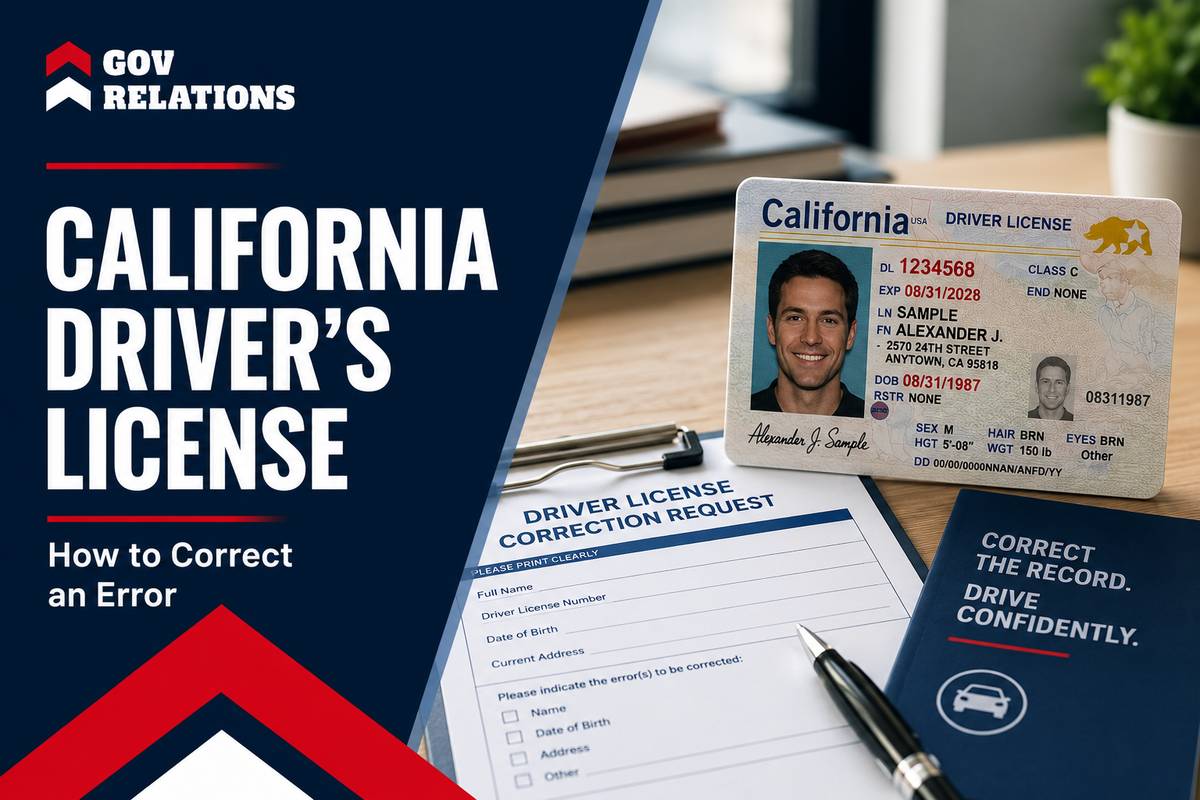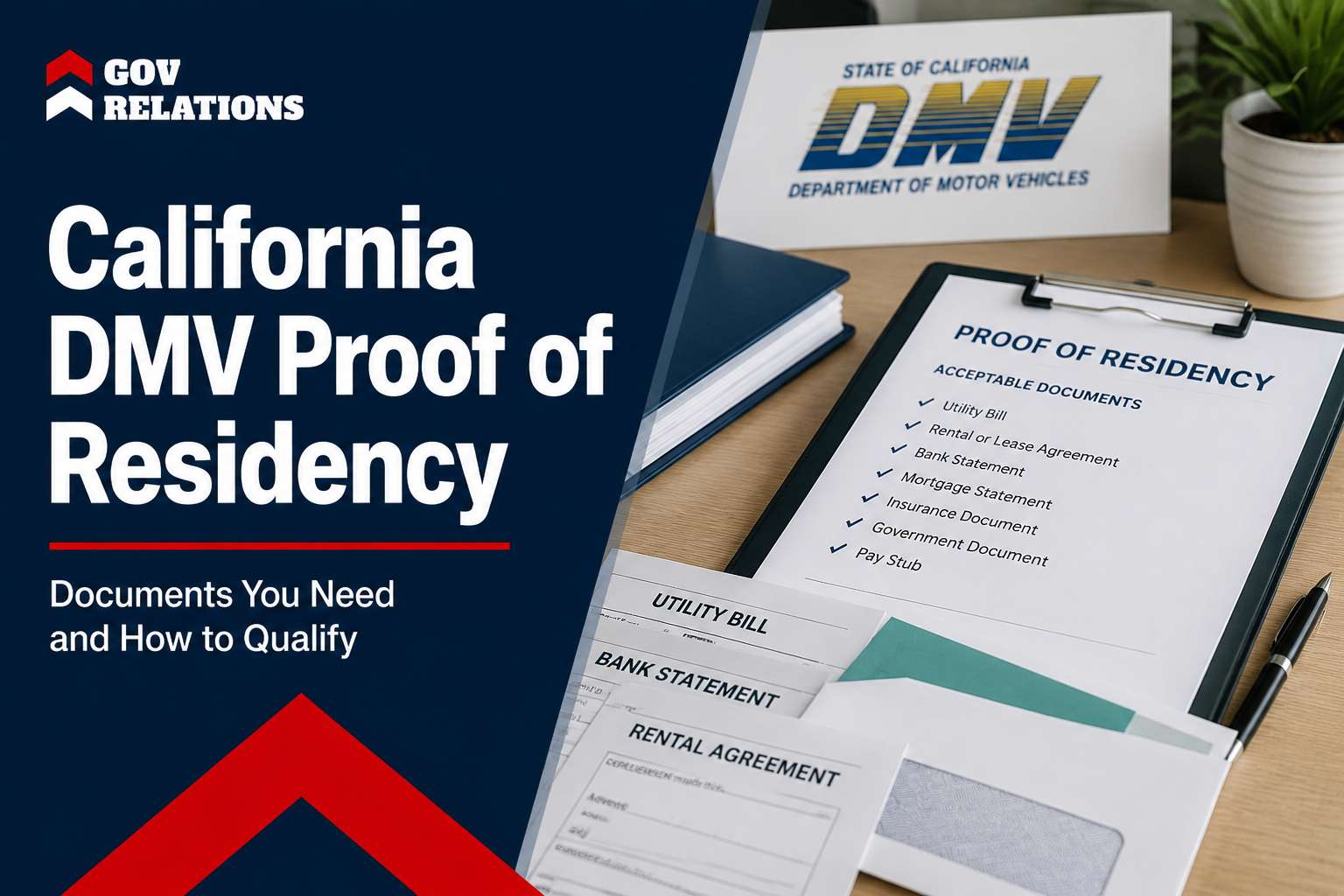
To prove California residency at the Department of Motor Vehicles (DMV), you bring one printed document for a standard license or two printed documents for a REAL ID, each showing your name and a California address that matches your application. That single rule trips up more applicants than any other step. As of May 1, 2025, about 19.5 million Californians held a REAL ID, roughly 58% of all license and ID holders, and the most common reason for a rejected application is a residency document that does not match the address on file.
This guide shows you which documents the DMV accepts, how many you need for each card type, the exceptions for PO Boxes and name mismatches, and how to spot DMV scams before they reach you.
Key Takeaways
- Document count depends on card type: A standard California license or ID needs one proof of residency. A REAL ID needs two separate documents.
- Addresses must match exactly: The California address on every residency document must match the address you enter on your DMV application, or the application is rejected.
- Printed only, no phone screens: California DMV proof of residency must be printed. Copies are fine, but a bill shown on your phone is not accepted.
- AB 60 licenses use standard rules: Assembly Bill 60 applicants prove residency with the same documents as a standard license, but cannot receive a REAL ID.
- Name mismatches have a workaround: If documents are not in your name, you trace your relationship to the named person with a birth, marriage, or guardianship record.
- Scams target DMV applicants: The official site is dmv.ca.gov. Any text or email charging fees or demanding personal data through a non-gov link is fraud.
What Does California Count as Residency?
California considers you a resident if you intend to live in the state for six months or more within a single year. Residency is not measured by time alone. It is also established by actions that show California is your home, according to the California DMV new resident guide.
The DMV treats several specific actions as evidence of intent to reside in California: being present in the state for six months or longer within a 12-month period without it being a temporary or transient visit, registering to vote, taking a job or opening a business here, paying resident tuition at a public college, enrolling dependents in a California primary or secondary school, or renting or owning the home that serves as your primary residence.
There is a deadline most new residents miss. When you establish residency or bring a vehicle into California, state law gives you 20 days to apply for a California driver's license and register your vehicle. Waiting longer can expose you to penalties, so gather your residency documents as soon as you arrive.
How Many Proof of Residency Documents Do You Need?
The number of residency documents you bring depends entirely on the card you are applying for. A standard card requires one document. A REAL ID requires two. A REAL ID is a federally compliant license or ID, marked with a gold bear and star, that you now need to board a domestic flight or enter most federal buildings since the federal enforcement date passed on May 7, 2025.
California DMV Proof of Residency by License Type
| Card Type | Documents Required | Key Condition |
|---|---|---|
| REAL ID license or ID card | Two | Both documents must show your first and last name, and the physical address must match your application. |
| Standard (non-compliant) license or ID | One | One acceptable document showing your name and California address. |
| AB 60 driver's license | Same as standard | Uses the standard residency documents, but AB 60 holders are not eligible for a REAL ID. |
For a REAL ID, both documents must display your first and last name, and the physical address on them must match the address you enter on the DMV application exactly. For a standard license or ID card, you only need one acceptable document. Assembly Bill 60 (AB 60) lets people who cannot provide proof of legal presence obtain a California license; AB 60 applicants prove residency the same way standard applicants do.
Which Documents Does the California DMV Accept as Proof of Residency?
The California Code of Regulations (Title 13, Section 15.01) lists the documents the DMV will accept. To qualify, a document must be printed, must clearly show your name and California address, and cannot be displayed on a phone screen. Copies printed from your computer are allowed. The full categories appear below.
| Document Category | Examples and Conditions |
|---|---|
| Housing and property | Rental or lease agreement, deed or title, mortgage bill, property tax bill. Rental agreements must include both the landlord and tenant signatures. |
| Utilities and bills | Home utility bills for electricity, water, gas, or trash, and cellular phone bills. These must show the service address. |
| Financial and tax | Bank or credit card records, IRS or California Franchise Tax Board returns, and an approved homeowner's tax exemption (Form BOE-266). |
| Employment and medical | Pay stubs and medical documents that clearly show your name and residential address. |
| Insurance | Medical, dental, vision, life, home, rental, or vehicle insurance documents. Must be current and valid. |
| Government and official | Voter registration confirmation, USPS Change of Address confirmation (Form CNL 107), vehicle or vessel title or registration, and court documents listing you as a resident. |
| Education | School documents and proof of payment of resident tuition. Foreign school records must be sealed and include a photo of you at the age the record was issued. |
| Organizational letters | Letters on official letterhead from a homeless shelter, employer, faith-based organization, or government agency attesting that you reside in California. |
Utility bills and bank statements are the documents the DMV sees most often, and they are the easiest to produce on short notice. If you are unsure, the official DMV REAL ID document checklist lists every accepted item in one place.
Special Situations: PO Boxes, Name Mismatches, and Name Changes
The DMV has clear rules for applicants whose living situation or paperwork does not fit the standard pattern. Three situations come up most often: using a PO Box, having documents in someone else's name, and a name change. Each has a specific fix.
If You Use a PO Box
For a REAL ID, one of your two residency documents must display both your PO Box (Post Office Box) and your physical residence address. The second document may show only the PO Box. This rule exists so the DMV can confirm where you actually live, not just where your mail goes.
If Documents Are Not in Your Name
Minors and spouses often have no bills or leases in their own names. You can still prove residency by tracing your relationship to the person whose name is on the documents, according to the DMV REAL ID residency guidance. You present that person's residency document plus a legal record proving your relationship.
- Birth certificate: for a minor using a parent's residency documents.
- Marriage or domestic partnership certificate: for a spouse or partner using the other person's documents.
- Adoption documents: for an adopted child using an adoptive parent's documents.
- Court guardianship documents: for a ward using a guardian's documents.
If Your Name Has Changed
If the name on your residency documents differs from the name on your primary identity document because of marriage, divorce, or a court order, you must provide certified legal evidence of the change. A certified marriage certificate, a dissolution of marriage document, or a court-ordered name change decree bridges the gap between the two names. Order any certified court document well ahead of your appointment, because retrieving archived records takes time.
How to Prepare Your Proof of Residency Step by Step
A few minutes of preparation prevents a wasted trip. Follow these six steps before you visit a DMV office, and your residency documents should clear on the first try.
- Confirm your card type. Decide whether you need a REAL ID (two documents) or a standard license or ID (one document) so you gather the right number.
- Pick documents from two different categories. For a REAL ID, choose two documents that are not from the same source, such as a utility bill and a bank statement, to reduce the chance of a rejection.
- Check the address on each one. Make sure the California address matches, character for character, the address you will enter on your application.
- Print everything. Print electronic bills and statements at home. The DMV does not accept documents shown on a phone or tablet screen.
- Handle name issues in advance. If documents are not in your name or your name has changed, gather the relationship or name-change record described above.
- Start your application online. Complete the electronic license or ID application on dmv.ca.gov before your appointment to cut your in-office time.
Key Terms You Will See at the DMV
The DMV uses a handful of terms and form numbers that confuse first-time applicants. Here is what each one means in plain language.
- REAL ID: A federally compliant license or ID, marked with a gold bear and star, required to fly domestically or enter secure federal facilities.
- AB 60 license: A California driver's license for people who cannot show proof of legal presence. It is valid for driving but is not a REAL ID.
- Proof of residency: A printed document showing your name and a California address that matches your application.
- CCR Title 13, Section 15.01: The California regulation that lists every document the DMV accepts as proof of residency.
- Form CNL 107: The USPS Change of Address confirmation, one of the accepted government residency documents.
A Recent Change Worth Knowing About in 2026
Even a valid REAL ID is not always permanent, and 2026 brought a clear example. In early 2026, the California DMV announced that about 325,000 cardholders, roughly 1.5% of REAL ID holders, must replace their cards after a legacy software issue from 2006 applied the wrong expiration dates to some records. The DMV is waiving the replacement fees and expediting the process for affected residents.
DMV Director Steve Gordon explained the response this way: “We proactively reviewed our records, identified a legacy system issue from 2006, and are notifying impacted customers with clear guidance on how to maintain a valid California-issued credential.” He added that for nearly 99% of REAL ID holders, no action is required.
The lesson for anyone gathering proof of residency today is simple. Keep the documents you used to get your card, and watch your mail for any official DMV notice. With about 35 million license and ID cards in circulation statewide as of January 2026, even a small percentage adds up to hundreds of thousands of people who need to act.
Scam Warning: Fake DMV Texts and Websites Are Common
Government applicants are a frequent target for fraud, and DMV scams spike whenever a deadline gets attention. Before you respond to any message about your license, ID, or residency documents, use these checks to tell a real notice from a fake one.
- The official website is dmv.ca.gov. Any link that ends in something other than .gov, even one that uses “DMV” in the address, is not the real California DMV.
- The DMV does not text you demanding payment or personal data. Unsolicited texts claiming your registration or REAL ID will be canceled unless you click a link and pay are a scam.
- No third party can charge you to submit your application. You pay official DMV fees to the DMV. Sites that charge an extra fee to file your documents are not part of the official process.
- Real notices never ask for full financial details by link. The DMV will not ask for your bank login or full card number through an emailed or texted link.
If you receive a suspicious DMV message, do not click any link and do not reply. Report it to the Federal Trade Commission (FTC) at ReportFraud.ftc.gov, then confirm anything about your record by going directly to dmv.ca.gov or calling the DMV yourself.
Get Your Documents Ready Before Your DMV Visit
Proving California residency comes down to three things: bring the right number of printed documents for your card type, make sure every address matches your application, and handle any name issue with the correct legal record. Get those right, and the residency step is quick.
As of 2026, the fastest path is to gather your documents now, start your license or ID application online at dmv.ca.gov, and book an appointment so you avoid the longest lines. Your next step today is to pull two recent documents from different categories, confirm the addresses match, and print them. With your proof of residency ready, the rest of the DMV visit is straightforward.
Once your DMV records are updated, use Gov-Relations’ guide to the addresses you should update when moving to California so banks, insurers, government agencies, healthcare providers, and other essential services have your correct information.
Frequently Asked Questions
Can I use my phone to show a utility bill as proof of residency?
No. California DMV proof of residency must be printed. A bill or statement shown on a phone or tablet screen is not accepted. Print electronic documents at home before your appointment, since copies printed from your computer are allowed.
How many proof of residency documents do I need for a REAL ID?
You need two different printed documents for a REAL ID. Both must show your first and last name, and the physical California address on them must match the address on your application exactly. A standard license or ID requires only one document.
What if my bills are in my spouse's or parent's name?
You can still prove residency by presenting the document in that person's name along with a legal record of your relationship. A marriage certificate works for a spouse, and a birth certificate works for a minor using a parent's documents.
Does an AB 60 license require different residency documents?
No. AB 60 applicants prove California residency using the same documents as a standard license. The difference is that an AB 60 license is not federally compliant, so AB 60 holders cannot receive a REAL ID.
What happens if the address on my documents does not match my application?
A mismatched address is the most common reason an application is rejected. The California address on every residency document must match the address you enter on your DMV application. Update or reprint documents so the addresses line up before you go.
Can I use a PO Box as proof of residency?
Only in part. For a REAL ID, one of your two documents must show both your PO Box and your physical residence address. The second document can show only the PO Box. A PO Box alone is not enough to establish where you live.