Dental schools offer cheap or free dental implants by letting supervised students and residents place them at prices roughly 30% to 70% below those of a private practice. A single implant that runs $3,000 to $6,000 in 2026 can drop to a few hundred or a couple of thousand dollars at a teaching clinic. Free implants are available through clinical trials and charities, but they come with strict rules.
This guide shows you which schools qualify you, how to apply, and where the truly free options are.
Key Takeaways
- Real savings: Dental school clinics place implants 30% to 70% below private practice rates because supervised students and residents do the work.
- Cheap, not always free: Most teaching clinics charge a reduced fee. Genuinely free implants come from clinical trials and a few charities, not the schools themselves.
- You must qualify: Schools screen for healthy gums, enough jawbone, and stable overall health before they accept you as an implant patient.
- Expect a longer timelineA schedule outlining the key activities, milestones, and deadlines throughout the project's duration...: Faculty must approve every step, so treatment from screening to final crown can take several months to over a year.
- Free routes have limits: Clinical trials cover the implant free but accept only patients who fit narrow medical criteria, and charity waitlists can run one to two years.
- Scams target this search: Any site charging a fee to release a free implant grantA sum of money given by a government or other organization for a particular purpose, usually without... is fraudulent, so verify every offer against an official source first.
Can You Really Get Cheap or Free Dental Implants at a Dental School?
Yes. Accredited dental schools run teaching clinics where dental students and postgraduate residents place implants under the direct supervision of licensed faculty specialists. You pay a reduced fee, not the private-practice price, because the clinic is training providers while it treats you. The University of Louisville School of Dentistry reports that student-clinic procedures can cost up to 50% less than area private practices, with resident clinics saving up to 30%.
Free is a different word from cheap, and the difference matters. The school clinic itself almost always charges something. Truly free implants come from two other sources tied to schools: clinical research trials that supply the implant at no cost, and charity programs that route donated care through volunteer dentists. We cover both further down.
Quality is not the tradeoff. Because a student is learning, each step is slower and gets checked by an attending specialist before the work continues. Many university clinics use the same 3D scanning and implant systems as high-end private offices. What you trade for the lower price is time and patience, not clinical standards.
How Much Do Implants Cost, and How Much Do Dental Schools Save You?
A single dental implant in the United States costs $3,000 to $6,000 in 2026, once you add the implant post, the abutment, and the crown. Bigger cases climb fast. An All-on-4 fixed arch runs roughly $20,000 to $40,000 per arch, and a complex full-mouth restoration can approach $90,000. Preparatory work like extractions, bone grafting, or a sinus lift adds hundreds to thousands more.
Those numbers explain the demand. For someone on a fixed income, a $4,200 bill is not a stretch goal; it is a closed door. A dental school reopens it. The table below shows what each clinic tier gives you and what you give up in return.
| Provider Type | Typical Savings | Who Does the Work | What You Trade |
|---|---|---|---|
| Student clinic | 50% to 70% less | Third- and fourth-year dental students, supervised by faculty | Longest appointments and possible waitlist |
| Resident clinic | 25% to 30% less | Licensed dentists in advanced specialty training | Fewer openings than the student clinic |
| Faculty practice | About 10% to 20% less | Full-time faculty specialists | Smallest discount, closest to private pace |
| Clinical trial | Up to 100% (free) | University researchers and specialists | Must fit strict study criteria |
Real pricing shows the gap. In a large metro market, a single implant that a private practice quotes near $4,500 can run closer to $2,000 in a university student clinic. Stack a school fee with a payment plan or pre-tax HSA dollars, and the out-of-pocket number falls again.
Which Dental Schools Offer Strong Implant Programs?
Several U.S. dental schools run well-regarded implant clinics with published patient programs. Each sets its own fees, rules, and limits, so treat this as a starting shortlist and confirm details with the school directly.
University of Pennsylvania School of Dental Medicine (Philadelphia, PA)
Penn Dental Medicine runs a teaching clinic where costs average 50% to 70% below those of private practices. It accepts MedicaidA joint federal and state program that helps with medical costs for some people with limited income ... and most dental insurance plans, and it offers named grants such as the Astra Grant for single-tooth replacements and the Noble Grant for lower dentures anchored on two implants.
University of California, San Francisco (UCSF) School of Dentistry
The UCSF Student Implant Program provides affordable implants and crowns after a comprehensive screening. It places implants only in premolar or molar areas, requires a stable bite, limits treatment to two implants per patient, and does not restore front teeth. Those limits are common at student clinics and worth knowing before you apply.
Touro College of Dental Medicine (Albuquerque, NM)
Touro's New Mexico facility offers implant dentistry at large discounts, with reported savings of $10,000 to $20,000 on full-arch cases. Board-certified specialists oversee the work using digital dentistry tools.
Columbia University College of Dental Medicine (New York, NY)
The Implant Center at Columbia handles cases from single-tooth replacements to complex reconstructions for trauma and oral cancer patients, at costs below those of private practice. Other respected programs include Loma Linda University, the University of Michigan, Harvard School of Dental Medicine, and New York University College of Dentistry.
Do You Qualify? Dental School Implant Eligibility
You qualify for a dental school implant clinic if your case fits the program's teaching needs and your mouth is healthy enough for surgery. Schools screen every applicantThe individual or organization submitting the grant proposal and responsible for implementing the pr... because an implant only succeeds on a stable foundation. Meeting the conditions below does not guarantee acceptance, but missing them usually means a no.
To be eligible, you generally must have:
- Healthy gums: A mouth free of active periodontal (gum) disease, since infection around an implant is a leading cause of failure.
- Enough jawbone: Sufficient bone density and volume to hold the implant, or a willingness to have a bone graft first.
- Stable overall health: No uncontrolled systemic conditions such as unmanaged diabetes, and no recent heart events that raise surgical risk.
- A qualifying tooth position: Some student programs place implants only in the back of the mouth and cap the number of implants per patient.
Schools also require a clean starting point. Any needed fillings, extractions, or gum treatment must be finished before an implant goes in. If you are ruled out, the free-care and low-cost routes later in this guide still apply.
How to Apply for Dental Implants at a Dental School: Step by Step
Applying to a dental school clinic follows a set order. Each step must clear faculty review before the next begins, which is why the process is thorough and slow. Follow this sequence to avoid the delays that stall applications.
- Contact the school for a screening. Call or use the clinic's patient intake page to request a screening appointment. Most schools work on a request-and-screening basis.
- Complete the initial screening. Expect a basic exam and X-rays to check whether your case fits the current teaching curriculum and your general suitability for implants.
- Attend a comprehensive evaluation. If accepted, a detailed exam, often with 3D CBCT imaging, maps your bone structure and builds a treatment plan.
- Finish preparatory work first. Complete any required fillings, extractions, or gum treatment, because schools will not place an implant in an unhealthy mouth.
- Have the implant placed. A supervised student or resident surgically sets the titanium post. This visit usually takes one to two hours.
- Allow the healing period. Wait three to six months for osseointegration, the process where the jawbone fuses to the implant, before restoration.
- Return for the final crown. Once healed, the clinic attaches the abutment and the crown. BudgetA detailed financial plan outlining the projected costs of the project, including personnel, equipme... for several months to over a year from start to finish.
Where to Find Truly Free Dental Implants
Free implants exist, but they come from clinical trials and charities rather than a standard school fee schedule. Demand is high, and the criteria are narrow, so apply early and to more than one place at once.
Clinical Research Trials
Universities and research institutions test new implant materials and healing methods, and participants often receive the implant and surgery at no cost. Some studies even reimburse time and travel. Eligibility is strict and tied to the study's medical and demographic criteria. Search active studies at ClinicalTrials.gov, and use the NIDCR guide to finding dental care to locate university clinics and low-cost options.
Charity and Grant Programs
The Dental Lifeline Network runs the Donated Dental Services program, which has provided more than $500 million in donated treatment to over 170,000 vulnerable people since 1985. You may qualify if you are over 65, permanently disabled, or medically fragile with no other way to pay. Implants and complex plans sometimes exceed what volunteers can provide, and waitlists can run one to two years, so set expectations accordingly.
Grant programs fill other gaps. The Cosmetic Dentistry Grants program distributes partial grants toward implant and cosmetic work after a free oral-health assessment from a participating dentist, though you must complete any basic dentistry at your own expense first. Charitable events like the Mission of Mercy, organized by state dental associations, mostly cover urgent care such as extractions, but some associated programs offer limited restorative help.
Community Health Centers
Federally Qualified Health Centers charge on a sliding scale based on your income. Not every center places implants, but larger ones offer advanced care or referrals to reduced-cost specialists. Find one near you with the federal HRSA health center locator.
Key Terms You Will See at an Implant Clinic
Implant paperwork uses words that decide whether you get approved and what you pay. Here is what each one means:
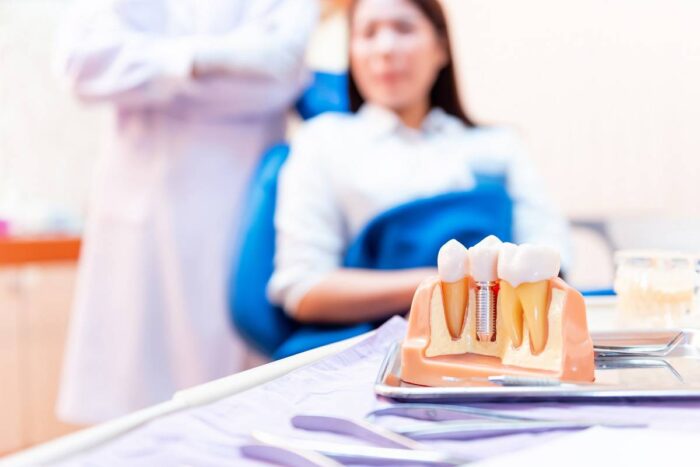
- Implant post: The titanium or ceramic screw placed into the jawbone that acts as the artificial tooth root.
- Abutment: The small connector piece that joins the implant post to the visible crown.
- Crown: The visible, tooth-shaped cap that sits on top and does the chewing and smiling.
- Osseointegration: The three-to-six-month healing process in which the jawbone fuses to the implant post.
- CBCT imaging: Cone Beam Computed Tomography, a 3D scan that lets the clinic plan the surgery with precision.
- Bone graft: A procedure that adds bone volume when your jaw does not have enough to hold an implant on its own.
What We See Work in Practice
In our experience helping readers fund dental work, almost no one gets an implant fully paid by a single source. The wins come from stacking. A reader gets the surgical placement done at a university student clinic to cut the base price, spreads the remaining balance across an in-house payment plan, and applies to a charity in the same week as a backup.
The pattern that fails is waiting for one free implant to appear while paying a fee to a site that promised it. Treat the dental school as the anchor of a plan, then layer a payment option and a charity application around it. Apply to the school and the charity in parallel, because both move slowly, and running them together can save you a month or more.
Scam Warning: How to Spot a Fake Free Dental Implant Offer
This search attracts fraud because scammers know people need help fast. Before you hand over a dollar or a document, run every free implant offer through these four checks.
- A real program is free to apply for. Any site or caller charging a fee to submit your application or release a grant is not legitimate.
- Official applications use .gov or verified school domains. A URL that borrows a program name but ends in .com or .net, however official it looks, is not the government.
- Agencies do not cold-call with benefits. Any unsolicited call, text, or email offering an implant grant you never applied for is a scam.
- No real program needs your card number to give you money. A request for a credit card to claim free care is always fraudulent.
If you get an unsolicited free implant offer, do not respond and do not click any link. For a full breakdown of how these traps work, read our guide on spotting fake dental grant schemes, and report fraud to the Federal Trade Commission at ReportFraud.ftc.gov.
Build Your Real Path to an Affordable Implant
Cheap or free dental implants through dental schools are real, and as of 2026, they are one of the most reliable ways to cut the cost of a procedure that runs into the thousands. A teaching clinic trims 30% to 70% off the price, clinical trials can cover it entirely, and charities help the patients who qualify. What each route shares is a screening step, a longer timeline, and clear rules you can prepare for.
Start here today: call one accredited dental school near you and ask to schedule an implant screening. While you wait for that appointment, check whether you qualify for a charity like the Dental Lifeline Network, and read our full guide to dental grants for individuals to see every program, who qualifies, and how to apply. Running two real options at once beats waiting on a single free grant that may never come.
Frequently Asked Questions
Do dental schools really offer free dental implants?
Rarely for free, often cheap. Most dental school clinics charge a reduced fee, roughly 30% to 70% below private practice. Genuinely free implants come from clinical trials that supply the implant at no cost or from charities like the Dental Lifeline Network, both with strict eligibility rules.
How much can I save on implants at a dental school?
Student clinics save the most, often 50% to 70% below private practice, since supervised students do the work. Resident clinics save around 25% to 30%, and faculty practices save about 10% to 20%. A single implant priced near $4,500 privately can run close to $2,000 at a student clinic.
Who qualifies for a dental school implant program?
You generally qualify with healthy gums, enough jawbone to hold the implant, and stable overall health with no uncontrolled conditions. Some student programs place implants only in back teeth and limit the number per patient. Every school screens applicants before accepting them.
How long does the process take at a dental school?
Plan for several months to over a year. Faculty must approve each step, appointments run longer, and the implant needs three to six months to fuse to the bone before the final crown is placed. The tradeoff for the lower price is a longer timeline.
What if I do not qualify for a dental school or charity program?
You still have options. Federally Qualified Health Centers charge on a sliding income scale, financing plans spread the cost, and pre-tax HSA or FSA dollars lower what you pay.