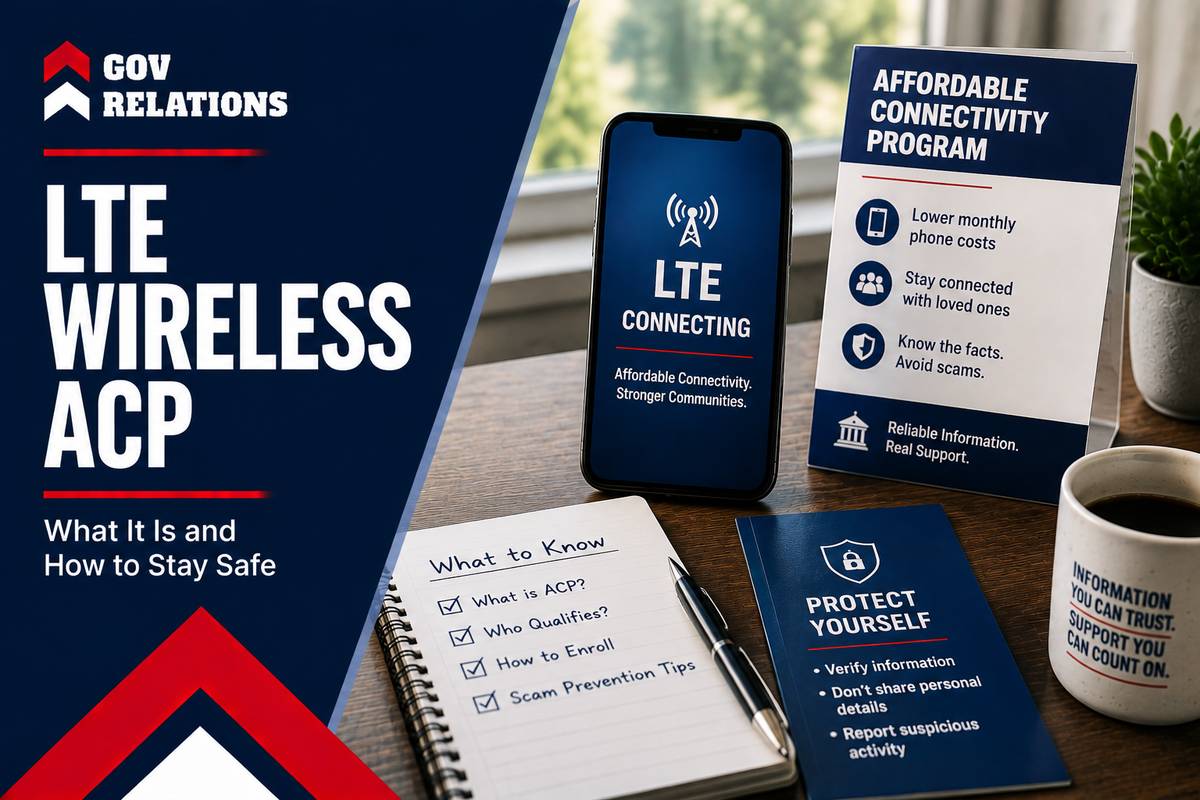
The LTE Wireless ACP is a private discount plan created and run by LTE Wireless Inc., a Brooklyn-based wireless company. It is not the federal Affordable Connectivity Program. The federal ACP, which gave roughly 23 million households up to a $30 monthly internet discount, ended on June 1, 2024, and Congress has not funded a national replacement. LTE Wireless launched its own program under a similar name to keep offering low-cost service and devices.
This guide explains what the LTE Wireless ACP actually offers, how it differs from the federal Lifeline program that is still active, and the exact steps to verify any free phone or tablet offer before you share your information. For more free device and benefit guides, start with our government assistance guides.
Key Takeaways
- LTE Wireless ACP is private, not federal: LTE Wireless Inc. created and runs this program itself. It is not the government's Affordable Connectivity Program, which shut down in 2024.
- The federal ACP has ended: The Affordable Connectivity Program stopped on June 1, 2024, after its $14.2 billion in funding ran out, cutting off about 23 million households.
- Lifeline is still active: The FCC's Lifeline program still gives a $9.25 monthly discount ($34.25 on Tribal lands) and is the legitimate federal path to low-cost phone service.
- Watch for co-pays: LTE Wireless lists charges such as an $8 monthly co-pay and a one-time device fee, so its service is not always fully free.
- Real Lifeline devices are free: Approved Lifeline providers never charge an upfront fee for a phone or tablet, which is the clearest red flag to check on any offer.
- Verify before you apply: Confirm any provider through the official National Verifier at USAC before you share your Social Security number or upload documents.
What Is the LTE Wireless ACP?
The LTE Wireless ACP is a company-run discount plan from LTE Wireless Inc. that offers mobile service and a device for a small co-pay. On its own website, LTE Wireless states the program is “created and managed by LTE Wireless” to replace the federal ACP after it ended in 2024.
According to LTE Wireless, its version of the program lets every member of a household enroll, not just one person. The company advertises talk, text, and data for as low as an $8 monthly co-pay, plus a free tablet or smartphone in exchange for a one-time co-pay. That structure matters. A true federal benefit does not ask you to pay a co-pay for a device, so the word “free” deserves a close read here.
The key point is the name. The “ACP” in “LTE Wireless ACP” borrows the title of a federal program that no longer exists. The federal Affordable Connectivity Program was funded by Congress and administered by the Federal Communications Commission (FCC). The LTE Wireless ACP is a private business offer. Both can be legal, but they are not the same thing, and confusing them can cost you money.
LTE Wireless also offers the actual federal Lifeline program, which is separate from its private “ACP” plan. That overlap is part of why the naming causes confusion. You can qualify for real Lifeline through LTE Wireless or any other approved provider without paying for a device.
Did the Federal ACP Really End? What Happened in 2024
Yes. The federal Affordable Connectivity Program ended on June 1, 2024, after Congress did not renew its $14.2 billion in funding. At its peak, over 23 million households received the benefit, which paid up to $30 a month toward internet (up to $75 on Tribal lands) plus a one-time device discount of up to $100.
As of 2026, no single federal program has replaced the ACP. The Congressional Research Service confirms that no direct national successor exists, though several bills to revive it have been introduced. This funding gap is exactly why private companies started launching their own look-alike programs to keep serving low-income customers.
A handful of states have stepped in on their own. In 2026, New Mexico became the first state to launch a direct, state-funded replacement (the Low-Income Telecommunications Assistance Program, or LITAP), and California opened a broadband pilot for eligible households. You can track the state-by-state replacement programs to see what is active where you live. Outside those states, the federal Lifeline program is the main national option still running.
LTE Wireless ACP vs. the Federal Lifeline Program
The fastest way to understand the LTE Wireless ACP is to compare it side by side with the federal Lifeline program, which is the legitimate government benefit still available in 2026. One is a private company plan. The other is a federal program with oversight, a public application system, and no device fees.
| Feature | LTE Wireless ACP (private) | Federal Lifeline (FCC / USAC) |
|---|---|---|
| Who runs it | LTE Wireless Inc., a private company | The FCC, administered by USAC |
| Monthly cost | Advertised from an $8 monthly co-pay | $9.25 monthly discount; many plans are free after it |
| Device cost | Free device with a one-time co-pay | No upfront fee for a Lifeline device |
| Oversight | Company terms; no federal ACP oversight | Federal rules, annual recertification, audits |
| How to verify | Check the company directly and on BBB | Verify at the National Verifier (USAC) |
| Availability | Limited to LTE Wireless service areas | Available in every state and territory |
How to Verify a Free Phone or Tablet Offer Before You Apply
Before you hand over personal details for any “free government phone” offer, run it through six quick checks. These steps separate a legitimate Lifeline provider from a look-alike that may charge fees or misuse your information. They take a few minutes and can save you from a costly mistake.
- Match the program name to its real source. A federal program links to a .gov site. If a company says it runs “the ACP” on its own, remember the federal ACP ended in 2024 and cannot be offered by a private business.
- Confirm the provider through USAC. Use the official National Verifier at USAC and the “Companies Near Me” tool to see approved Lifeline providers in your area.
- Check that the device is truly free. Approved Lifeline providers never require an upfront payment for a phone or tablet. A required device co-pay is a signal that you are looking at a private plan, not a federal benefit.
- Find the .gov application path. The real Lifeline application runs through the FCC's Lifeline portal. If the only way to “apply” is through a company site with no federal link, slow down and verify.
- Never pay with gift cards or share codes over the phone. The FCC warns that requests for gift cards, wire transfers, or your Social Security number over an unsolicited call are classic fraud signals. Real programs do not work that way.
- Look up the company on the Better Business Bureau. Search the exact business name on BBB.org, read recent complaints, and note whether the company responds to them. A pattern of unanswered complaints is a warning worth taking seriously.
How to Apply for Legitimate Government Phone Help in 2026
If your goal is real, verifiable help with phone or internet costs, apply for the federal Lifeline program. It gives a $9.25 monthly discount ($34.25 on Tribal lands) and is available nationwide. Here is the process, based on the FCC's consumer guidance.
- Check your eligibility. You qualify if your household income is at or below 135% of the Federal Poverty Guidelines, or if you take part in SNAP, MedicaidA joint federal and state program that helps with medical costs for some people with limited income ..., SSI, Federal Public Housing Assistance, a Veterans Pension, or certain Tribal programs.
- Apply through the National Verifier. Submit your application at the official National Verifier, or call the Lifeline Support Center at 1-800-234-9473 for a mailed form.
- Upload documents if needed. If the system cannot confirm your eligibility automatically, upload proof dated within the past 12 months. Online submissions during business hours are often reviewed within minutes.
- Choose an approved provider. Once you are approved, the portal shows participating providers in your area. Compare plans, since some are free after the discount and others add features for a fee.
- Enroll, use it, and recertify. Sign up with your chosen provider, use the service at least once every 30 days if it has no monthly charge, and recertify your eligibility each year to keep the benefit.
Seniors on Medicare and fixed incomes can find related device and benefit help at seniorstrong.org, which covers programs written for adults 55 and older.
Key Terms: ACP, Lifeline, MVNO, VoLTE, and Co-Pay
A few terms come up again and again in free phone offers. Knowing what each one means makes it easier to tell a real benefit from a marketing pitch.
ACP (Affordable Connectivity Program): A federal internet discount program that ended on June 1, 2024. Any current “ACP” offer from a company is a private plan, not the federal program.
Lifeline: An active FCC program, run since 1985, that lowers phone or internet bills by $9.25 a month ($34.25 on Tribal lands) for eligible low-income households.
MVNO (Mobile Virtual Network Operator): A company that sells wireless service using another carrier's towers. LTE Wireless operates as an MVNO, and its supported bands (B12, B66, B71) point to the T-Mobile network.
VoLTE (Voice over LTE): Technology that carries phone calls over the 4G LTE data network instead of older 3G. It keeps call quality high as carriers retire their older networks.
Co-pay: A fee the customer pays out of pocket. On a genuine Lifeline plan, there is no device co-pay, so any required co-pay tells you the offer is a private company product.
What the LTE Wireless Devices Actually Offer
In our review of low-cost device programs, the hardware in this category tends to be entry-level, and the LTE Wireless lineup follows that pattern. The phones and tablets handle calls, messaging, and basic browsing, but they are not built for heavy gaming or high-resolution video. Here is how the two main devices compare.
| Feature | Nitro N62 (Phone) | Astro 10r (Tablet) |
|---|---|---|
| Display | 6.3" HD+ waterdrop | 10.1" HD IPS (800x1280) |
| Processor | MediaTek Quad-Core | UNISOC 2.0GHz Quad-Core |
| RAM | 2GB | 3GB |
| Storage | 32GB, expandable | 32GB, expandable to 512GB |
| Operating system | Android 12 | Android 12 |
| Connectivity | 4G LTE, Wi-Fi, VoLTE, BT 5.0 | 4G LTE, Wi-Fi, Bluetooth |
One detail matters for anyone who streams or video calls: most “unlimited” plans in this category cap high-speed data (often around 4.5GB), then slow speeds to about 128kbps. That reduced speed handles texts and basic email, but struggles with video. LTE Wireless also offers a basic Neo Flip LTE phone for people who want calls and texts without a smartphone.
Scam Warning: How to Spot a Fake “Free Government Phone” Offer
Programs that serve low-income households attract scammers who copy government language to sound official. The offer that sounds too good to be true usually is. Before you respond to any free phone or tablet pitch, watch for these red flags.
- A fee for a “free” device. Real Lifeline providers never charge an upfront payment for a phone or tablet. A required co-pay means it is a private plan, not a federal benefit.
- Unsolicited calls or texts. The government will not call, text, or email to offer you benefits you did not apply for. Treat any surprise “you qualify” message with caution.
- Pressure to act right now. Fake urgency is a tactic. Scammers rush you so you stop thinking clearly. A real benefit does not vanish if you take a day to verify it.
- Requests for gift cards or full banking details. No government program asks for gift cards or a credit card to “release” benefits. Never share your Social Security number over an unsolicited call.
- No .gov application path. If the only way to apply is a company website with no federal link, verify the provider through USAC before you enter any information.
If you receive a suspicious offer, do not click links in the message. Report phone and text scams to the FCC and file a fraud report with the FTC at ReportFraud.ftc.gov. Reporting helps protect the next person who receives the same pitch.
The Bottom Line on the LTE Wireless ACP
The LTE Wireless ACP is a private company plan, not the federal Affordable Connectivity Program, which ended in 2024. It may be a legitimate low-cost option for some households, but the co-pays and the reused program name mean you should read the terms carefully and never assume you are signing up for a government benefit. As of 2026, the federal Lifeline program remains the verified national path to low-cost phone and internet service, with no device fees and full federal oversight.
Your next step is simple: verify before you enroll. Confirm any provider through USAC, apply for Lifeline through the official system, and check your state for a new replacement program. For step-by-step help with free device and connectivity programs, explore our free phone and internet benefit guides and apply with confidence.
Frequently Asked Questions
Is the LTE Wireless ACP the same as the government ACP?
No. The LTE Wireless ACP is a private program that LTE Wireless Inc. created and runs itself. The federal Affordable Connectivity Program ended on June 1, 2024, and no private company can offer the federal benefit. The similar name is a marketing choice, not a sign of government backing.
Is the federal ACP coming back in 2026?
Not as of 2026. Congress has introduced bills to revive ACP-style funding, but none have passed. There is no direct federal replacement. Your active options are the federal Lifeline program and, in a few states, new state-funded broadband programs such as New Mexico's LITAP.
Does the LTE Wireless ACP cost money?
It can. LTE Wireless advertises service from an $8 monthly co-pay and a one-time co-pay for a free device. Terms change, so confirm the current price directly with the company. On the genuine federal Lifeline program, there is no device fee and many plans are free after the $9.25 discount.
How do I know if a Lifeline provider is legitimate?
Verify the provider through the official National Verifier and the “Companies Near Me” tool at USAC. A legitimate provider appears in that system, never charges for a Lifeline device, and links you to the federal application. Check the company on BBB.org as a second step.
What is the difference between Lifeline and ACP?
Lifeline is an active FCC program that discounts phone or internet bills by $9.25 a month. The ACP was a separate, larger internet-only discount of up to $30 a month that ended in 2024. Lifeline continues; ACP does not. Any current “ACP” offer is a private plan using the old name.