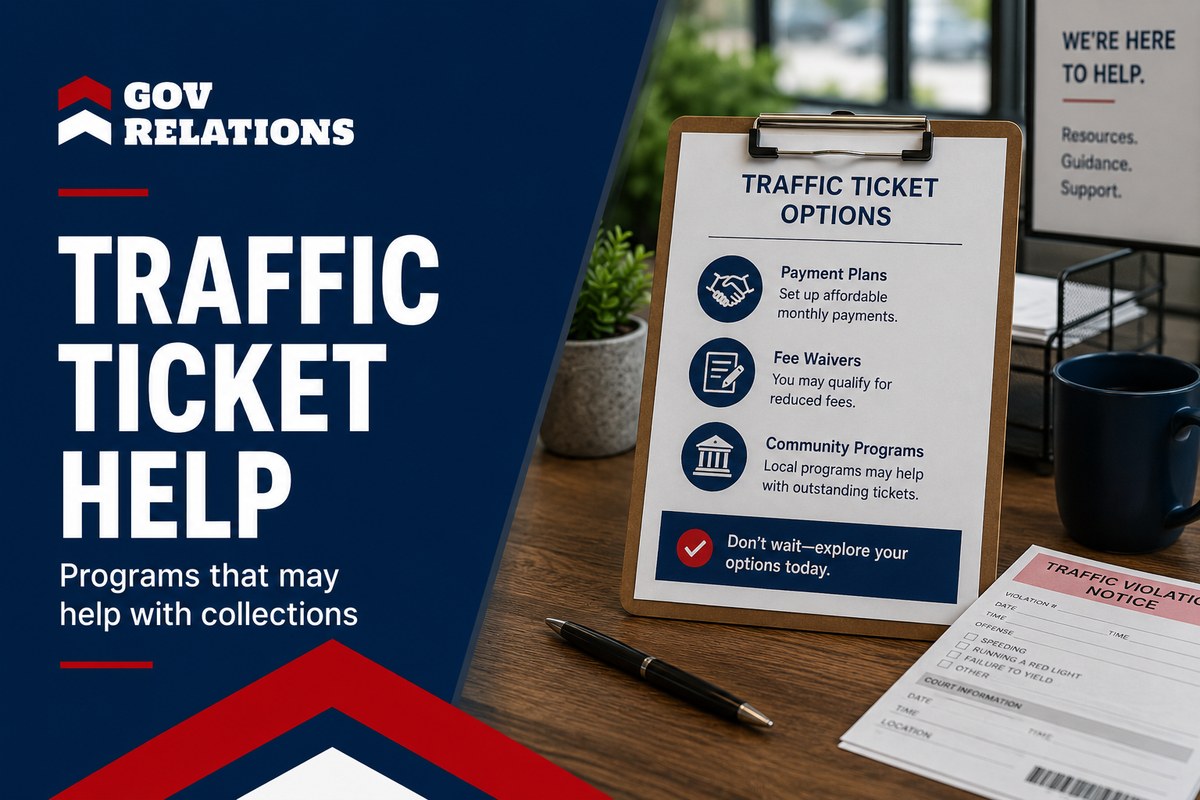
Programs to help pay off traffic ticket collections exist in nearly every state. They include court-ordered fine reductions, payment plans, community service in place of cash, city-run amnesty programs, and ability-to-pay hearings that lower the balance based on your income. As of 2026, over 11 million Americans have had a driver's license suspended over unpaid traffic fines and fees, and outstanding court debt across the United States tops $27 billion. Most people who qualify for relief never apply because they do not know these programs exist.
This guide covers what programs exist in 2026, who qualifies, how to apply, what your rights are when a ticket goes to collections, and how to spot scam offers that target people in your situation.
Key Takeaways
- Most courts offer relief: Payment plans, fine reductions, community service, and ability-to-pay hearings are available in nearly every U.S. court for traffic infractions.
- Income is the main qualifier: Programs to help pay off traffic ticket collections typically require household income below 200 to 300 percent of the federal poverty line.
- Amnesty programs erase old debt: Cities like Chicago waive ticket debt over 3 years old once eligible motorists pay the base fines on recent tickets.
- 25 states ended license suspensions: Twenty-five states and Washington D.C., have passed laws ending driver's license suspensions for unpaid fines and fees since 2017.
- The FDCPA protects you: Federal law limits how debt collectors can contact you and requires written debt validation within 30 days of their first notice.
- Scam offers are common: Any service that charges a fee to apply for a free court-run program is fraudulent. All legitimate applications go directly to the court.
- Action is free: Filing an ability-to-pay request, requesting community service, or asking for a payment plan costs nothing and stays on file once submitted.
What Are Programs to Help Pay Off Traffic Tickets Collections?
Programs to help pay off traffic ticket collections are court-run and city-run options that reduce, restructure, or replace the cash owed on a traffic ticket. They include payment plans, community service hours, fine reductions based on income, and amnesty programs that waive old debt. Every state has at least one of these options. Most are free to apply for.
These programs exist because courts learned a hard truth over the last decade. Suspending licenses and adding penalties to people who cannot pay produces more uncollected debt, not less. Research from the Fines and Fees Justice Center shows that accumulated court fees often exceed the original fines, which traps people in a cycle of debt and license suspensions that prevents them from earning the income to pay.
As a result, courts have built easier paths to resolution. The California MyCitations tool lets eligible drivers request a reduced fine, a payment plan, more time to pay, or community service through a single online form. Texas courts allow a Statement of Inability to Pay that opens the same options. Chicago, Seattle, Phoenix, and Washington, D.C. each run their own version. The names differ. The mechanics are the same.
Who Qualifies for Traffic Ticket Debt Relief?
Eligibility for programs to help pay off traffic ticket collections is based mainly on income and household size. Most programs use the federal poverty guidelines as the threshold. Some count enrollment in another assistance program as proof. The rules vary by court, but the common criteria are consistent enough to predict whether you qualify before you apply.
You likely qualify if any of the following apply to you:
- Your household income is at or below 200 percent of the federal poverty line (most ability-to-pay programs).
- Your household income is at or below 300 percent of the federal poverty line (Chicago Clear Path Relief and similar city programs).
- You receive SNAP, MedicaidA joint federal and state program that helps with medical costs for some people with limited income ..., SSI, SSDI, TANF, or WIC (most programs count public assistance as automatic proof of need).
- You can document that the necessary expenses (rent, utilities, medical bills) take up your full income.
- You are facing homelessness, have recently lost a job, or have a medical condition that prevents you from working.
Each court reviews proof of income (pay stubs, tax returns, benefit awardA general term for funds provided to an individual or organization to support a specific purpose or ... letters, bank statements). The decision rests with the judge or court clerk. A reduction is not guaranteed, but courts that accept ability-to-pay requests almost always offer some form of relief: a payment plan, community service, more time, or a lower balance.
Comparing the Major Traffic Ticket Debt Relief Programs by State
The table below compares five of the most widely used state and city programs that help pay off traffic ticket collections. Each one operates differently. Compare the eligibility rules and benefits before choosing which to apply for. If your state is not listed, check with your local court clerk: most jurisdictions offer at least one of these debt relief options under a different name.
| Program | Where It Applies | What You Get | Who Qualifies |
|---|---|---|---|
| MyCitations | California (all counties) | Reduced fine, payment plan, extra time, or community service for infractions | Anyone with a qualifying infraction who can show financial hardship |
| Ticket Help Texas | Texas (statewide) | Payment plan, community service, fine waiver, or alternative sentence | Drivers who file a Statement of Inability to Pay and meet income standards |
| Clear Path Relief | Chicago, Illinois | Pay base fines on recent tickets; debt over 3 years old is waived in full | Household income at or below 300% of federal poverty guidelines |
| Income-Based Fine Reduction | Washington D.C. | Camera ticket reduced by 50% through lottery selection | SNAP-enrolled households with eligible camera violations |
| ComplianceAdherence to the rules, regulations, and requirements set forth by the grantor, ensuring proper use ... Assistance Program (CAP) | Arizona | Payment plan for civil traffic and parking charges; no judge appearance needed | Drivers with civil traffic balances who make a down payment |
| Debt Reduction Hearings | Seattle, Washington | Reduction or full removal of fines from collections | Low-income drivers who present financial hardship at hearing |
Sources: Judicial Branch of California, Texas Law Help, City of Chicago, DC Government.
How to Apply for an Ability-to-Pay Hearing: Step-by-Step
An ability-to-pay hearing is the most common path to reducing a traffic ticket balance that has gone to collections. The process is free. You do not need a lawyer. You do need to show the court that paying the full fine would create a real financial hardship. Follow these steps in order.
- Locate the court that issued the ticket. Find the court address on the citation itself or by searching your state's court directory. Even if the debt has been transferred to a collection agency, the court still controls the case and can grant relief.
- Request the ability-to-pay form. Call the court clerk or visit the court website. In California, the form is TR-320. In Texas, it is the Statement of Inability to Pay. In other states, ask for the financial hardship affidavit.
- Gather your proof of income. Pull together pay stubs from the last 30 days, your most recent tax return, current bank statements, and any award letters for SNAP, SSI, SSDI, Medicaid, or other public assistance.
- List your monthly expenses. Write out your rent or mortgage, utility bills, food, childcare, transportation, medical costs, and any other necessary expenses. The court compares these against your income.
- Complete the form fully. Fill in every field. Incomplete forms get returned, which delays your case. Include the case number, your full name, your address, and your contact phone number.
- Submit the form to the court. File it in person at the court clerk's window, by mail, by drop box, or through the court's online portal, where available. Keep a copy for your records.
- Wait for the court's decision. California courts respond to MyCitations requests within 30 days. Some states schedule a hearing instead. If the court schedules one, attend in person or by phone if a remote appearance is offered.
- Choose your preferred relief. If the court approves your request, you typically choose between a reduced fine, a payment plan, community service hours, or extra time to pay. Pick the option you can realistically complete.
If your request is denied, you can appeal or refile with additional documentation. A denial is not the end of the case. Many people succeed on a second submission with better proof of hardship.
Cash Alternatives: Community Service, Payment Plans, and Fine Waivers
Programs to help pay off traffic ticket collections do not always require cash. Three alternatives are widely available when the court grants relief. Each one resolves the debt fully and clears it from collections, the same as paying in full.
Community Service
Most courts allow you to work off the fine at an approved nonprofit, government agency, or court-approved program. The hourly rate set by the court determines how many hours equal your balance. Some courts set the rate at minimum wage, others set it higher. In some states, job training programs and substance abuse treatment count toward the hours.
Payment Plans
Almost every court accepts payment plans for traffic ticket balances. The Arizona Compliance Assistance Program (CAP) allows drivers to enter a plan online without ever appearing in front of a judge. A small down payment plus monthly installments restores eligibility to reinstate a suspended license. Chicago's Clear Path Relief plan runs for 24 months with a $10 minimum monthly payment, and a single missed payment does not eject you from the program on the first offense.
Fine Reductions and Full Waivers
Judges have wide discretion to reduce or waive fines when a driver shows real inability to pay. Proof matters here. Bring pay stubs, tax returns, expense documentation, or benefit award letters. In some courts, simply showing enrollment in SNAP, SSI, or Medicaid is enough to receive an automatic reduction. The DC Income-Based Fine Reduction Pilot cuts certain camera tickets in half for SNAP-enrolled households selected through a lottery.
Your Rights When Traffic Tickets Are Sent to Collections
When a traffic ticket goes unpaid, the court typically refers it to a private collection agency. From that point, you have specific federal protections, but the rules around traffic and court debt have a few wrinkles worth understanding.
The Fair Debt Collection Practices Act (FDCPA), enforced by the Federal Trade Commission, bars debt collectors from harassing you, lying about how much you owe, or threatening illegal actions. The FDCPA applies to most third-party collectors that take over a traffic ticket. One caveat: court-imposed criminal justice fines and fees are sometimes excluded from the FDCPA's definition of consumer debt, so the protections do not always reach the agency collecting on a court's behalf. That said, the rights below apply in nearly every state.
Within 30 days of the collector's first contact, you have the right to:
- Receive a written validation notice that lists the original creditor, the amount owed, and how to dispute the debt.
- Dispute the debt in writing. Once disputed, the collector must stop contacting you until they send written verificationThe process of confirming the accuracy and authenticity of project activities, data, and reports..
- Demand the collector stop calling you at work, at inconvenient hours, or after you tell them to stop in writing.
- Go directly to the court instead of the collection agency. Most courts will reopen your case to consider an ability-to-pay request even after collections start.
Going directly to the court is often the most effective move. Texas Law Help advises that drivers do not have to pay the collection agency at all. They can contact the court and ask to set up a hearing instead. Judges retain the power to reduce the fine, set up a payment plan, or order community service, regardless of whether collections are involved.
How to Restore a Driver's License Suspended for Traffic Debt
Driver's license suspensions for unpaid traffic fines are one of the most damaging consequences of traffic ticket collections. About 85 percent of working Americans drive to work. Losing a license often means losing a job, which makes the original debt even harder to pay. As of 2026, this consequence is changing across the country.
Since 2017, 25 states and Washington, D.C., have passed reforms ending or limiting debt-based license suspensions. The list includes California, Texas, Mississippi, Idaho, Maine, Montana, Hawaii, Maryland, Oregon, Virginia, West Virginia, New York, Arkansas, Arizona, Colorado, Delaware, Illinois, Indiana, Michigan, Minnesota, Nevada, New Mexico, Ohio, Vermont, Utah, and Washington. Ohio's 2024 reform also waived reinstatement fees and automatically restored suspended licenses for affected drivers.
If your license is currently suspended for unpaid traffic tickets, take these steps to begin reinstatement:
- Check whether your state has passed a Free to Drive reform. If yes, your license may be eligible for automatic or simplified reinstatement.
- Resolve the underlying debt through a payment plan, community service, or a fine reduction granted at an ability-to-pay hearing.
- Pay any reinstatement fee required by your state DMV. New Jersey charges $100; South Carolina charges $100; many states are eliminating this fee under Free to Drive reforms.
- File proof of insurance with the DMV if required. Some states ask for an SR-22 certificate of financial responsibility before reinstating the license.
Key Terms You Will See When Resolving Traffic Ticket Debt
Court paperwork and collection notices use specific terms that often go undefined. Knowing the meaning of each one helps you respond correctly when you receive a letter or fill out a form.
Ability-to-Pay Hearing: A court process where a driver shows the judge that paying the full fine would create a real financial hardship. The judge can then reduce the fine, allow a payment plan, or convert the balance into community service.
Civil Assessment: An added penalty charged when a driver fails to appear or fails to pay a traffic ticket on time. In California, civil assessments can be challenged with a Good Cause Statement filed at the court.
Debt Validation: A written notice from a collection agency that lists the original creditor, the amount owed, and the date the debt was assigned. Federal law (FDCPA) requires the agency to send this within 5 days of first contact or upon written request within 30 days.
Deferred Disposition: A court agreement where the driver completes specific requirements (community service, driving school, no new violations) in exchange for the ticket being dismissed without a conviction on record.
Failure to Appear (FTA): A separate violation is added when a driver misses a court date for a traffic ticket. FTA charges add fees, can trigger a license suspensionTemporary disqualification of an individual or organization from participating in federal programs o..., and create their own collection action.
Reinstatement Fee: A flat fee charged by the state DMV to restore a suspended driver's license once the underlying debt is resolved. Several states have eliminated this fee under Free to Drive reforms.
Scam Warning: How to Spot Fake Traffic Ticket Relief Offers
Traffic ticket debt relief is a popular target for scam operators. Every legitimate program described in this guide is free to apply for and runs through a government court or city agency. Anyone charging a fee to file an ability-to-pay request, an amnesty application, or a license reinstatement is running a scam. The Federal Trade Commission receives thousands of complaints each year about fraudulent debt relief services that target drivers.
Use these checks before paying anyone for traffic ticket help:
- The official application URL ends in .gov. Any other URL, even one that uses court terminology or includes the program name, is not a government site.
- Real programs do not charge fees to apply. A payment plan may require a small down payment toward your actual fine balance, but applying for the plan itself is always free.
- Courts never call, text, or email you to offer a ticket reduction. If you did not initiate the contact, treat the offer as fraudulent.
- No government program asks for your bank login, full Social Security number, or credit card information to apply for relief.
- Be cautious of guaranteed results. No legitimate service can promise that a judge will grantA sum of money given by a government or other organization for a particular purpose, usually without... your request before the judge has reviewed your case.
If you receive an unsolicited offer, report it at ReportFraud.ftc.gov and do not click any links in the message. You can also check our analysis of the 2025 Emergency Debt Relief Program for an example of how to evaluate a debt relief offer before you act on it.
Expert Insight on Debt-Based License Suspensions
Reform advocates have spent the last decade pushing states to disconnect license suspensions from court debt. Alec Karakatsanis, founder and executive director of Civil Rights Corps, summarized the scale of the problem when the Free to Drive campaign launched. He noted that "more than 11 million people nationwide have had their driver's licenses suspended over unpaid fees and fines," calling it 11 million people unable to get to work, see their families, or carry out daily tasks that most people take for granted. That number has driven the legislative reforms now active in 25 states.
The pattern these reforms address is well documented. Research from the Urban Institute estimates that outstanding U.S. court debt exceeds $27 billion. In New York City alone, an Independent BudgetA detailed financial plan outlining the projected costs of the project, including personnel, equipme... Office report found $1.02 billion in unpaid parking and speeding tickets accumulated between 2017 and 2022, with the unpaid share rising from roughly 10 percent of tickets issued in 2017 to 29 percent of tickets issued in 2022. The pattern points to the same conclusion that motivated the reforms: people who cannot pay are not deterred by adding more fees. They are pushed deeper into debt.
For readers facing this exact situation, the takeaway is practical. The court that issued your ticket has the power to reduce, restructure, or waive the debt entirely. The court would rather collect a smaller amount it can actually receive than carry a balance that continues to grow and never gets paid. Filing an ability-to-pay request is the first move, and it is free.
Next Steps for Resolving Your Traffic Ticket Collections
Traffic ticket collections feel permanent, but they rarely are. As of 2026, every state offers some combination of ability-to-pay hearings, payment plans, community service options, or amnesty programs that reduce or eliminate the balance. The single most important action you can take is to contact the court that issued the ticket and request the ability-to-pay form. Doing this is free, costs you nothing in time beyond filling out the paperwork, and almost always produces some form of relief.
For related help with monthly bills and obligations, see our guide to charities and grants that help in paying bills. The system was built to be confusing, but the path through it is short once you know where to start: contact the court, file the form, bring the proof of income, and ask for the relief option that fits your situation.
Frequently Asked Questions
Can I still get a traffic ticket reduced after it has gone to collections?
Yes. The court that issued the ticket keeps the legal authority to reduce, waive, or restructure the debt even after a collection agency has taken over. Contact the court clerk directly, ask for the ability-to-pay form, and submit it with your proof of income. The collection agency does not control the outcome. The judge does.
Will paying off a traffic ticket in collections remove it from my credit report?
Paying the debt does not automatically remove the collection account from your credit report. It updates the status to paid. Some collection agencies will agree to delete the account in exchange for payment if you negotiate this in writing before paying. A paid traffic ticket collection still affects your credit, but a paid balance is less damaging than an active, unpaid one.
Does a traffic ticket in collections affect my driver's license?
It depends on the state. As of 2026, 25 states and Washington D.C., have ended or limited debt-based license suspensions. In the remaining 25 states, an unpaid traffic ticket can trigger a license suspension after a set period. Check your state's current rules through the Free to Drive coalition or call your local DMV to confirm.
How long does an ability-to-pay request take?
California's MyCitations system gives the court up to 30 days to respond. Some states schedule a hearing within 2 to 6 weeks. Smaller courts process requests faster than large urban ones. While the request is pending, the court typically pauses any new collection actions or penalties on your case.
Can I qualify for a traffic ticket relief program if I have multiple tickets?
Yes. Chicago's Clear Path Relief specifically handles multiple tickets and waives debt over 3 years old once a driver pays the base fines on more recent tickets. California's MyCitations allows multiple cases to be reviewed in sequence. Bring documentation for every ticket when you apply, including case numbers and the original fine amounts.