Less sleep is associated with more work hours, and long and short sleep durations are linked with lower education and income levels.[1]
Children from low-income families are likelier to experience reduced sleep, potentially due to living in noisy neighborhoods.[2]
Adolescents with lower family income are 50% less likely to have inadequate sleep patterns.[3]
Racial and ethnic minorities and socioeconomically disadvantaged populations tend to get less sleep and poorer quality sleep.[4]
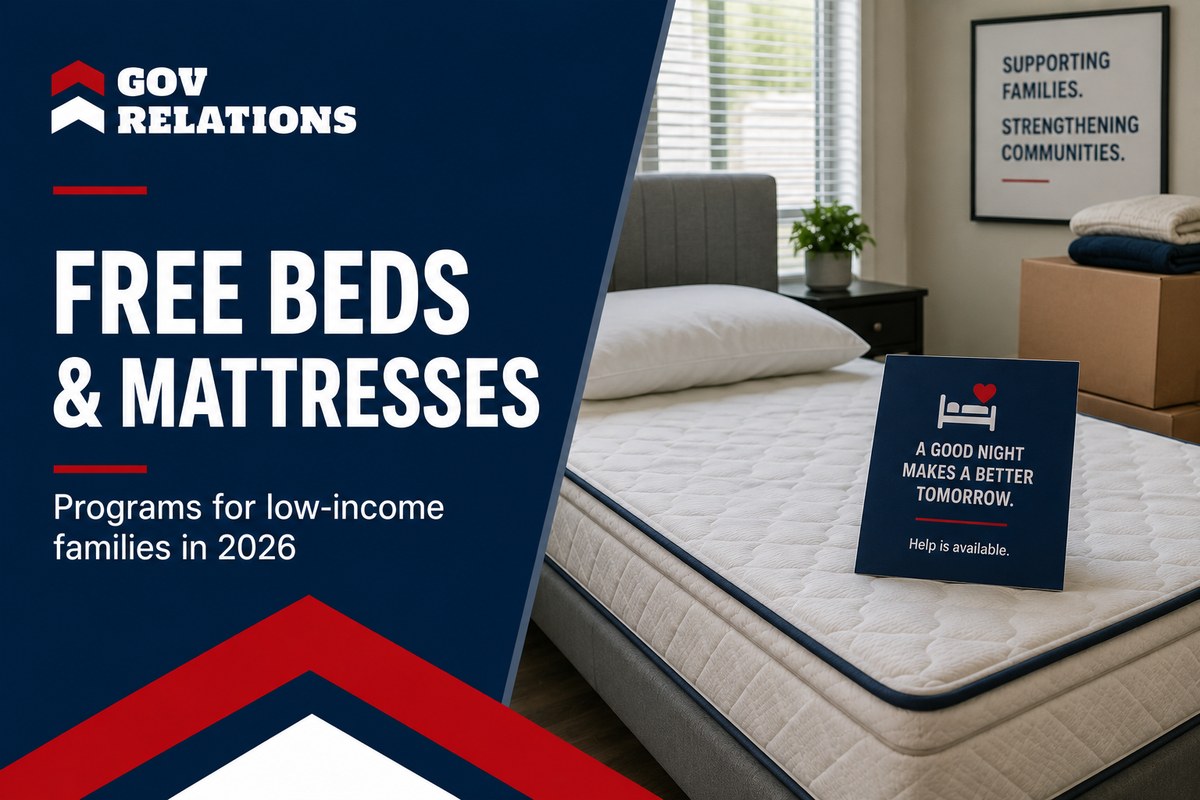
Free beds and mattresses for low-income families are available through verified national charities, community furniture banks, and online gift networks. Sleep in Heavenly Peace delivered 86,650 beds to children in need in 2025, and Ashley Furniture's Hope to Dream program donated nearly 13,500 complete bed sets that same year, according to organization reports. None of these programs costs a single dollar to apply.
This guide explains who qualifies, which programs serve your area, the documents you need before you apply, and how to spot the fraudulent offers that target families searching for help. If your child is sleeping on the floor, on a couch, or sharing one bed with siblings, you are in the right place to start.
Key Takeaways
- Free beds exist for kids and adults: Sleep in Heavenly Peace, Hope to Dream, Beds4Vets, and 114 furniture banks provide free beds and mattresses for low-income families nationwide.
- Income proof is the standard: Most programs require proof of income below 100% to 200% of the federal poverty line, plus a referral from a school, caseworker, or charity partner.
- Child programs versus all-ages programs: Sleep in Heavenly Peace and Hope to Dream serve kids aged 3 to 17; furniture banks serve adults, families, seniors, and veterans.
- Wait times are real: Furniture banks face an average waitlist of 100 families, so apply to two or three programs at the same time and stay flexible on bed size.
- Free should mean free: Legitimate programs never charge an application fee, never ask for credit card information, and never demand payment for delivery.
- Sleep loss has measurable costs: Children without their own bed experience shorter sleep duration and reduced school performance in research from the Children's Hospital of Philadelphia.
How Furniture Poverty Affects Families in 2026
Furniture poverty is the inability to afford essential household items like beds, tables, and chairs, and it affects more American households than most people realize. This is not a rare problem confined to homelessness. It reaches into working households that pay rent on time and still cannot afford a twin mattress for a child.
According to the Furnish Together coalition, over 66% of American households will lack critical furniture at some point in their lives, and roughly 32% of Americans are currently experiencing some form of furniture poverty. In July 2025, the coalition held the first Capitol Hill briefing on the issue at the Rayburn House Office Building, raising the topic to federal policy attention.
The shortage is tied to the broader housing crisis. The National Low Income Housing Coalition's 2026 Gap Report found just 35 affordable and available rental homes for every 100 extremely low-income renter households, with a national shortage of 7.2 million homes. Seventy-four percent of these 11 million extremely low-income renters are severely cost-burdened, spending more than half of their income on rent. When rent eats half a paycheck, beds and mattresses are often the first items left out of the budgetA detailed financial plan outlining the projected costs of the project, including personnel, equipme....
The impact on children is what most people miss. Research from the Children's Hospital of Philadelphia's Beds for Kids program found that children who received a bed and brief sleep education slept longer at night and used fewer electronics in the bedroom. A separate sleep space also reduces social isolation and increases feelings of belonging at home, an effect documented in multiple peer-reviewed studies of low-income child development.
Who Qualifies for Free Bed and Mattress Programs in 2026?
Eligibility rules vary by program, but most free bed providers use one of three basic standards: income level, family status, or referral from a partner agency. Knowing the rules before you apply prevents wasted time and avoids denials over missing paperwork.
You may qualify for a free child's bed if:
- Your household income is at or below 200% of the federal poverty line, and
- You have at least one child between the ages of 3 and 17, and
- The child currently does not have their own bed (sleeps on the floor, on a couch, or shares one bed with siblings or a parent).
You may qualify for a free adult bed if:
- You receive government assistance such as SNAP, MedicaidA joint federal and state program that helps with medical costs for some people with limited income ..., TANF, or Section 8, and
- You are transitioning out of homelessness, fleeing domestic violence, or recovering from a fire or natural disaster, and
- You have a referral from a social worker, case manager, or partner charity.
You will usually need to provide:
- A government-issued photo ID
- Proof of income (pay stubs, tax return, or benefit award letterAn official notification from the grantor indicating that the grant has been approved and outlining ...)
- Proof of residence (lease or utility bill)
- Proof of government assistance, where applicable
- A referral letter from a partner agency, where required
U.S. military veterans transitioning into permanent housing qualify for Beds4Vets through their local Veterans Administration office, even if they do not meet the standard low-income test. Foster parents qualify for several programs through child welfare partner agencies, separate from the standard child applicantThe individual or organization submitting the grant proposal and responsible for implementing the pr... rules.
National Programs That Provide Free Beds and Mattresses
Each program below has confirmed delivery records, verified eligibility criteriaThe specific requirements and conditions that applicants must meet to qualify for a grant., and an active application process as of 2026. The comparison table covers the five largest national bed and mattress providers serving low-income families in the United States.
| Program | Who It Serves | What You Receive | How to Apply | Key Restrictions |
|---|---|---|---|---|
| Sleep in Heavenly Peace | Children ages 3 to 17 | Twin bed frame, mattress, sheets, pillow, comforter | Apply directly at shpbeds.org/apply | Must live in a zip code with an active chapter; the legal guardian must apply |
| Hope to Dream (Ashley) | Children ages 3 to 16 | Twin mattress, bed frame, pillow, bedding | Nominate through ahopetodream.com | SponsorshipFinancial support provided by an organization or individual for an event, activity, or project, ofte... by a school counselor or caseworker is usually required |
| Beds4Vets | U.S. military veterans | Bed, sheets, comforter, plus kitchen and bathroom basics | Apply through your local VA office | Must be a veteran transitioning out of homelessness |
| Furniture Bank Network | Families and adults exiting crisis | Bed, mattress, and additional household items | Apply through a partner agency referral | 114 furniture banks nationwide; average waitlist of 100 families |
| Salvation Army | Low-income individuals and families | Furniture vouchers for thrift store use | Apply at a local Salvation Army office | Available items vary by location; not always twin beds |
In 2025, Sleep in Heavenly Peace surpassed 300,000 cumulative beds delivered since its founding, and projects reaching 400,000 total beds delivered in 2026. Hope to Dream, partnered with Ashley Furniture and Sleep in Heavenly Peace, has delivered more than 190,000 beds to children across the United States and Canada since 2010, with nearly 13,500 of those delivered in 2025 alone.
How to Apply for a Free Bed in 5 Steps
The application process is similar across most programs. Follow these five steps to apply the first time correctly and avoid the common mistakes that delay or disqualify applicants.
- Confirm a chapter or partner serves your area. Sleep in Heavenly Peace operates more than 388 active chapters as of 2025, but coverage gaps still exist. Search the chapter map at shpbeds.org/chapters before you apply. For Hope to Dream, check which Ashley store in your region participates.
- Gather your documentation. Pull together a photo ID, proof of income, proof of residence, and any benefit awardA general term for funds provided to an individual or organization to support a specific purpose or ... letters before you start the application. Most denials happen because applicants submit incomplete files.
- Secure a referral, if required. Hope to Dream, Beds4Vets, and most furniture banks require a sponsor: a school counselor, social worker, caseworker, faith leader, or partner charity who can vouch for your situation. Sleep in Heavenly Peace accepts direct family applications without a referral.
- Submit the application. Apply online where possible. Sleep in Heavenly Peace accepts applications at shpbeds.org/apply, and Hope to Dream accepts nominations at ahopetodream.com. Local chapters review applications monthly, so the timing of your submission matters.
- Apply to more than one program at the same time. Wait times can stretch from one month to over a year. Submit applications to two or three programs at once and accept the first available bed. Family situations change quickly, and the goal is to get a child off the floor as soon as possible.
Free Bed Options for Adults and Whole Households
Most national bed programs focus on children, which leaves adults wondering where to turn. The answer is the furniture bank network and the community gift economy, both of which serve adult applicants and full households exiting crisis.
Furniture banks are nonprofit organizationsEntities that use surplus revenues to achieve their goals rather than distributing them as profit or... that collect donated furniture and redistribute it to families exiting homelessness, domestic violence, or other crisis situations. There are over 100 furniture banks operating in the United States as of late 2025. Most require a referral from a social service agency, but they typically provide more than a bed. A single furniture bank delivery may include a couch, a kitchen table, dishes, and bedding.
The Buy Nothing Project is the largest free gifting platform in the world, with more than 14 million members in over 50 countries. Each year, members share roughly 162,000 metric tons of items worth approximately $360 million, according to Buy Nothing's official figures. Posting a respectful "Ask" for a clean twin mattress in your local group is one of the fastest ways to find a bed when other programs have long waitlists.
Freecycle, Craigslist Free, Facebook Marketplace Free, and Nextdoor are additional community channels. They take more vigilance, especially with used mattresses, but they can fill gaps when other programs cannot. Inspect any used mattress for stains, sagging, odor, and bed bug signs before bringing it into your home.
Key Terms You Will See When Applying
Government and charity application language can confuse first-time applicants. The terms below appear in most bed and furniture programs, and knowing them in advance prevents avoidable mistakes.
Furniture poverty is the inability to access, afford, or maintain essential household furniture and appliances needed for a safe, functional home. The term was formalized in the United States by the Furnish Together coalition in 2025.
Furniture bank is a registered nonprofit or social enterprise that collects donated furniture and gives it to households in need, usually through a partner agency referral system.
Bed set or bed kit is the full sleeping package most charities deliver: a twin frame, a new mattress, sheets, a pillow, and a comforter. Hope to Dream and Sleep in Heavenly Peace both use this format.
Referral is a formal recommendation from a social worker, school counselor, caseworker, or faith leader confirming that an applicant qualifies for charity assistance. Many bed programs do not accept direct applications without one.
Means-tested describes a program that requires applicants to prove their income falls below a set threshold, often expressed as a percentage of the federal poverty level, before they can receive benefits.
Real Impact: What a Free Bed Changes in a Family's Life
Jordan Allen, CEO and Executive Director of Sleep in Heavenly Peace, summarized the impact in the organization's 2025 annual report: "In 2025, together we delivered 86,650 beds to children in need. Behind every bed is a volunteer who gave their time, a chapter leader who organized their community, and a donor who chose to invest in a child's future. Behind every number is a child who now has a safe place to sleep and dream."
The clinical research backs up the testimony. The Children's Hospital of Philadelphia's Beds for Kids program studied the effect of bed provision combined with brief parent-focused sleep education in low-income families. Children who received a bed slept longer at night, used fewer electronics in their bedrooms, and reported better sleep quality within the study window.
The scale is repeating across the country. In Lansing, Michigan, the local Sleep in Heavenly Peace chapter delivered more than 800 beds in 2025, with 2,600 delivered cumulatively since its founding in 2018, according to local news reports. In Columbia, Missouri, the chapter has delivered nearly 350 beds in its first two years. As of 2026, Sleep in Heavenly Peace estimates that its chapters now serve roughly 28% of the U.S. population.
Scam Warning: How to Spot Fake Free Bed Offers
Families searching for free beds online are a frequent target of scam websites and fraudulent text messages. Watch for these red flags before you share any personal information.
- The real programs are always free. Any website, person, or service charging an application fee, a delivery fee, or a processing fee is not part of a legitimate free bed program.
- The official URLs are predictable. Sleep in Heavenly Peace's official site is shpbeds.org. Hope to Dream is ahopetodream.com. Beds4Vets is beds4vets.org. Lookalike URLs with extra words, dashes, or unusual domain extensions are almost always fraudulent.
- No legitimate program contacts you out of the blue. Charities do not send unsolicited text messages, emails, or phone calls offering free beds to people who never applied. Any unsolicited "you qualify for a free bed" message is a scam.
- No charity asks for a credit card number to claim a free bed. If a payment field appears at any step of the application, leave the site immediately.
- Watch for fake government branding. No federal government agency directly delivers free beds to private homes. Sites that imply they are "the official government bed program" are misrepresenting themselves.
If you suspect a scam, do not click any links in the message and report it to the Federal Trade Commission.
Your Next Steps to Get Help & Stay Informed
If your child is sleeping on the floor right now, your next step is to apply to Sleep in Heavenly Peace and confirm a chapter serves your zip code. As of 2026, the organization projects delivering over 91,000 beds in this year alone and crossing 400,000 cumulative beds delivered since its founding. If a chapter does not serve your area, nominate your child through ahopetodream.com and contact your nearest furniture bank. Apply to more than one program at the same time, gather your documents while you wait, and stay alert to the scam offers that target families in your exact situation. You qualify for help. The programs above exist for families like yours.
Want more help navigating assistance programs and government resources? Find out how to get government support for unemployed job training to learn how federal and state programs can help you build financial stabilityRequirements for demonstrating the financial health and stability of the applicant organization..
Frequently Asked Questions
Does the government give free beds and mattresses to low-income families?
The federal government does not directly deliver free beds, but federally funded charities, faith-based programs, and Continuum of Care housing partners do. Programs like Sleep in Heavenly Peace and Hope to Dream are private nonprofits. Furniture banks sometimes receive federal funding through HUD housing assistance and homeless services grants, and a 2025 bill called the Housing to Homes Act would expand that funding stream.
How long does it take to receive a free bed after applying?
Wait times range from one month to over a year, depending on the program, your local chapter's volunteer capacity, and the time of year. Sleep in Heavenly Peace's Columbia, Missouri, chapter reports delivery within about one month of application. Furniture banks face an average waitlist of 100 families, according to Congresswoman Andrea Salinas's 2025 statement introducing the Housing to Homes Act.
Can I get a free bed if I am not a parent?
Yes, but most national child-focused programs will not serve you. Adult applicants should apply to local furniture banks (114 nationwide), the Salvation Army, or Goodwill voucher programs through their partner social service agencies. Beds4Vets serves U.S. military veterans regardless of family status. The Buy Nothing Project and Freecycle are open to all adults at any income level.
Are used mattresses from free programs safe?
Sleep in Heavenly Peace, Hope to Dream, and Beds4Vets all deliver brand-new mattresses, not used ones. Furniture banks typically provide gently used items that have been inspected for cleanliness and structural integrity. Mattresses from Buy Nothing, Freecycle, or Craigslist are donor-direct and require your own inspection. Check for stains, sagging, odor, and any sign of bed bugs before accepting one.
What if no Sleep in Heavenly Peace chapter serves my area?
Check Hope to Dream's nomination network at ahopetodream.com, your local Salvation Army or Goodwill social service partner, the nearest furniture bank through furniturebanks.org, or a local Buy Nothing group on Facebook or the Buy Nothing app. In 2025, Sleep in Heavenly Peace trained 47 new chapters and now has 388 active across the country, so coverage continues to expand year over year.
Can foster parents apply for free beds for their foster children?
Yes. Foster parents qualify for most major bed programs, often through their state child welfare partner agencies rather than direct application. Many Hope to Dream nominations come through foster care caseworkers, and Sleep in Heavenly Peace prioritizes foster placements with multiple children sharing one bed.
- Hale, Lauren, et al. "Who Gets the Best Sleep? Ethnic and Socioeconomic Factors Related to Sleep Complaints." Sleep, vol. 33, no. 5, 2010, pp. 585–592, ncbi.nlm.nih.gov/pmc/articles/PMC2861987/. Accessed 20 Nov. 2023.
- El-Sheikh, Mona, et al. "Disparities in Sleep Duration among American Children: Effects of Race and Ethnicity, Income, Age, and Sex." Proceedings of the National Academy of Sciences, vol. 119, no. 19, 2022, pnas.org/doi/full/10.1073/pnas.2120009119. Accessed 20 Nov. 2023.
- Pereira, Érico Felden, et al. "Sleep in Adolescents of Different Socioeconomic Status: A Systematic Review." Journal of Clinical Sleep Medicine, vol. 11, no. 12, 2015, pp. 1429–1439, ncbi.nlm.nih.gov/pmc/articles/PMC4685568/. Accessed 20 Nov. 2023.
- "Members of Minorities, Low-Income Communities Get Less Sleep, Have More Sleep Problems." Psychiatric News, American Psychiatric Association, 2020, psychnews.psychiatryonline.org/doi/10.1176/appi.pn.2020.11a18. Accessed 20 Nov. 2023.