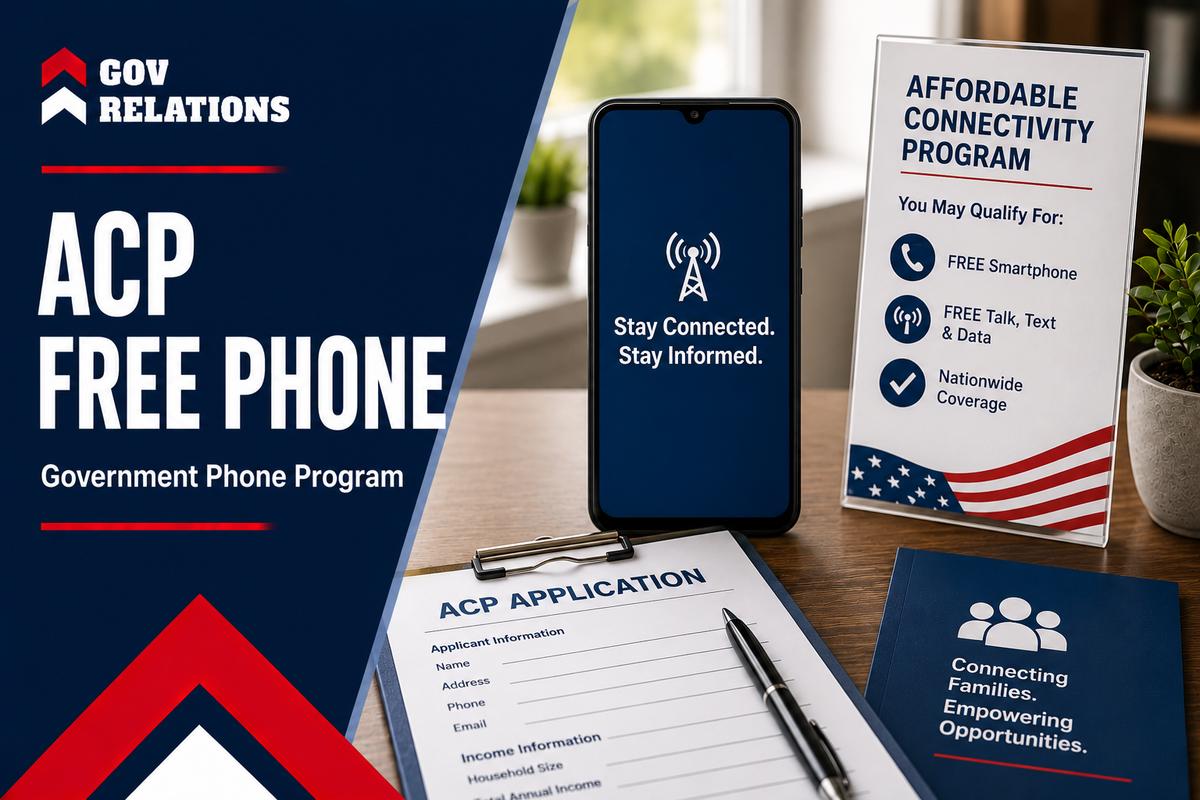
The ACP free phone program no longer exists. The Affordable Connectivity Program (ACP) stopped accepting new applications on February 7, 2024, and ended completely on June 1, 2024. If you are searching for an ACP free phone in 2026, the federal program that now provides free government phones is Lifeline. At its peak, the ACP served more than 23 million households before its funding ran out.
This guide explains what happened to the ACP, which program replaced it, whether you qualify, and the exact steps to get a free phone this year. For a wider view of the benefits you may be eligible for, our government assistance guides organize programs by your situation.
Key Takeaways
- The ACP has ended: The Affordable Connectivity Program stopped new applications in February 2024 and fully expired on June 1, 2024, with no federal replacement since.
- Lifeline is the answer now: An ACP free phone in 2026 means applying through Lifeline, the FCC program that funds free government phones for low-income households.
- The income limit is 135%: You may qualify if your household income is at or below 135% of the Federal Poverty Guidelines, which is $21,546 for one person in 2026.
- Benefit programs qualify you: Enrollment in MedicaidA joint federal and state program that helps with medical costs for some people with limited income ..., SNAP, SSI, Federal Public Housing Assistance, or a Veterans Pension can make you eligible without proving income.
- The phone is free through providers: Lifeline pays carriers up to $9.25 per month, and many bundle that subsidyFinancial assistance granted by a government to support a specific economic activity or sector, redu... into a free smartphone with talk, text, and data.
- Most eligible people miss out: Only about one in five eligible households is enrolled in Lifeline, so millions who qualify for a free phone never claim it.
- Watch for scams: The real program is always free, and applications route through the official National Verifier, never a site that asks for a credit card.
Is the ACP Free Phone Program Still Available in 2026?
No. The ACP free phone program is not available in 2026. The Affordable Connectivity Program stopped taking new applications on February 7, 2024, and ended completely on June 1, 2024, after Congress did not renew its $14.2 billion in funding. Any website still advertising a new ACP free phone is working from outdated information.
The ACP launched in December 2021 to help low-income households afford internet service and connected devices. It provided a discount of up to $30 per month toward internet, or up to $75 per month for households on qualifying Tribal lands, and it supported over 23 million households at its peak, according to the Congressional Research Service. When the money ran out, the discount disappeared for every enrolled household at once.
Congress has introduced bills to revive the benefit, including the proposed Affordable Connectivity Program Extension Act, but none have passed as of mid-2026. The Federal Communications Commission (FCC) confirms the program is closed. A few states have built their own programs to fill part of the gap. New Mexico launched its Low-Income Telecommunications Assistance Program on July 1, 2026, and California opened a broadband pilot in January 2026. These programs focus mostly on internet service and vary by location. For phone service nationwide, Lifeline is the federal option.
What Replaced the ACP Free Phone? The Lifeline Program
Lifeline replaced the ACP as the way to get a free government phone. Lifeline is an FCC program, managed by the Universal Service Administrative Company (USAC), that lowers the cost of phone and internet service for low-income households. It has operated since 1985, long before the ACP existed, and it remains active in all 50 states, Washington, D.C., and U.S. territories.
The federal Lifeline discount is up to $9.25 per month on qualifying service, or up to $34.25 per month for households on Tribal lands. The subsidy is paid directly to the phone provider, not to you. Many participating carriers combine that payment with their own promotions to give eligible customers a free basic smartphone plus a monthly allotment of talk, text, and data. You can read the program details on the FCC Lifeline page and the USAC Lifeline site.
Here is the part most people miss. Only about one in five eligible households is enrolled in Lifeline. The barrier is not eligibility. It is awareness. Millions of people who could claim a free phone and plan right now do not, simply because no one told them they qualify. If you receive a disability benefit and need a reliable way to reach your doctor, your caseworker, or an emergency line, this is one of the few federal benefits you can claim in an afternoon. Readers who receive SSI or SSDI can also review free government phones for people on disability benefits for options specific to their situation.
Do You Qualify for a Free Government Phone in 2026?
You qualify for a free government phone in 2026 if your household income is at or below 135% of the Federal Poverty Guidelines, or if you take part in a qualifying government assistance program. You need to meet only one of these two paths, not both. Lifeline allows one benefit per household, defined as people who live together and share income and expenses.
Path 1: You Take Part in a Qualifying Program
You qualify automatically if you or someone in your household is enrolled in any of these federal programs. This path skips the income check, since the program you are already in has verified your income.
- Medicaid
- Supplemental Nutrition Assistance Program (SNAP)A federal aid program that provides food-purchasing assistance for low- and no-income individuals an..., also known as food stamps or EBT
- Supplemental Security Income (SSI)
- Federal Public Housing Assistance (FPHA)
- Veterans Pension and Survivors Benefit
Path 2: Your Household Income Is at or Below 135% of the Poverty Guidelines
If you do not take part in a listed program, you can still qualify based on gross household income. The 2026 limits are set at 135% of the Federal Poverty Guidelines and rise with household size. Alaska and Hawaii have higher limits because their cost of living is higher. The official eligibility rules are published by USAC.
| Household Size | 48 States & D.C. | Alaska | Hawaii |
|---|---|---|---|
| 1 Person | $21,546 | $26,933 | $24,786 |
| 2 People | $29,214 | $36,518 | $33,602 |
| 3 People | $36,882 | $46,103 | $42,417 |
| 4 People | $44,550 | $55,688 | $51,233 |
| Each additional person | Add $7,668 | Add $9,585 | Add $8,816 |
There is one more path. Survivors of domestic violence, human trafficking, or related crimes may qualify under a special provision at up to 200% of the Federal Poverty Guidelines, or through the Special Supplemental Nutrition Program for Women, Infants, and Children (WIC)A federal assistance program providing nutrition education, healthy food, and other services to preg... or a Federal Pell GrantA subsidy provided by the federal government to help students pay for college, awarded based on fina.... This provision grants up to six months of emergency Lifeline support while protecting the applicant’s privacy. WIC and the Pell GrantA sum of money given by a government or other organization for a particular purpose, usually without... are not standard Lifeline programs; they count only under this survivor provision.
ACP vs. Lifeline: What Changed
The two programs are easy to confuse, which is why so many people still search for an ACP free phone. This table shows the difference at a glance.
| Feature | ACP (Ended) | Lifeline (Active in 2026) |
|---|---|---|
| Status | Closed on June 1, 2024 | Active nationwide |
| Monthly benefit | Up to $30 ($75 on Tribal lands) | Up to $9.25 ($34.25 on Tribal lands) |
| Main focus | Internet service and devices | Phone or internet service |
| Free phone available | Through some providers | Through many participating providers |
| How to apply | No longer accepting applications | National Verifier at LifelineSupport.org |
| Runs since | December 2021 | 1985 |
How to Apply for a Free Government Phone: Step by Step
Applying takes about an afternoon once your documents are ready. Every application routes through the National Verifier, the official system that confirms your eligibility. Follow these five steps in order.
- Gather your documents. You need proof of identity, such as a driver’s license or passport, and proof of eligibility. For program-based eligibility, use a current-year benefit letter. For income-based eligibility, use a prior-year state or federal tax return or three consecutive months of pay stubs.
- Apply through the National Verifier. Apply online at LifelineSupport.org, by mailing a paper application, or through a participating provider’s website, which routes your application through the same system.
- Get your Application ID. Once the National Verifier approves you, it issues an Application ID. Keep this number, because you need it to finalize enrollment with a provider.
- Choose a participating provider. Enter your Application ID on your chosen provider’s website. The provider then applies your Lifeline benefit and ships your free smartphone and SIM card to your address.
- Recertify every year. Lifeline requires annual recertification. If you do not confirm your eligibility each year, you are removed from the program and lose the benefit.
If automatic verificationThe process of confirming the accuracy and authenticity of project activities, data, and reports. does not confirm your details, you enter a manual review. You can also call the USAC Lifeline Support Center at 1-800-234-9473 to request a paper application. Full instructions are on the USAC how-to-qualify page.
Which Providers Offer Free Phones Through Lifeline in 2026?
Because the Lifeline subsidy is paid to the carrier, the free phone model and the amount of data vary by company and by state. The four providers below are among the most widely available in 2026. A specific phone model, such as an iPhone, is never guaranteed, and offers change with stock.
| Provider | Network | Typical Free Phone Benefit |
|---|---|---|
| AirTalk Wireless | Multiple carriers | Up to 12GB of 5G data, unlimited talk and text, free or discounted smartphone, plus a Bring Your Own Device data option |
| Assurance Wireless | T-Mobile | Free basic Android phone, unlimited talk and text, and 10GB to 12GB of data depending on your state |
| SafeLink Wireless | Verizon (TracFone) | Free smartphone or a free SIM for your own phone, unlimited talk and text, and a state-based data allotment |
| TruConnect | T-Mobile | Free Android phone, unlimited talk and text, and up to 12.5GB of data, with extra perks in select markets |
For provider-specific application walkthroughs, gov-relations.com covers individual carriers in depth, including TruConnect’s Lifeline plans and Life Wireless free government phones. Confirm that your chosen provider has coverage at your address before you apply.
Key Terms to Know Before You Apply
Government phone programs use a handful of acronyms that trip people up. Here is what each one means in plain language.
- Affordable Connectivity Program (ACP): The federal internet-discount program that ended on June 1, 2024. It is no longer accepting applications.
- Lifeline: The active FCC program that provides discounted phone and internet service, and, through many carriers, a free smartphone.
- National Verifier: The centralized system that checks whether you qualify for Lifeline. Every application passes through it.
- Universal Service Administrative Company (USAC): The nonprofit that runs Lifeline day to day on behalf of the FCC.
- Federal Poverty Guidelines (FPG): The annual income figures the government uses to set eligibility. Lifeline uses 135% of these guidelines.
- Bring Your Own Device (BYOD): An option that lets you keep your current phone and receive a free SIM card instead of a new handset.
What Former ACP Recipients Should Do Right Now
In our experience helping readers find assistance programs, most people who ask about an ACP free phone already qualify for Lifeline and simply did not know the two programs were separate. If your ACP internet discount disappeared in 2024, your first move is not to keep searching for the old program. It is to check your Lifeline eligibility.
Consider a common case. A reader who received SNAP, relied on the ACP for internet, and lost that discount when the program closed. That same SNAP enrollment qualifies them for Lifeline on the program path, with no income paperwork required. They gather their EBT card and a state ID, apply through the National Verifier, receive an Application ID, and pick a provider that ships a free phone. The whole process fits in a single afternoon, and the phone covers calls to work, healthcare providers, and family.
One caution from readers who have applied: make sure the name on your ID matches the name on your benefit documents exactly. Mismatched names are the most common reason an application stalls in manual review.
Scam Warning: How to Spot a Fake Free Government Phone Offer
People searching for free government phones are a frequent target for fraud. Before you apply anywhere, here is how to tell a real offer from a fake one.
- The real program is always free. Any website or person charging a fee to submit your Lifeline application is not part of the official program.
- Applications route through the National Verifier. The official information site is LifelineSupport.org, and the program rules live on FCC.gov. Treat any other site that promises instant approval with caution.
- The government will not contact you out of the blue. Any unsolicited call, text, or email offering you a free phone you never applied for is a scam.
- No program asks for a credit card to give you a free phone. Any offer that requires payment to claim a free device or free service is fraudulent.
If you receive an unsolicited free phone offer, do not respond and do not click any links in the message. Report it to the Federal Trade Commission at ReportFraud.ftc.gov.
Your Next Step to Get a Free Phone
The ACP free phone is gone, but the need it met has not changed, and the Lifeline program covers it. As of 2026, Lifeline is the federal program that provides free government phones to low-income households, and only about one in five eligible households has claimed it. If you receive Medicaid, SNAP, SSI, Federal Public Housing Assistance, or a Veterans Pension, or if your income is at or below 135% of the Federal Poverty Guidelines, you likely qualify right now.
Your next step is to gather your ID and proof of eligibility, then apply through the National Verifier at LifelineSupport.org. For provider comparisons, application walkthroughs, and guides to other benefits you may qualify for, start with our government assistance guides.
Frequently Asked Questions
Is the ACP free phone program still available in 2026?
No. The Affordable Connectivity Program stopped new applications on February 7, 2024, and ended on June 1, 2024, when its funding ran out. There is no federal replacement as of mid-2026. To get a free government phone now, apply through the Lifeline program.
What is the difference between the ACP and Lifeline?
The ACP was a temporary internet-discount program worth up to $30 per month that ended in 2024. Lifeline is a permanent FCC program, active since 1985, worth up to $9.25 per month on phone or internet service. Lifeline is the program that still provides free government phones.
Can you still get a free government phone after the ACP ended?
Yes. You can still get a free government phone in 2026 through Lifeline. Many participating carriers use the Lifeline subsidy to provide a free basic smartphone with talk, text, and data. You qualify by income or by taking part in a program like Medicaid, SNAP, or SSI.
What income qualifies for a free government phone in 2026?
Your household must earn at or below 135% of the Federal Poverty Guidelines. For 2026, that is $21,546 for one person and $44,550 for a family of four in the 48 contiguous states. Alaska and Hawaii have higher limits.
Do you get a free phone with Lifeline or just a discount?
The federal Lifeline benefit is technically a service discount of up to $9.25 per month, paid to the carrier. Many carriers bundle that discount with their own promotion to include a free smartphone. A specific phone model, such as an iPhone, is never guaranteed and depends on the provider.
Can I qualify for a free phone if I have SNAP or EBT?
Yes. Participation in SNAP, often accessed through an EBT card, qualifies you for Lifeline on the program path. You do not need to prove your income separately. Upload a photo of your EBT card and a matching state ID when you apply through the National Verifier.
Is an ACP replacement coming back in 2026?
Several bills to revive ACP funding have been introduced in Congress, including the Affordable Connectivity Program Extension Act, but none had passed as of mid-2026. A few states, including New Mexico and California, launched their own programs in 2026, though these focus mainly on internet service.