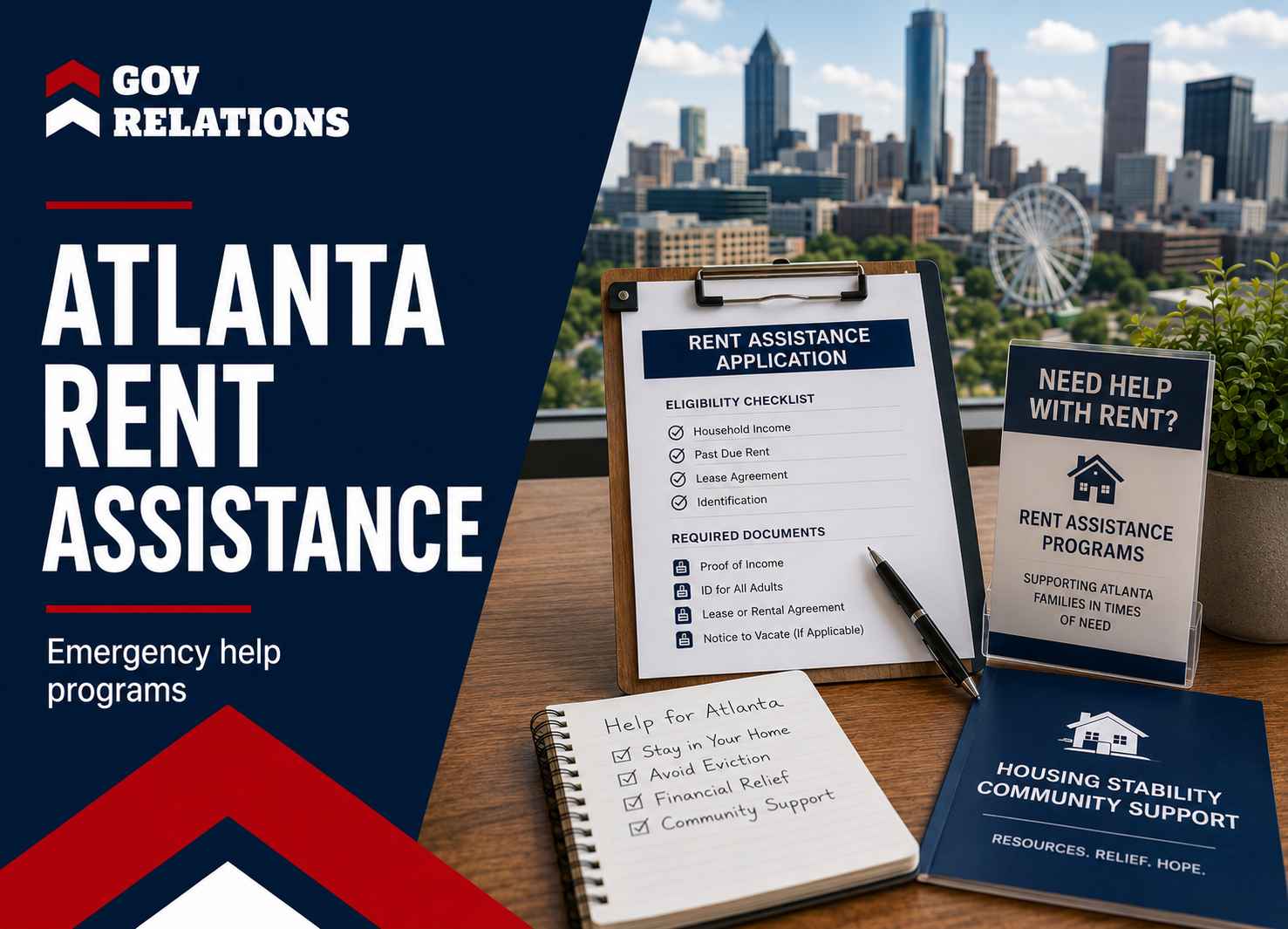
Atlanta offers emergency rental assistance through federal, state, county, and nonprofit programs that can cover past-due rent, prevent eviction, and connect you with housing services at no cost. The metro area faces one of the worst housing crises in the country: in 2025, landlords filed more than 144,000 eviction cases across the five-county region, a rate of roughly one filing for every four renter households. That is more than all eviction filings in New York City or the state of Virginia combined. If you are behind on rent or facing a notice to vacate, assistance is available.
This guide covers every major Atlanta rent assistance program, who qualifies, how to apply, and what to do if your situation is urgent.
Key Takeaways
- ARCHI Universal Application: 18 organizations accept one 6-minute online application that matches you to the right provider within 2 to 4 weeks.
- City of Atlanta Housing Help Center: Free case management from City navigators at 2 Peachtree Street; apply at HousingHelpCenter.com or call 311.
- Income Eligibility Threshold: Most programs require household income at or below 80% of AMI, which is $91,360 per year for a family of four in Atlanta (FY 2025).
- Eviction Crisis Scale: Atlanta's five-county region led the nation in eviction filings in 2025, with Black renters filing 71% of all cases despite making up 53% of renters.
- All Assistance Is Free: Every program in this guide is free to apply for. Any website or person charging a fee to submit your application is a scam.
- Start with 211: Call 211 to reach the United Way of Greater Atlanta referral line and get connected to assistance programs in minutes.
Why So Many Atlanta Renters Are Falling Behind
Atlanta's rental market has become one of the hardest in the South. The average rent across the metro area sits between $1,544 and $2,000 per month as of early 2026. At the same time, Georgia's minimum wage remains $5.15 per hour, more than $2 below the federal minimum. The math creates a gap that is impossible to close for working families in lower-wage jobs.
Cassandre Damas, managing attorney for the Atlanta Volunteer Lawyers Foundation's Housing Court Assistance Center, put it plainly: "The general rule is that a person should only pay 30% of their income to housing. When your wage or your income pay is $1,200 or a little bit less after taxes, you can't afford a $1,700 one-bedroom home. The math is not math-ing."
Eviction Lab, a Princeton University research team that tracks evictions nationwide, found that metro Atlanta's five-county region (Fulton, Gwinnett, Cobb, Clayton, and DeKalb) recorded 144,003 eviction filings from February 2025 through early 2026. That rate, roughly one filing for every four renter households, was more than double the national average eviction filing rate of 7.9%.
If you are behind on rent in Atlanta, you are not alone, and assistance exists. The programs below are organized so you can find the right one for your situation and apply today.
Am I Eligible? Understanding Income Limits for Atlanta Rent Assistance
Most Atlanta rent assistance programs use HUD's Area Median Income (AMI) to determine who qualifies. AMI is the midpoint household income for the Atlanta-Sandy Springs-Roswell metro area, updated each year by the U.S. Department of Housing and Urban DevelopmentEligibility for projects aimed at revitalizing urban areas and addressing urban-specific challenges.....
For FY 2025, the Atlanta metro AMI is $114,200 for a family of four. Most emergency rental assistance programs require household income at or below 80% of that figure. The table below shows income limits by household size:
| Household Size | 50% AMI (Very Low Income) | 60% AMI | 80% AMI (Low Income) |
|---|---|---|---|
| 1 person | $40,100 | $48,120 | $64,200 |
| 2 people | $45,800 | $54,960 | $73,300 |
| 3 people | $51,550 | $61,860 | $82,450 |
| 4 people | $57,250 | $68,700 | $91,360 |
| 5 people | $61,850 | $74,220 | $98,700 |
| 6 people | $66,400 | $79,680 | $106,000 |
Source: HUD FY 2025 Income Limits for the Atlanta-Sandy Springs-Roswell Metro Area. Figures are approximate. Check program-specific guidelines for exact thresholds.
Programs that serve households at 50% AMI or below generally have shorter waitlists and faster approvals. If your income falls in that range, mention it when you apply, as many programs prioritize lower-income applicants.
The ARCHI Universal Application: One Form, 18 Programs
If you do not know which program to apply for, start here. The Atlanta Regional Collaborative for Health Improvement (ARCHI) partnered with 18 local organizations to create a single application for rental, mortgage, and utility assistance. You fill out one form, and ARCHI matches you with the provider best equipped to help you.
You may qualify for ARCHI-coordinated assistance if you meet the following conditions:
- You need help paying rent, a mortgage, or utility bills.
- Your household income is at or below 80% of the Atlanta area median income.
- You live in the metro Atlanta area.
How to apply through ARCHI:
- Visit archicollaborative.org/community-assistance or call 211.
- Complete the 6-minute online application, available 24 hours a day, 7 days a week.
- Submit your form. It is free and requires no fee at any point.
- Wait for a response from ARCHI or a matched provider within 2 to 4 weeks.
- Gather your documents before your appointment: a government-issued ID, proof of income, your lease or rental agreement, and any past-due rent or utility notices.
ARCHI providers include the Midtown Assistance Center, BCM Georgia, Catholic Charities Atlanta, Atlanta Legal Aid Society, Emmaus House, Crossroads Community Ministries, and others. The platform coordinates cases across agencies so multiple organizations can work on your request together.
Important: Between January 2023 and December 2024, there were 37,864 unique applicants through the ARCHI system, of which 919 received funding. Demand exceeds supply. Apply as early as possible and pursue multiple programs at the same time.
City of Atlanta Housing Help Center
The Housing Help Center is the official housing resource center run by the City of Atlanta. It was launched in the fall of 2023 and is staffed by City of Atlanta employees who serve as housing navigators. Navigators help residents identify relevant programs, complete applications, and connect to legal aid or emergency services.
You may qualify for Housing Help Center assistance if:
- You live within the City of Atlanta limits.
- You face eviction, housing instability, or an unresolved code enforcement concern.
- You need help finding emergency relocation resources, rental assistance, or legal aid.
How to apply:
- Complete the intake form at HousingHelpCenter.com.
- If you need help with the form or do not have internet access, call 311 or (404) 492-7640.
- A navigator will review your intake form and respond within 7 to 10 business days, often sooner.
- Schedule your appointment. The office is located at 2 Peachtree Street, near the Five Points MARTA station, and is open Monday through Friday, 9 AM to 5 PM. Navigators can schedule outside these hours if needed.
Note: The City's Eviction Diversion Program with Star-C has concluded. General rental assistance is still available through the Housing Help Center.
State and Federal Programs
Georgia Housing Choice Voucher Program (Section 8)
The Housing Choice Voucher Program, commonly called Section 8, provides monthly rental subsidies to very low-income individuals and families. The Georgia Department of Community Affairs (DCA) administers the program across 149 of Georgia's 159 counties, while Atlanta Housing (AH) administers vouchers within the City of Atlanta.
You may qualify if:
- Your household income is at or below 50% of the Atlanta area median income (Very Low Income threshold).
- You are a U.S. citizen or eligible non-citizen.
- You have no active sex offender registration.
The subsidyFinancial assistance granted by a government to support a specific economic activity or sector, redu... follows the tenant, not the unit. After your first year, you can use your voucher anywhere in the United States that has a Housing Choice Voucher program. DCA does not charge any fees to apply.
Apply or get on the waiting list at Atlanta Housing. For state vouchers outside the city, contact DCA at dca.georgia.gov.
Waiting lists are often long. Register as soon as you can, and continue pursuing other programs while you wait.
Atlanta Housing Community-Based Assistance
Atlanta Housing manages more than 90 apartment communities across the city where rental subsidies are tied to the unit rather than a portable voucher. Some communities are designated for seniors or adults 55 and older. To apply, contact each community's property managementThe tracking and oversight of equipment and other assets purchased with grant funds to ensure proper... office directly to check whether the waiting list is open.
HOPWA: Housing for People Living with HIV/AIDS
The City of Atlanta's HOPWA (Housing Opportunities for Persons With AIDS) program provides housing assistance and supportive services to low-income individuals and families living with HIV/AIDS. To access HOPWA services, call 311 if you live within Atlanta city limits, or 404-546-0311 if you live outside the city. Hours are Monday through Friday, 7 AM to 7 PM.
County-Level Rent Assistance Programs
Fulton County: Emergency Solutions Grant and TBRA
Fulton County administers the Emergency Solutions Grant, which funds emergency shelter, eviction prevention, rapid rehousing, and emergency utility assistance for county residents outside Atlanta city limits. The county also runs a Tenant-Based Rental Assistance (TBRA) program that provides rental payments and housing inspections for low-income residents.
DeKalb County: Integrated Community Care Initiative
DeKalb County launched the Integrated Community Care Initiative using $13 million in federal Emergency Rental Assistance funding. The program distributed funds through nine local nonprofits for rent, utilities, and legal services related to eviction. This program expired on June 30, 2025. For current DeKalb County housing assistance, contact the Family Service Agency of DeKalb County or call 2-1-1 for updated referrals.
DeKalb County residents facing eviction can also contact DeKalb Pro Bono for free legal services or Atlanta Legal Aid Society at (404) 521-0790.
Key Nonprofit Providers: Contacts and Who They Serve
These organizations provide direct emergency rental assistance to Atlanta residents. Most are funded through a mix of federal, state, and private dollars. Funds are limited, and applications are often reviewed on a first-come, first-served basis.
| Organization | Services | Who They Serve | Contact |
|---|---|---|---|
| Midtown Assistance Center (MAC) | Emergency rent and utility assistance; food pantry; ID vouchers; clothing support | Low income, working households in 14 Atlanta zip codes | Apply via ARCHI or call 404-681-5777 |
| BCM Georgia | Emergency rental assistance to prevent eviction and utility shutoffs | Metro Atlanta families in temporary crisis with a child in Atlanta Public Schools | Apply via ARCHI or visit bcmgeorgia.org |
| The Salvation Army | Emergency help with rent, utilities, food, and clothing | Individuals and families in financial crisis across multiple counties | 404-486-2888 or call 211 |
| Hearts to Nourish Hope | STEP Program: temporary rental assistance; Calvary Refuge Center for housing | Clayton County families facing imminent eviction; young adults | 404-361-5309 |
| Catholic Charities Atlanta | Housing counseling, foreclosure prevention, rental counseling, financial education | Families and individuals seeking to remain housed or find new housing | housingcounseling@ccatlanta.org |
| Atlanta Legal Aid Society | Free civil legal help; eviction prevention; housing rights education | Low income individuals across metro Atlanta | (404) 521-0790; Eviction Defense Hotline: (404) 941-9494 |
| Nicholas House | Rapid rehousing; homelessness prevention; back rent payments; security deposit help | Families with enough income to sustain rent but facing a temporary crisis | Complete pre-screen form at nicholashouse.org |
| Partners for HOME | Permanent supportive housing; citywide homeless response coordination | Individuals experiencing homelessness or housing instability | Call 311 for assistance |
| Emmaus House | Emergency rent and utility assistance; food pantry; Georgia State ID vouchers | Residents near the Peoplestown neighborhood; drop-in center available | emmaushouseatlanta.org |
How to Apply for Atlanta Rent Assistance: Step-by-Step
Follow these steps in order. You can apply to multiple programs at the same time.
- Call 211 first. The United Way of Greater Atlanta operates a toll-free referral line that connects you to programs in your area. Calling 211 is the fastest way to identify what is currently accepting applications near your address.
- Complete the ARCHI universal application. Visit archicollaborative.org/community-assistance and fill out the 6-minute form. This one application reaches 18 partnering organizations.
- File an intake form with the City of Atlanta Housing Help Center. Visit HousingHelpCenter.com or call (404) 492-7640. A navigator will respond within 7 to 10 business days.
- Contact county-specific programs. Fulton County residents outside Atlanta city limits: contact the Department of Community Development. DeKalb County residents: call 211 for current referrals.
- Prepare your documentation. Most programs require: a state ID or passport; proof of income for all adults (pay stubs, bank statements, or benefit letters); a copy of your lease or rental agreement; past-due rent or utility notices; and a written statement of your financial hardship.
- If you have received an eviction notice, contact Atlanta Legal Aid immediately. Call (404) 521-0790 or the Eviction Defense Hotline at (404) 941-9494. Free legal representation is available. Do not move out before your court date unless physically forced to, as leaving early can waive legal defenses that might keep you housed.
- Follow up on every application. Assistance funds are limited and often distributed on a first-come, first-served basis. Keep records of every application you submit, including the date, the program name, and any confirmation number you receive.
Which Program Is Right for Your Situation?
Different programs serve different needs. Use this table to identify where to start based on your current situation.
| Your Situation | Best Starting Point | Next Step |
|---|---|---|
| Behind on rent, not sure where to start | ARCHI universal application | Visit archicollaborative.org or call 211 |
| Received an eviction notice | Atlanta Legal Aid Society | Call (404) 941-9494 immediately |
| Need ongoing rental subsidy (not one-time help) | Housing Choice Voucher (Section 8) | Register at atlantahousing.org for the waitlist |
| Living with HIV/AIDS and facing housing instability | HOPWA Program (City of Atlanta) | Call 311 or 404-546-0311 |
| Single parent with children in Atlanta Public Schools | BCM Georgia via ARCHI | Apply at archicollaborative.org |
| Clayton County resident near eviction | Hearts to Nourish Hope | Call 404-361-5309 |
| Need legal advice before a court date | Atlanta Volunteer Lawyers Foundation | Visit atlantalegalaid.org or call (404) 521-0790 |
| Need help with utilities, not rent | Midtown Assistance Center or Emmaus House | Apply via ARCHI or call 404-681-5777 |
Documents You Will Need Before You Apply
Gathering these documents before you start will speed up every application you submit. Most programs require the same core set.
- Government-issued photo ID.
- Proof of income for every adult in the household. This can be recent pay stubs (last 30 to 60 days), a benefits award letterAn official notification from the grantor indicating that the grant has been approved and outlining ... (SSI, SSDI, or Social Security), bank statements, or a letter from an employer.
- Proof of housing costs. Your current lease or rental agreement and any past-due rent notices from your landlord.
- Proof of financial hardship. A termination letter, a statement showing reduced hours, medical bills, or other documentation showing why you fell behind.
- Utility bills (if applying for utility assistance alongside rent assistance).
- Social Security numbers for all household members (required by some federal programs).
If you are missing a document, apply anyway and explain the gap. Many agencies can work with alternative documentation if you communicate clearly.
Scam Warning: Fake Atlanta Rent Assistance Offers Are Common
Before you apply anywhere, here is how to tell the difference between a legitimate program and a scam:
- Every legitimate Atlanta rent assistance program is free to apply for. Any website or person charging a fee to submit your application is not part of an official program.
- Official program websites end in .gov or are listed on this guide. If a site uses the name of a real program but the URL does not match, leave the site.
- No government agency will contact you by phone or text to offer you benefits you did not apply for. Unsolicited calls or texts claiming to offer rent assistance are scams.
- No program will ask for your credit card number to release assistance. Approved funds go directly to your landlord or utility provider, not to you by debit card or wire transfer.
If you receive a suspicious offer, do not respond. Report it to the Federal Trade Commission at ReportFraud.ftc.gov.
Frequently Asked Questions About Atlanta Rent Assistance
How long does Atlanta rent assistance take to process?
Processing times vary by program. ARCHI-coordinated assistance typically responds within 2 to 4 weeks. The City of Atlanta Housing Help Center responds to intake forms within 7 to 10 business days. Emergency programs at nonprofit providers like the Midtown Assistance Center or The Salvation Army may be faster when funds are available. If you have received an eviction notice with a court date, contact Atlanta Legal Aid immediately rather than waiting for assistance funds to process.
Can I receive rent assistance and other benefits at the same time?
Yes. Receiving emergency rental assistance does not automatically disqualify you from other government programs such as SNAP, MedicaidA joint federal and state program that helps with medical costs for some people with limited income ..., or SSDI. Each program has its own rules. A few programs count certain types of housing assistance as income when calculating eligibility, so confirm the stacking rules with each agency before you apply.
What if I am already in eviction court?
Call Atlanta Legal Aid at (404) 521-0790 or the Eviction Defense Hotline at (404) 941-9494. Free civil legal representation is available for low-income residents facing eviction. The Atlanta Volunteer Lawyers Foundation also operates a Housing Court Assistance Center inside the Fulton County Courthouse. Do not move out before your court date. Leaving early can mean losing legal defenses that would otherwise allow you to stay in your home.
I am a veteran. Are there rent assistance programs specifically for me?
Yes. Project Community Connections, Inc. (PCCI) in Atlanta provides Supportive Services for Veteran Families (SSVF), which covers rental arrears, long-term housing stabilityRequirements for projects aimed at providing stable and affordable housing solutions., and clinical and supportive services for veterans at risk of homelessness. Call (404) 215-9991 or visit the office at 302 Decatur Street. Atlanta Housing also offers a program that combines a Section 8 housing voucher with case management specifically for veterans. For a full list of veteran housing programs beyond the VA, see the gov-relations.com veteran housing guide.
I live outside Atlanta city limits. Can I still get help?
Yes. Many programs serve the broader metro area. The ARCHI universal application covers multiple counties. Fulton County residents outside the city limits can contact the Fulton County Department of Community Development. DeKalb County residents can call 211 for current referrals. Clayton County residents can contact Hearts to Nourish Hope at 404-361-5309. The Georgia DCA Housing Choice Voucher program serves 149 counties statewide.
What if there is no money left in a program I applied for?
This happens often in Atlanta because the need for rental assistance far exceeds available funding. If one program closes or runs out of funds, continue pursuing the others on this list. Call 211 each time you apply, as referral staff know in real time which programs have active funding. Apply to multiple programs at the same time rather than waiting for one to process before starting another.
Your Next Steps in Securing Rent Assistance
Facing rental arrears or an eviction notice in Atlanta can feel overwhelming, but you are not alone. Atlanta and the broader Georgia region offer a patchwork of federal, state, county, and nonprofit support designed to help renters stay housed and avoid the worst consequences of housing instability. These programs range from streamlined applications like the ARCHI universal form to HUD‑linked subsidies such as Section 8 and localized county rental assistance options.
While funding is limited and demand often outpaces supply, being informed and proactive, especially by starting with 211 referrals, completing the ARCHI application, and contacting the City of Atlanta Housing Help Center, increases your chances of receiving assistance sooner. Prioritize legal support if you are already in eviction proceedings, and don’t hesitate to apply to multiple programs at once to maximize your opportunities for help.
Each program has specific eligibility criteriaThe specific requirements and conditions that applicants must meet to qualify for a grant. and application processes, so gathering correct documentation and following up on submissions is critical to your success. Emergency rental assistance is free to apply for, and legitimate providers will never charge you a fee to process your application.
Look Beyond Emergency Rent Assistance
To expand your understanding of housing resources beyond emergency rent assistance, including faith‑based and community supportDemonstration of local community support for the project, often through letters of support or commun... networks that can supplement your applications or provide alternative aid, explore Gov‑Relations’ resource on churches that help with rent and housing.