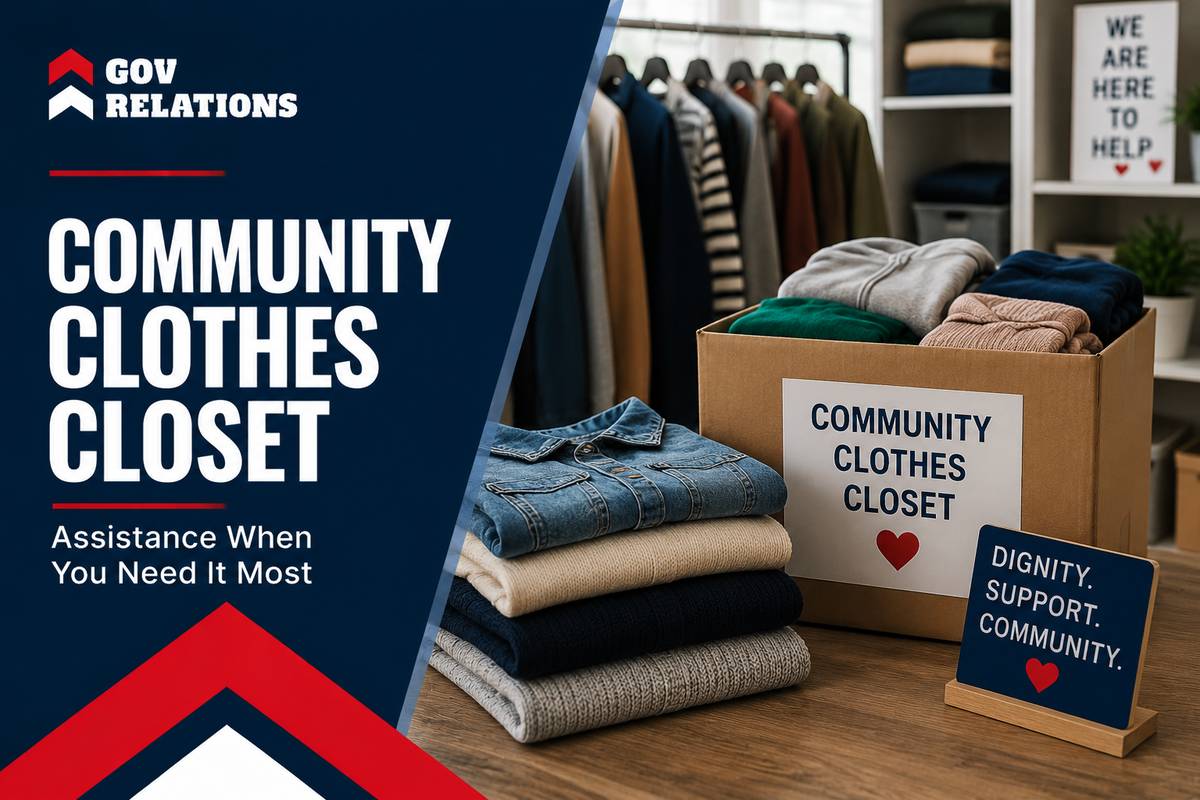
A community clothes closet is a nonprofit program that gives free clothing to people who need it, and you get clothing assistance from one by finding a local closet, confirming you meet its income or referral requirements, and visiting during open hours with a photo ID and proof of need. An estimated two out of every five children in the United States are clothing-insecure, according to Nonprofit Quarterly, and clothing is one of the few basic needs that federal food benefits will not cover.
This guide explains what a clothes closet is, who qualifies, exactly what to bring, and how to find one near you.
Key Takeaways
- Free clothing, no purchase needed: A community clothes closet gives away donated and sometimes new clothing at no cost to people who meet basic income or referral requirements.
- Food benefits skip clothing: SNAP and WIC cannot be used to buy clothes, which is a core reason an estimated 2 in 5 US children are clothing insecure.
- Income proof or a referral qualifies you: Most closets ask for a photo ID plus proof of income or a referral from a food pantry, school, or shelter.
- 211 and FindHelp locate closets fast: Dialing 2-1-1 or searching FindHelp.org by ZIP code returns local clothing closets, vouchers, and giveaway events.
- National groups fill specific gaps: Dress for Success, Career Gear, and Cradles to Crayons supply interview attire and children's essentials beyond everyday wear.
- Scam sites target clothing searches: No legitimate clothes closet charges an application fee or asks for card numbers to release free clothing.
What Is a Community Clothes Closet?
A community clothes closet is a nonprofit or faith-based program that collects donated clothing and gives it away free of charge to individuals and families who need it. Some closets run like a small store where you browse and pick your own sizes. Others hand out pre-packed bundles based on the ages and clothing needs you list when you sign up.
Clothing insecurity is the lack of clean, properly fitting, and season-appropriate clothing. It is a hidden form of poverty that sits alongside food and housing insecurity, and demand is rising. Requests for clothing at one regional clothing bank grew 25% from 2024 to 2025 and 88% over three years, according to The Sharing Shelf.
Part of the reason the gap stays hidden is that public benefits rarely reach clothing. SNAP (Supplemental Nutrition Assistance Program) and WIC (Women, Infants, and Children) both cover food, not clothes, and only a handful of states offer any clothing allowance at all, according to Note in the Pocket. That leaves a clothes closet, a clothing voucher, or a charity giveaway as the main ways a family gets clothing help.
Who Qualifies for Clothing Assistance?
You qualify for most community clothes closets if your household income falls at or below a set limit, often 200% of the federal poverty guidelines, or if you already receive a government benefit. Many closets accept a referral from a partner agency in place of income paperwork, which makes qualifying simpler than most people expect.
You may qualify if any of the following describe your situation:
- Your household income is at or below the closet's limit (commonly 200% of the federal poverty line).
- You are enrolled in a benefit such as MedicaidA joint federal and state program that helps with medical costs for some people with limited income ..., SNAP, WIC, or SSI (Supplemental Security Income).
- A partner organization refers you (a food pantry, school, shelter, or caseworker).
- Your children receive free or reduced-price school lunch.
- You are unemployed, job searching, a veteran, or a domestic-violence survivor (for some specialized closets).
Rules change from one closet to the next, so confirm the specific requirement before you go. Some closets serve anyone who walks in, with no income check at all. Others draw a strict service-area boundary and only help residents of a single county or city.
What Documents Should You Bring to a Clothes Closet?
Bring a photo ID for yourself, proof of income or benefit enrollment, and identification for any children you are collecting clothing for. Having these ready in advance is often the difference between shopping the same day and being asked to come back.
Prepare these items before your visit:
- Photo ID: a driver's license, state ID, or passport for the adult applying.
- Proof of income: recent pay stubs, a benefits award letterAn official notification from the grantor indicating that the grant has been approved and outlining ..., or a tax return.
- Proof of benefit enrollment: your Medicaid, SNAP, WIC, or SSI card or letter, if you receive one.
- IDs for your children: birth certificates or school IDs, plus their current clothing and shoe sizes.
- A referral, if required: a note or form from the agency that sent you.
How to Get Clothing Assistance Step by Step
Getting clothing assistance follows the same path almost everywhere: find a closet, confirm you qualify, gather your documents, get a referral if one is required, and then visit during open hours. Here is the full process from start to finish.
- Locate a nearby clothes closet using 211 or FindHelp.org (both explained below).
- Call ahead to confirm hours, the service area, and whether a referral is required.
- Check the eligibility rules and confirm you meet the income or benefit requirement.
- If a referral is required, contact a partner agency (a food pantry, school social worker, or shelter) and ask them to send one.
- Gather your documents: photo ID, proof of income or benefit enrollment, and IDs for your children.
- Visit during open hours. Many closets issue an ID card (sometimes called a "blue card") on your first visit that sets how often you can return.
- Ask about visit limits and related help. Many closets also run food pantries, coat drives, and school-uniform programs.
Which Clothing Assistance Option Fits Your Situation?
The right option depends on what you need and how fast you need it. A clothes closet works best for everyday and seasonal wear, a voucher lets you choose new items at a store, national nonprofits specialize in interview or children's clothing, and local giveaways offer fast help with little paperwork. The table below compares all four.
| Option | Best For | How It Works | What You Typically Need |
|---|---|---|---|
| Community clothes closet | Everyday and seasonal clothing for the whole family | Shop in person for your sizes or receive a pre-packed bundle | Photo ID plus income proof or a referral |
| Clothing voucher | Choosing new items yourself | Redeem a voucher or gift card at a designated partner store | A referral and proof of need |
| National nonprofit | Job-interview attire or children's essentials | Caseworker referral, then a styled appointment or a mailed package | An agency referral |
| Local or online giveaway | Fast, low-paperwork help | First-come, first-served events or buy-nothing community groups | Usually nothing |
National Organizations That Provide Free Clothing
Beyond your local closet, several national organizations run scalable clothing programs, most reached through a caseworker or partner-agency referral. Dress for Success and Career Gear focus on work attire, Cradles to Crayons and Operation School Bell focus on children, and large charities like the Salvation Army and St. Vincent de Paul cover general everyday needs.
| Organization | Who They Serve | What They Provide | How to Access |
|---|---|---|---|
| Dress for Success | Women entering or returning to work | Professional interview and work attire, plus career support | Referral from a partner agency, then an appointment |
| Career Gear | Men who are low-income or job seeking | Interview clothing and job-readiness coaching | Referral from a partner agency |
| Cradles to Crayons | Children in low-income families | Clothing, shoes, diapers, and school supplies | Through a network of social-service partners |
| Operation School Bell | Students who need school clothing | New school clothes to support attendance | School referral through the Assistance League |
| Salvation Army | Individuals and families in need | Everyday clothing, coats, and household goods | Visit a local center; some ask for ID and proof of need |
| St. Vincent de Paul | All ages and genders | Free clothing closets and thrift stores, plus other aid | Visit a local conference or store |
How to Find a Community Clothes Closet Near You
Two free tools locate clothing closets faster than a general web search: the 211 helpline and FindHelp.org. Both are confidential, cost nothing, and list local programs by category and ZIP code, so you skip the guesswork of calling around.
211: Dial 2-1-1 from any phone or visit 211.org. A trained specialist connects you to local clothing closets, food pantries, and financial help. The service runs in most US communities and answers in multiple languages.
FindHelp.org: Enter your ZIP code at FindHelp.org and filter for clothing. The platform lists thousands of programs with hours, contact details, and eligibility notes, which lets you confirm a closet fits before you travel to it.
You can also call your county or city social services office, ask a school social worker, or check nearby churches.
Why Clothing Access Changes Real Outcomes
Access to appropriate clothing shapes confidence, school attendance, and job prospects, which is why clothing assistance does more than meet a physical need. The link between what people wear and how they perform has a name in psychology, and the research behind it is well established.
Psychologists call this effect "enclothed cognition," the systematic influence clothes have on the wearer's mindset, described in a 2012 study in the Journal of Experimental Social Psychology. Adam Galinsky, a professor and co-author of that study, put it plainly: clothing “affects how other people perceive us, as well as how we think about ourselves."
The stakes are highest for children. Kids without appropriate clothing are more likely to miss school, driven by embarrassment, bullying, or simply not owning a winter coat. A survey of more than 100 caseworkers by The Sharing Shelf found that clothing insecurity contributed to low self-esteem in 84% of affected students, bullying in 55%, and skipping school in 37%. A clean, well-fitting outfit is a small thing that removes a large barrier.
How to Avoid Clothing Assistance Scams
Before you share any personal details, learn how to tell a real clothing program from a fraudulent one. People searching for free clothing are a frequent target for scam sites, and a few simple checks protect you.
- Real clothes closets are free to use. Any site or person charging an "application fee" for free clothing is not legitimate.
- No program needs your card number. A request for a credit card or bank account to release free clothing is a scam.
- Be wary of "free clothing grants." Offers that promise cash grants for clothing in exchange for personal data upfront are a common fraud.
- Verify before you share. Confirm any program through 211 or FindHelp.org before giving out your Social Security number or bank details.
If you receive an unsolicited clothing offer that asks for money or sensitive information, do not respond and do not click any links. Report it to the Federal Trade Commission (FTC) at ReportFraud.ftc.gov.
Find Clothing Help Near You Today
A community clothes closet gives you a direct, no-cost way to clothe yourself and your family, and getting help comes down to five moves: find a closet, confirm you qualify, gather your documents, get a referral if one is required, and visit during open hours. As of 2026, demand for clothing assistance keeps climbing, so acting sooner gives you the widest choice of sizes and seasonal items.
Your next step is simple: dial 2-1-1 or search FindHelp.org to find a clothes closet near you, then use the document checklist above to prepare for your visit. For more options to free clothing, explore our guide to where you can find a clothes pantry near you.
Frequently Asked Questions
How often can you visit a community clothes closet?
Visit limits vary by closet. Many allow one shopping trip per month or a set number of visits per year, tracked with an ID card issued on your first visit. A few allow more frequent visits for growing children or during seasonal changes. Ask about the limit when you sign up.
Can you get clothing assistance without a referral?
Yes. Many clothes closets serve anyone who meets an income limit, and some serve anyone who walks in with no income check. Referral-based closets are common, but they are not the only kind. Use 211 or FindHelp.org to find a walk-in closet near you if you cannot get a referral quickly.
Does SNAP or WIC cover clothing?
No. SNAP and WIC both cover food only and cannot be used to buy clothing. Only a small number of states offer any clothing allowance through other programs. This gap is exactly why community clothes closets, vouchers, and charity giveaways exist to fill the need.
What should you do if you do not qualify for a clothes closet?
Try a different closet with looser rules, a walk-in giveaway event, or a thrift-store voucher program. Buy-nothing groups and local swap events rarely check income at all.
Are community clothes closets only for homeless people?
No. Clothes closets serve a wide range of people, including working families, single parents, seniors on fixed incomes, veterans, and anyone facing a temporary financial setback. You do not need to be homeless to qualify. Meeting the income limit or holding a referral is usually enough.