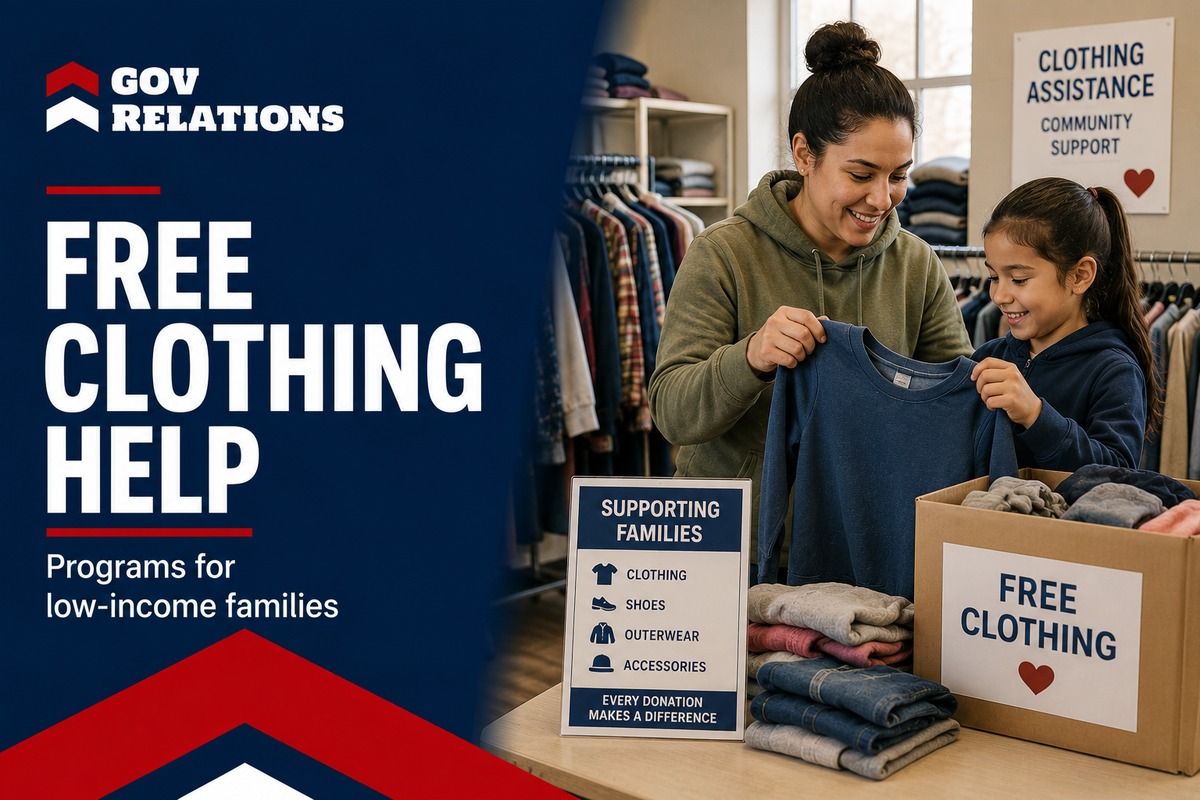
Free clothes programs for low-income families come from three main sources: state Temporary Assistance for Needy Families (TANF)A federal assistance program that provides temporary financial assistance to low-income families wit... clothing allowances, national nonprofits like Cradles to Crayons and Dress for Success, and local church clothing closets that you can find through the 211 helpline. According to Cradles to Crayons, two in five children in the United States face clothing insecurity, meaning they lack adequate, appropriate, or affordable clothing for school, work, or daily activities.
This guide shows you which programs you may qualify for, what documents you will need, exactly how to apply, and how to spot scam offers that target people searching for clothing assistance.
Key Takeaways
- No federal clothing program exists: Unlike SNAP or WIC, no single federal program pays for clothing, so help comes from state TANF, nonprofits, and local charities.
- TANF can cover clothing costs: Some states allocate part of their TANF cash assistance specifically for clothing, including West Virginia's $200 per-child School Clothing Allowance.
- 211 is the fastest way to find local help: Calling 211 or visiting 211.org connects you to clothing closets and voucher programs by ZIP code in under five minutes.
- Income limits usually fall under 200% FPL: Most free clothes programs for low-income families set eligibility between 100% and 200% of the 2026 Federal Poverty Level.
- Free clothing is always free to apply for: Any organization charging a fee to access free clothing assistance is a scam and should be reported to ReportFraud.FTC.gov.
Why Federal Programs Do Not Cover Clothing
Federal safety net programs cover food, housing, energy, and medical care, but not clothing. This is one of the most surprising things people learn when they first apply for assistance. SNAP (Supplemental Nutrition Assistance Program) benefits cannot be spent on clothes. WIC (Women, Infants, and Children) vouchers cannot be spent on clothes either. The two largest food-related federal programs both leave clothing out entirely.
Lynn Margherio, Founder and CEO of Cradles to Crayons, has spoken publicly about this gap. As she told Nonprofit Quarterly in 2025, "There really are no federal programs that support diapers. You cannot use SNAP, you can't use WIC to pay for diapers or clothing, and there are only a small handful of states that have financial allowances for clothing, and those allowances tend to be very minimal."
This means the money for clothing assistance comes mostly from state-administered TANF funds, nonprofit organizationsEntities that use surplus revenues to achieve their goals rather than distributing them as profit or..., and local faith-based groups. Knowing where to look in this patchwork system is the first step to claiming the help that is available.
What Clothing Assistance Is Available Through TANF?
TANF is a federally funded, state-run cash assistance program. Some states allocate part of that cash to clothing specifically. Eligibility is set by each state, but the federal program serves families with children under 19 who fall below certain income thresholds.
You may qualify for TANF if:
- You have a child under 19 in your household, or you are pregnant.
- Your household income is below your state's TANF eligibility limit.
- You are a U.S. citizen or qualified non-citizen.
- You meet your state's work participation rules, with exceptions for caregivers, parents of infants, and people with disabilities.
A few states run dedicated clothing assistance programs through TANF or state funds:
- West Virginia offers a School Clothing Allowance of $200 per eligible child each year, paid directly to families during back-to-school season.
- Oregon has historically distributed clothing payments three times a year (May, August, and November) through its Department of Human Services.
- North Dakota ties winter clothing giveaways to its Low Income Home Energy Assistance Program (LIHEAP) enrollment, recognizing that winter clothing and heating costs are connected.
To apply for TANF in your state, visit the Administration for Children and Families TANF page, which lists every state's TANF office with direct links to applications. You can also apply through USA.gov's welfare benefits portal.
How Do the Major National Clothing Nonprofits Compare?
National nonprofits fill the gap that federal programs leave. Each one has its own focus, eligibility rules, and application process. Here is how the most active national programs compare in 2026.
| Organization | Who It Serves | What You Receive | How to Apply |
|---|---|---|---|
| Cradles to Crayons | Children birth through age 12 in low-income or homeless situations | KidPacks with seasonally appropriate clothing, shoes, and school supplies | Through partner agencies or Giving Factory Direct online |
| Dress for Success | Women entering or re-entering the workforce | Complete interview outfit, professional career attire, career coaching | Referral through a partner agency |
| Career Gear | Low-income men entering the workforce | Interview outfit, professional attire, financial literacy support | Referral through a partner agency in cities served |
| The Salvation Army | Individuals and families in financial need | Clothing vouchers redeemable at Salvation Army thrift stores | Apply at your local Salvation Army Corps office |
| Goodwill | Individuals in crisis or emergency situations | Emergency clothing voucher (varies by location and household size) | Through partner social service agency referral |
| Baby2Baby | Children living in poverty, ages 0 to 12 | Diapers, baby clothing, hygiene products | Through partner schools, hospitals, shelters, and agencies |
Cradles to Crayons is the largest of these by reach. Since 2002, the organization has supplied nearly six million packages of clothing, shoes, diapers, and school supplies to children in need. Its Giving Factory Direct platform now serves families nationwide, matching donors directly with children who need specific items. Just $33 covers a single child head to toe through the program.
Where to Find Faith-Based and Local Clothing Closets
Local faith-based organizationsReligious groups that provide funding for charitable projects, community services, and humanitarian ... are often the fastest way to get free clothes when you need them this week. They do not have long waitlists, they rarely require extensive paperwork, and most do not require you to share their religious beliefs. Services are typically available to people of all faiths and backgrounds.
- Catholic Charities runs clothing assistance through more than 160 local agencies nationwide. Many locations operate clothing closets or give vouchers redeemable at Catholic Charities thrift stores.
- The Salvation Army distributes clothing vouchers through more than 7,500 service locations. Vouchers are usually limited to one issuance every four to six months per household.
- St. Vincent de Paul Society operates thousands of local conferences that provide free clothing through home visits and parish-based programs.
- Jewish Family Services (JFS) operates in major cities including Philadelphia, San Diego, Atlanta, and Los Angeles. Their basic needs programs typically combine free clothing with food assistance.
- Local ministries such as MUST Ministries run dedicated job interview clothing programs, providing professional attire for people preparing for employment.
Professional Clothing Programs for Adults Seeking Work
Adults preparing for job interviews or returning to work need different clothing than children. Two organizations focus specifically on this need, and both serve people across the United States.
Dress for Success is a global nonprofit with more than 130 offices in 15 countries that has served over 1.3 million women. Eligible women receive a complete interview outfit at their first appointment, plus access to additional career attire once they are hired. The organization also offers career coaching and job retention support. Find your nearest office at dressforsuccess.org.
Career Gear serves low-income men with the same model: free interview outfits, professional attire for new jobs, and additional support like financial literacy classes and interview preparation.
Both organizations require a referral from a partner agency. This usually means a workforce development office, a homeless shelter, a community college career center, or a social services case manager has to send you. Walk-in service is rare. Call ahead before visiting any location.
How to Apply for Free Clothing Assistance Step by Step
Most free clothing programs follow a similar application path. Follow these steps in order to maximize your chance of getting help quickly.
- Call 211 or visit 211.org. This free service connects you to local clothing closets, voucher programs, and emergency assistance based on your ZIP code. The call is confidential and available 24 hours a day in most areas.
- Make a list of what you need. Be specific: clothing for which family members, what sizes, and which seasons. Some programs serve only children, some only women, some only adults preparing for work. Knowing what you need helps you skip programs that do not apply to you.
- Check eligibility before you call each program. Most programs publish their income limits on their websites. Compare your income to the 2026 Federal Poverty Level published by HHS: $15,960 per year for one person and $33,000 for a family of four in the 48 contiguous states.
- Gather your documents. Most clothing assistance programs ask for proof of identity, proof of income, and proof of residency. Bring originals or clear photocopies.
- Schedule an appointment. Many clothing closets operate by appointment only. Walk-in service is becoming less common since 2020, when many nonprofits restructured their distribution model.
- Attend your appointment with all documents. Bring your documents, a list of needed items with sizes, and a way to carry clothing home.
- Ask about follow-up appointments. Most programs allow repeat visits at set intervals, usually every three to six months. Knowing this in advance lets you plan for the year ahead.
What Documents You Will Need
Free clothing programs require less paperwork than federal benefit programs, but they still need to verify your eligibility. Most ask for:
- A valid photo ID for the head of household (state ID, driver's license, or passport).
- Proof of income from the last 30 days. Recent pay stubs, an unemployment award letterAn official notification from the grantor indicating that the grant has been approved and outlining ..., an SSI or SSDI awardA general term for funds provided to an individual or organization to support a specific purpose or ... letter, or a Social Security benefit statement.
- Proof of residency. A utility bill, lease agreement, or piece of government mail with your current address.
- Documentation for each household member. Birth certificates for children, school enrollment letters, or custody papers, when applicable.
- Referral letter, if required. Dress for Success, Career Gear, and some Cradles to Crayons partner programs require a referral from a social service agency, school, or workforce center.
If you already receive MedicaidA joint federal and state program that helps with medical costs for some people with limited income ..., SNAP, SSI, or TANF, your enrollment letter for that program often substitutes for proof of income. Always ask the clothing program if they accept this as a shortcut. It can save you a trip back home for additional paperwork.
Key Eligibility Terms Defined
These terms come up repeatedly in clothing assistance applications. Knowing them in advance helps you fill out forms faster and avoid mistakes.
- Federal Poverty Level (FPL): The income threshold the federal government uses to determine eligibility for assistance programs. For 2026, $15,960 for one person and $33,000 for a family of four, as published by HHS.
- TANF (Temporary Assistance for Needy Families): A federally funded, state-run cash assistance program for low-income families with children.
- SNAP (Supplemental Nutrition Assistance Program): Food stamp benefits. Often accepted as income verificationDocumentation proving the income levels of the beneficiaries, often required for grants targeting lo... for clothing programs, even though SNAP itself cannot pay for clothing.
- WIC (Women, Infants, and Children): A nutrition program for pregnant women, new mothers, and young children. Also accepted as income verificationThe process of confirming the accuracy and authenticity of project activities, data, and reports. by many clothing programs.
- SSI (Supplemental Security Income): A monthly benefit for people with disabilities or seniors with limited income, administered by the Social Security Administration.
- Clothing Voucher: A paper or electronic certificate redeemable for free clothing at a specific store or thrift shop.
- Clothing Closet: A physical location where free clothing is distributed directly. Sometimes called a clothing bank or clothing pantry.
Scam Warning: How to Spot Fake Clothing Assistance Offers
Scammers target people searching for free clothing assistance. Before you respond to any offer, here is how to tell the difference between a real free clothing program and a fraudulent one.
- Real clothing programs never charge an application fee. Any website or person asking you to pay to apply for free clothing assistance is running a scam.
- No legitimate program requires your credit card or bank account number for free clothes. If a clothing offer asks for payment details, leave the site or hang up the phone.
- Government clothing assistance comes through your state TANF office, not private companies. Any business claiming to "process your government clothing application" for a fee is not a real government service.
- The government will never contact you by text or email to offer you free clothing. Unsolicited offers of free clothes, especially ones requiring you to click a link or share personal information, are almost always phishing attempts.
- Real nonprofits do not pressure you to act immediately. If a clothing offer says you must accept within minutes or hours, it is a scam.
If you received a suspicious clothing assistance offer, do not respond and do not click any links in the message. Report it to the Federal Trade Commission at ReportFraud.FTC.gov. Reports help the FTC track scam patterns and warn other families before they fall for the same offer.
Take Action on Clothing Assistance in 2026
Clothing assistance for low‑income families in the U.S. isn’t centralized in one federal program. Instead, help comes from a combination of:
- State‑level TANF clothing allowances or short‑term supports in some states.
- National and community nonprofits offering free clothing or professional attire.
- Local charities, church clothing closets, and voucher programs can be found through 211.org or by calling 211.
Because eligibility and availability vary so much by area and circumstance, your next step should be to tap into local resources fast. Start by calling 211 with your ZIP code and needs list, and keep documentation ready to speed up your appointments.
Interested in getting broader financial assistance for your family too?
Explore our comprehensive guide to other essential government programs, including housing, single mom government assistance, food, childcare, and healthcare, that can free up your budgetA detailed financial plan outlining the projected costs of the project, including personnel, equipme... for clothing and more:
Frequently Asked Questions
Can I get free clothes if I do not qualify for TANF?
Yes. Many nonprofit and faith-based clothing programs use their own income limits, which are often higher than TANF thresholds. Cradles to Crayons, the Salvation Army, Catholic Charities, and most local clothing closets do not require TANF enrollment. Call 211 or visit 211.org to find programs that accept your specific income level.
How often can I get free clothes from the same program?
Most local clothing closets and Salvation Army voucher programs allow you to apply every four to six months. Cradles to Crayons partner agencies typically serve children annually for back-to-school clothing and seasonally for winter coats. Always ask about repeat visit policies when you first apply so you can plan for the year.
Do free clothing programs help undocumented immigrants?
Most nonprofit and faith-based clothing programs do not have citizenship requirements. Catholic Charities, the Salvation Army, Cradles to Crayons, and most local clothing closets serve everyone regardless of immigration status. Accessing nonprofit clothing assistance does not affect your immigration status or public charge determinations. State-run TANF clothing allowances, however, do require U.S. citizenship or qualified non-citizen status.
What if I need clothing for a job interview specifically?
Dress for Success serves women and Career Gear serves men with free professional attire for job interviews. Both require a referral from a workforce development office, community college career center, social service agency, or homeless shelter. If you do not have a referral, ask any social worker or career counselor you are already working with to send one on your behalf.
Can I get free baby clothes and diapers?
Yes. Baby2Baby and Cradles to Crayons both run dedicated programs for infants and toddlers, including diapers, baby clothing, and hygiene supplies. Both programs distribute through partner agencies, usually pediatric clinics, WIC offices, shelters, and home visiting programs. Local diaper banks listed by the National Diaper Bank Network also distribute through partner agencies. For more programs that help children specifically, see our guide on free kids clothes.
Are clothing donations the same as clothing vouchers?
No. A clothing donation refers to items given to a nonprofit for redistribution. A clothing voucher is a certificate you receive to redeem for free clothes at a specific store or thrift shop. Most Salvation Army and Goodwill programs use the voucher model, while Cradles to Crayons and church clothing closets distribute clothing items directly to families.