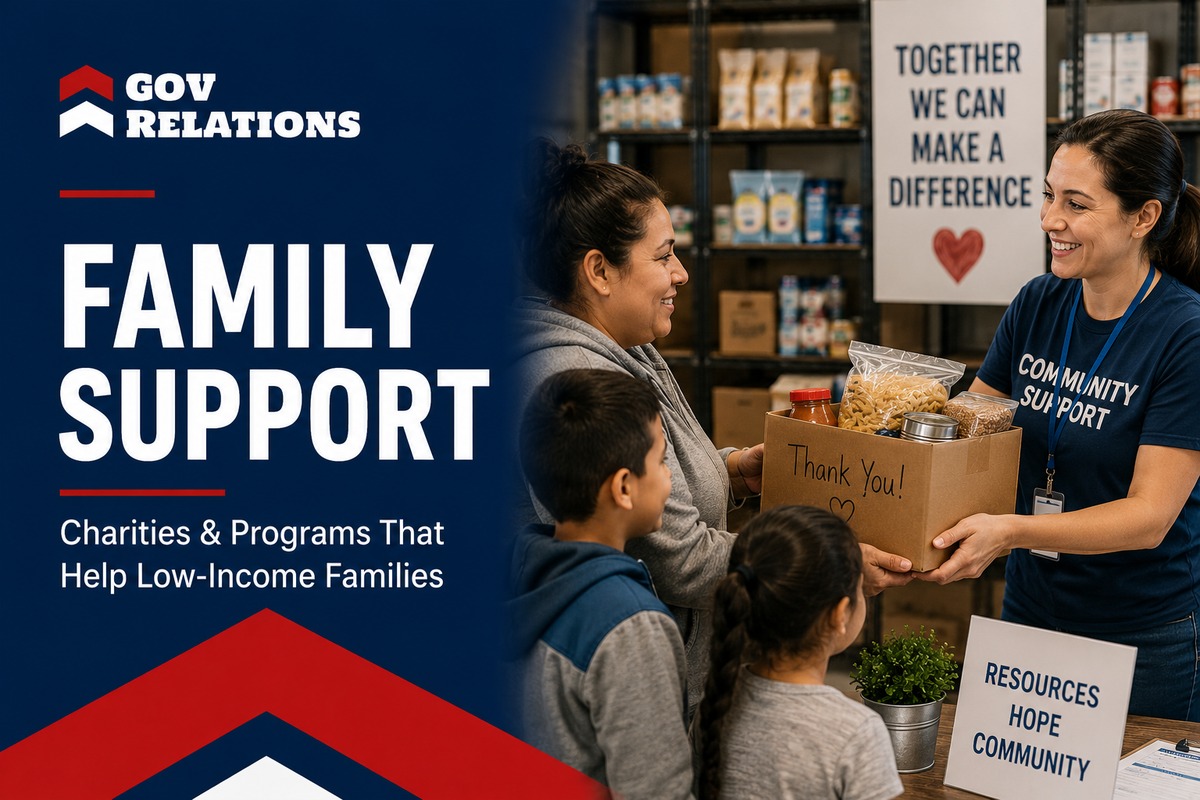
Several trusted charities help low-income families across the United States with food, housing, healthcare, and emergency financial assistance. According to the U.S. Census Bureau, 35.9 million Americans currently live in poverty, and 14% of them are children under 18. If you or someone you know needs help, this guide covers the top-rated organizations by service category, explains what each one provides, and tells you exactly how to reach them.
Beyond charitable organizations, millions of qualifying Americans also have access to government programs they never apply for. Our complete guide to government financial assistance programs explains what programs exist, whether you qualify, and the exact steps to apply.
Key Takeaways
- Feeding America is the largest food charity in the U.S.: It distributes 5.7 billion meals annually through a network of 200 food banks and 60,000 local pantries.
- Habitat for Humanity focuses on affordable housing: The organization has helped more than 65 million people globally build or improve their homes.
- Free medical care is available through a national clinic network: The NAFC's 1,400+ clinics serve 1.7 million patients each year at no charge.
- Multiple charities can be used at the same time: Housing, food, healthcare, and financial assistance programs operate independently and can be combined.
- Independent watchdog groups rate charity quality: Charity Navigator, CharityWatch, and the BBB Wise Giving Alliance publish public ratings you can check before you apply or donate.
- 211 connects you to local help instantly: Dialing 2-1-1 or visiting 211.org links you to nearby food, housing, and emergency financial assistance in your area.
How Many Families Need Charitable Assistance in the United States?
The scale of financial hardship in the United States is larger than most people realize. The Urban Institute reports that 49 percent of people in American families lack the resources to cover essential living expenses. That means nearly half of all families are one unexpected bill away from a financial crisis.
The burden falls heaviest on children. According to the Annie E. Casey Foundation, 16 percent of all children in the United States live below the poverty line. That is 11.4 million kids who depend on programs like the ones listed in this guide.
Food insecurity is another major issue. In 2024, about 13.7 % of U.S. households (nearly 48 million people) experienced food insecurity at some time during the year, with households below the federal poverty line more likely to struggle to afford enough food. These numbers make clear that charitable organizations are not a luxury resource. For tens of millions of Americans, they are the only safety net available.
How to Evaluate a Charity Before You Apply or Donate
Not every organization that calls itself a charity operates with integrity. Before reaching out to any organization on this list, it helps to understand how charity watchdog groups rate and evaluate nonprofits.
| Rating Organization | What They Evaluate | Top Standard |
|---|---|---|
| Charity Navigator | Impact, accountability, finances, leadership, and culture using their Encompass Rating System | 3-star rating |
| CharityWatch | Financial efficiency: how much of each dollar reaches the program vs. overhead | A or A+ grade; 75%+ spent on programs |
| Candid (GuideStar) | Financial transparencyProviding clear and accessible information about financial transactions and status to stakeholders a... and accessibility of organizational information | Platinum Seal of Transparency |
| BBB Wise Giving Alliance | 20 accountability standards covering governance, finances, and transparency | Meets all 20 standards |
CharityWatch states that top-rated charities generally spend 75 percent or more of their budgets on programs and spend $25 or less to raise $100 in public donations. When a charity spends more than that on fundraising, most of your donation or support goes toward marketing instead of services.
A quick check on any of these watchdog sites before contacting an organization gives you confidence that the help is real and the organization is trustworthy.
Scam Warning: Fake Charity Offers Target Families in Need
Real charities do not charge fees to receive assistance. The official application is always free.
No legitimate charity will contact you unsolicited by phone or text offering cash benefits.
If you receive a suspicious offer, report it to the FTC at ReportFraud.ftc.gov
Top Charities for Housing and Homelessness Prevention
Housing instability is one of the most urgent forms of hardship for low-income families. Rising rents and flat wages push families into eviction and homelessness faster than government assistance programs can respond. The following organizations work to fill that gap.
Habitat for Humanity
Habitat for Humanity was founded in 1976 and now works in all 50 U.S. states and approximately 70 countries worldwide. Their model is built on partnership: families in need of affordable housing work alongside volunteers to help build their own home. This approach, called sweat equity, reduces construction costs and gives families a stake in the outcome.
Since its founding, Habitat has helped more than 65 million people globally build or improve a place they call home. Learn more and find your local affiliate at habitat.org.
Family Promise
Family Promise is the leading national organization focused on family homelessness. They operate in more than 200 communities and offer a full range of services: prevention, emergency shelter, stabilization, and permanent housing support. They have served over one million family members since their founding more than 30 years ago.
Family Promise holds Charity Navigator's 3-star rating and Candid's Platinum Seal of Transparency. You can search for your local Family Promise chapter at familypromise.org.
Other Highly Rated Housing Charities
- Coalition for the Homeless (CharityWatch Rating: A)
- Bowery Residents' Committee (CharityWatch Rating: B+)
- National Low Income Housing Coalition: advocacy and research for affordable housing policy
Top Charities for Food Assistance and Hunger Relief
Food insecurity affects millions of low-income families every week. The following organizations are the most established and highest-rated options for accessing food assistance across the United States.
Feeding America
Feeding America is the largest hunger-relief organization in the country. It operates a network of 200 food banks and 60,000 food pantries and meal programs. Each year, the organization reaches approximately 40 million people and distributes 5.7 billion meals. Find your nearest food bank at feedingamerica.org.
Feeding America holds an A- rating from CharityWatch and strong marks from Charity Navigator, meaning the large majority of donations go directly toward food distribution rather than administration.
Other Top-Rated Food Charities
- Action Against Hunger-USA (CharityWatch Rating: A): focuses on child malnutrition and emergency food response
- Feed My Starving Children (CharityWatch Rating: A): packages nutritious meals for children in the U.S. and globally
- Food Bank For New York City (CharityWatch Rating: A-): the largest food bank system in New York City
Top Charities for Healthcare and Medical Assistance
Access to healthcare is a critical need for low-income families. According to KFF, more than 80 percent of uninsured individuals in the United States live in low-income families. The organizations below provide free or low-cost medical care to uninsured and underinsured patients.
National Association of Free and Charitable Clinics (NAFC)
The NAFC supports a network of more than 1,400 free and charitable clinics and pharmacies across the country. These clinics provide medical, dental, pharmacy, vision, and behavioral health services at no charge or for a small nominal fee to patients who cannot afford traditional care.
The NAFC network serves 1.7 million patients through 6 million patient visits per year, supported by over 189,000 volunteers. To find a free clinic near you by ZIP code, visit nafcclinics.org.
The Salvation Army
The Salvation Army is known for broad emergency social services, but it also operates 172 health facilities worldwide. Their services include medical care, rehabilitation, and addiction recovery support for low-income individuals and families. In the United States, The Salvation Army provides health services alongside its emergency financial assistance, food pantry, and shelter programs.
Top Charities Providing Comprehensive Assistance
Some families need help across multiple categories at once: food, financial assistance, clothing, and job training together. The following organizations take a whole-family approach.
World Vision
World Vision holds a perfect 100 out of 100 score on Charity Navigator. Their domestic programs serve 1.7 million adults and children annually in the United States, providing food, personal hygiene products, clothing, and school supplies. They also offer financial education classes to help families build long-term stability.
Society of St. Vincent de Paul
Founded in 1833, the Society of St. Vincent de Paul operates in 150 countries and provides direct assistance to people in need regardless of religion or background. Services include food pantries, rent and utility assistance, clothing, and job training through their Back 2 Work program. In 2020 alone, they completed over 1.5 million home visits to people in need across the United States.
How to Access Charitable Assistance for Your Family
If you need help right now, these are the fastest ways to connect with assistance:
- Dial 2-1-1 or visit 211.org: The 211 network connects you instantly to local charities, food programs, housing support, and emergency financial assistance in your area. This is the fastest starting point for most families.
- Use the government benefits finder: The USA.gov benefits portal helps you determine eligibility for SNAP, MedicaidA joint federal and state program that helps with medical costs for some people with limited income ..., TANF, and LIHEAP. Many families qualify for government programs alongside charitable assistance.
- Search for a free clinic: The NAFC website at nafcclinics.org has a ZIP code search tool that shows every free and charitable clinic in your area.
- Contact your local Feeding America food bank: Visit feedingamerica.org and use the food bank locator to find the nearest distribution site with hours and requirements.
- Reach out to a local Community Action Agency: These federally funded agencies provide emergency rent and utility assistance, weatherization programs, and job training. Search online for 'community action agency' plus your city name to find your local office.
Many families qualify for both charitable assistance and government benefits and never claim both.
Charities That Help Low-Income Families: A Side-by-Side Comparison
| Organization | Primary Service | People Served | Charity Rating |
|---|---|---|---|
| Feeding America | Food distribution | 40 million | A- (CharityWatch) |
| Habitat for Humanity | Affordable housing | 59 million globally (since 1976) | High (Charity Navigator) |
| Family Promise | Family homelessness | 1M+ served (lifetime) | 4 stars (Charity Navigator) |
| NAFC Clinics | Free healthcare | 1.7 million patients | N/A (network of 1,400+ clinics) |
| World Vision (US) | Comprehensive aid | 1.7 million (domestic) | 100/100 (Charity Navigator) |
| Society of St. Vincent de Paul | Multi-service aid | 1.5M+ visits (2020 US) | Highly rated |
Frequently Asked Questions
Can I receive help from a charity and a government program at the same time?
Yes. Charitable assistance and government benefit programs operate independently. Qualifying for SNAP or Medicaid does not disqualify you from receiving food from a local food pantry, housing support from a nonprofit, or free care from a charitable clinic. Many families use both simultaneously without any conflict between programs.
Do charities charge fees to receive assistance?
No. Legitimate charities provide their services at no cost to the people they serve. If any organization charges a fee to access assistance, that is a warning sign of fraud. All programs listed in this guide are free for eligible recipients. Report any organization charging fees to the FTC at ReportFraud.ftc.gov.
How do I find charity assistance near me?
The fastest method is to dial 2-1-1 or visit 211.org. This free service connects you to local food pantries, emergency shelters, financial assistance, and healthcare resources in your ZIP code. You can also use the Feeding America food bank locator and the NAFC clinic search tool for food and medical help, specifically.
What is the difference between a charity and a government assistance program?
A charity is a private nonprofit organization funded by donations and volunteers. A government assistance program is funded by federal or state tax dollars and administered by a government agency. Both types of programs provide real help to low-income families, and both are free to apply for. The main difference is that government programs have formal eligibility rules based on income and household size, while many charities serve anyone who walks through the door.
Which charity helps with emergency rent or utility bills?
The Society of St. Vincent de Paul provides direct rent and utility assistance in many communities. The Salvation Army also offers emergency financial assistance, including help with utility bills. For government-funded emergency assistance, LIHEAP (Low Income Home Energy Assistance Program) helps with heating and cooling costs, and many states have emergency rental assistance programs. The 211 network can direct you to whatever is available in your area today.
Your Next Step: Find Help Today
Millions of low-income families in the United States receive charitable and government assistance every year. The organizations listed in this guide are among the most trusted and highest-rated resources available. Each one provides real services, has been independently evaluated, and is free to access.
If you are not sure where to start, dial 2-1-1 or visit 211.org to find local programs right now. If you want to explore every government benefit program you may qualify for, use our complete guide to government financial assistance to identify programs by your situation.
Explore More Government Resources to Support Your Family
For a comprehensive overview of government programs you might qualify for, including eligibility and application steps, check out the in‑depth guide at https://gov‑relations.com/.