Free dental care for veterans is available in two ways: through the Department of Veterans Affairs (VA) for a limited set of eligibility classes, and through nonprofit, corporate, and state programs for the millions of veterans who do not qualify for VA coverage. Most veterans fall into the second group. Of the more than 9 million veterans eligible for VA medical care, roughly 3 out of 4 are ineligible for VA dental benefits, according to CareQuest Institute for Oral Health. The VA still provided dental care to nearly 888,000 veterans in fiscal year 2025, per the VA.
This guide shows you which programs exist, whether you qualify, and the exact steps to apply. If you want to compare grantA sum of money given by a government or other organization for a particular purpose, usually without... options now, start with our veterans dental grant programs hub.
Key Takeaways
- VA coverage is limited: Free VA dental care is tied to specific benefit classes based on service-connected conditions, POW status, or a 100% disability rating.
- Most veterans qualify elsewhere: About 3 out of 4 VA-medical-eligible veterans cannot get VA dental benefits and rely on nonprofit, corporate, or state programs.
- Recent discharge counts: Veterans who served 90 or more days can get a one-time course of free dental care if they apply within 180 days of separation.
- VADIP lowers costs: Veterans who do not qualify for free care can buy discounted dental insurance through Delta Dental or MetLife under VADIP.
- Nonprofits fill the gap: Everyone for Veterans, Dental Lifeline Network, and Aspen Dental provide free dental care for veterans who fail VA eligibility rules.
- Oral health is a real risk: Veterans are 60% more likely than nonveterans to have tooth decay, and 42% report gum disease, national research shows.
- Scams target this need: No legitimate veteran dental grant charges an application fee, and the real VA application always uses a .gov web address.
Who Qualifies for Free VA Dental Care?
You qualify for free VA dental care if the VA places you in a covered benefit class. Eligibility depends on your service history, disability rating, and current living situation, not your income. The VA sorts qualifying veterans into classes, and each class receives a defined level of dental care.
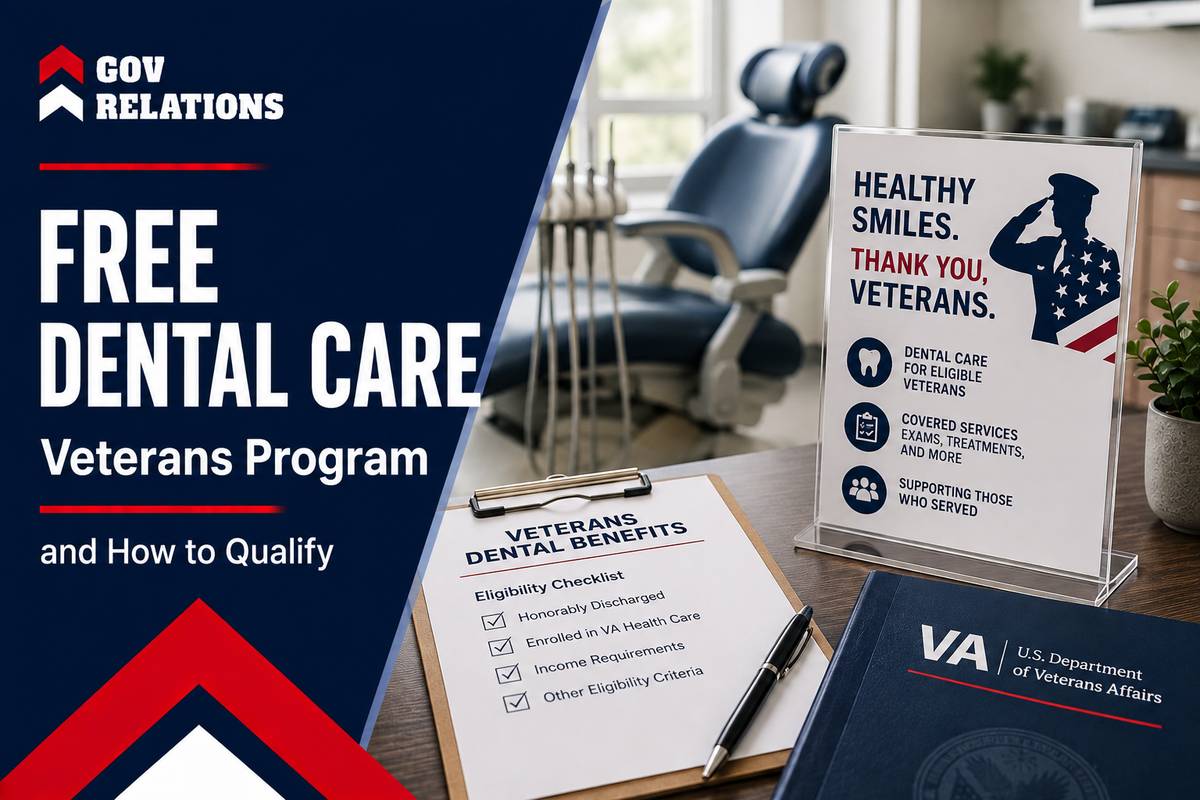
A service-connected dental condition is one that the VA links to your military service. If you have a service-connected compensable dental disability (Class I), were a prisoner of war (Class IIC), or have a 100% disabling service-connected rating (Class IV), you can receive any needed dental care. These are the broadest categories of free coverage. You can check your status with the VA dental care eligibility tool.
Other veterans receive narrower coverage. Recently discharged veterans who served 90 or more days on active duty can get a one-time course of dental care if they apply within 180 days of separation and their discharge paperwork does not show completed dental treatment. Veterans enrolled in the Homeless Veterans Dental Program (Class IIB) can receive a one-time course of care to relieve pain, treat gum disease, or support employment. Veterans in a Veteran Readiness and Employment program (Class V) may receive dental care needed to reach their employment goals.
If none of these classes fit your situation, you are not out of options. The VA Dental Insurance Program and a network of nonprofit, corporate, and state programs cover the majority of veterans who fall outside VA free-care rules. Those options are covered in the sections below.
VA Dental Eligibility Classes and What Each One Covers
The VA uses ten benefit categories to decide who gets free dental care and how much. The table below summarizes each class in plain language so you can find the one that matches your service and health situation before you apply.
| Eligibility Class | Who It Covers | Dental Care Provided |
|---|---|---|
| Class I | Veterans with a service-connected compensable dental disability | Any needed dental care |
| Class IIC | Former prisoners of war (POWs) | Any needed dental care |
| Class IV | Veterans rated 100% disabling, or unemployable and paid at the 100% rate for service-connected conditions | Any needed dental care |
| Class II | Veterans who served 90+ days, applied within 180 days of discharge, with no completed dental treatment shown on the DD214 | One-time course of dental care |
| Class IIA | Veterans with a noncompensable service-connected dental condition from combat wounds or service trauma | Care to restore a functioning set of teeth |
| Class III | Veterans whose dental condition is worsening a service-connected medical condition | Care to treat the oral condition affecting the service-connected health issue |
| Class V | Veterans in a Chapter 31 Veteran Readiness and Employment (VR&E) program | Dental care needed to reach employment goals |
| Class VI | Veterans receiving inpatient care where a dental issue complicates treatment | Care to address the dental issue hindering treatment |
| Class IIB | Veterans in the Homeless Veterans Dental Program | One-time course to relieve pain, aid employment, or treat gum disease |
| Inpatient | Veterans in VA hospital, nursing home, or domiciliary care | Dental services needed to manage a condition under treatment |
Source: VA dental care benefits. A VA dentist makes the final call on which services your class covers.
How to Apply for VA Dental Care Step by Step
To apply for VA dental care, confirm your eligibility class, enroll in VA health care, and then book an appointment at a VA dental clinic. You must be enrolled in VA health care before you can receive dental treatment. Follow these six steps in order.
- Confirm your eligibility using the VA dental benefits tool to see which class you fall into.
- Enroll in VA health care by completing VA Form 10-10EZ online. If you are already enrolled, you do not need to reapply.
- Gather your documents: your DD214 discharge certificate, your VA disability rating letter if you have one, and a photo ID.
- Contact your nearest VA dental clinic to schedule an appointment. You can call the VA at 1-877-222-8387 for help finding a clinic.
- Attend your exam. A VA dentist confirms which services your eligibility class covers and builds your treatment plan.
- If you are found ineligible, ask about the VA Dental Insurance Program or move to the nonprofit and state programs listed below.
VADIP: Discounted Dental Insurance If You Do Not Qualify
If you do not qualify for free VA dental care, the VA Dental Insurance Program (VADIP) lets you buy private dental insurance at a reduced cost. VADIP is a permanent VA program, not a temporary offer, and it is run through two carriers: Delta Dental and MetLife.
You are eligible for VADIP if you are enrolled in VA health care, or if you are a spouse or dependent child covered under the Civilian Health and Medical Program of the VA (CHAMPVA). Plans cover common procedures including exams, cleanings, fillings, extractions, root canals, crowns, and dentures. Premiums and copays vary by plan and carrier, so compare options before you enroll. You can review plan details on the VADIP page, and read our full breakdown of dental insurance options for veterans to weigh cost against coverage.
Free and Low-Cost Dental Programs for Veterans Beyond the VA
Nonprofit and corporate programs provide free or low-cost dental care to veterans who do not meet VA eligibility rules. These programs rely on volunteer dentists and donated services, so wait times and locations vary. The table below compares the largest national options.
| Program | Who It Helps | What You Get |
|---|---|---|
| Everyone for Veterans | Low-income veterans and their spouses with an honorable discharge and financial hardship | Free comprehensive dental care through volunteer dentists near you |
| Dental Lifeline Network (DDS) | Veterans who are 65+, permanently disabled, or medically fragile with no other way to pay | Free comprehensive treatment through Donated Dental Services |
| Veterans Smile Day | Veterans who do not qualify for VA dental benefits | Free cleanings, extractions, dentures, and root canals at annual events |
| Give Veterans a Smile (ADA Foundation) | Underserved veterans, through participating dentists (launched 2024) | Pro bono oral health care and help finding a dental home |
| Aspen Dental Healthy Mouth Movement | Veterans and spouses, nationwide, on annual Day of Service | Free exams, X-rays, and treatment, plus a discounted plan for VFW members |
For families of severely disabled veterans, coverage can extend further. Read our guide to dental benefits for families of 100% disabled veterans to see what spouses and dependents may claim.
State Dental Programs for Veterans
Several states run their own dental assistance programs for veterans, usually with residency and income requirements. If you live in one of these states, a state program can cover care the VA will not. Here are four active examples.
- Florida: The Florida Veterans Foundation Dental Care Grant helps Florida residents with a DD-214 who fall below a set poverty level and are less than 100% service-connected disabled.
- Texas: The Texas Veterans Commission funds nonprofits that deliver direct services, including dental care, with a focus on veterans aged 55 and older.
- New York: The Salute Vets with a Smile program connects veterans with volunteer dentists for free treatment across the state.
- California: CalVet provides dental benefits for veterans living in State Veterans Homes, and groups like Healing California run mobile clinics for veterans in need.
Key Dental Benefit Terms Veterans Should Know
A few terms come up again and again in veteran dental programs. Knowing them helps you read eligibility rules correctly and avoid applying for the wrong benefit.
Service-connected dental condition: A dental problem the VA links to your military service. Compensable conditions receive broader free care than noncompensable ones.
VADIP: The VA Dental Insurance Program, which sells discounted private dental insurance to veterans who do not qualify for free care.
CHAMPVA: The Civilian Health and Medical Program of the VA, which covers certain spouses and dependents and makes them eligible for VADIP.
DD214: Your Certificate of Release or Discharge from Active Duty. Almost every veteran dental program asks for it as proof of service.
Donated Dental Services (DDS): A Dental Lifeline Network program that provides free treatment through volunteer dentists to elderly, disabled, or medically fragile veterans.
What the Research Says About Veteran Oral Health
Veteran oral health is worse than the national average, which is why so many programs exist to fill the gap. Roughly 19 million veterans live in the United States, about 6% of the population, and they carry higher rates of tooth decay and gum disease than nonveterans, CareQuest Institute research shows.
The numbers are stark. Veterans are 60% more likely than nonveterans to experience tooth decay, and 42% report gum disease, according to a CareQuest and AIDPH report. Veterans also pay about 65% more in out-of-pocket dental costs than nonveterans, and nearly 3 million report feeling self-conscious about their teeth or dentures. Close to 600,000 veterans lost productivity in the past year because of oral health problems.
The access gap is widely recognized. Annaliese Cothron, executive director of the American Institute of Dental Public Health, has said veterans need “whole-person approaches to care in an integrated system” rather than fragmented coverage. In June 2026, CareQuest Institute launched a national campaign to expand veteran dental coverage and provider access, a sign that pressure to close this gap is growing.
How to Spot Veteran Dental Grant Scams
Fraudulent sites target veterans searching for free dental care, often using official-sounding names and fake grant offers. Before you share any personal or payment information, check every offer against these red flags.
- The real program is always free to apply for. Any site or caller charging a fee to submit your veteran dental application is not part of the official program.
- Official VA links end in .gov. If a site uses the VA name but the address does not end in .gov, it is not a government site.
- The government does not cold-call with benefit offers. Any unsolicited call, text, or email offering veteran dental benefits you did not apply for is a scam.
- No program asks for a credit card to release benefits. Any offer that requires payment to claim free dental care is fraudulent.
If you receive a suspicious offer, do not click any links in it. Report it to the Federal Trade Commission at ReportFraud.ftc.gov.
Your Next Step Toward Free Dental Care
Free dental care for veterans is real, but it is spread across VA classes, insurance programs, nonprofits, and state grants that each have their own rules. Start by confirming your VA eligibility class. If you do not qualify for free VA care, move straight to VADIP or a nonprofit program rather than paying out of pocket.
As of 2026, national pressure to expand veteran dental coverage is building, and more programs are opening each year. Your next step is to compare the grant options available to you today: visit our veterans dental grant programs hub and match your situation to a program you can apply for now.
Frequently Asked Questions
Can I get free dental care from the VA if I am not 100% disabled?
Yes, in some cases. A 100% disabling service-connected rating (Class IV) qualifies you for any needed care, but so do other classes. Former POWs, veterans with service-connected compensable dental conditions, and recently discharged veterans who apply within 180 days can also receive free VA dental care.
Do recently discharged veterans qualify for free dental care?
Often, yes. If you served 90 or more days on active duty, apply for dental care within 180 days of discharge, and your discharge paperwork does not show completed dental treatment, you can receive a one-time course of free VA dental care. Missing that 180-day window usually ends this specific benefit.
What can I do if I do not qualify for VA dental care?
You have two main paths. You can buy discounted insurance through the VA Dental Insurance Program (VADIP), or you can apply to nonprofit and state programs such as Everyone for Veterans, Dental Lifeline Network, Aspen Dental, or your state veterans foundation. Most veterans use these options rather than VA free care.
Does VADIP give free dental care?
No. VADIP is discounted insurance, not free care. It lowers the cost of exams, cleanings, fillings, root canals, extractions, and dentures through Delta Dental or MetLife. You still pay a premium and copays, but the rates are reduced for enrolled veterans and eligible CHAMPVA beneficiariesIndividuals or groups who directly benefit from the project's activities and outcomes..
Are there free dental programs for veterans' spouses and families?
Yes. Everyone for Veterans serves qualifying veterans and their spouses, and CHAMPVA beneficiaries can enroll in VADIP. Families of veterans with a 100% disabling rating may qualify for additional benefits, which our dedicated family dental benefits guide explains in detail.
How do I find free dental care for veterans near me?
Start with your nearest VA dental clinic, then check national nonprofits like Aspen Dental and Dental Lifeline Network, which match veterans to local volunteer dentists. Our guide on how to find free dental care for veterans near you walks through local search options step by step.