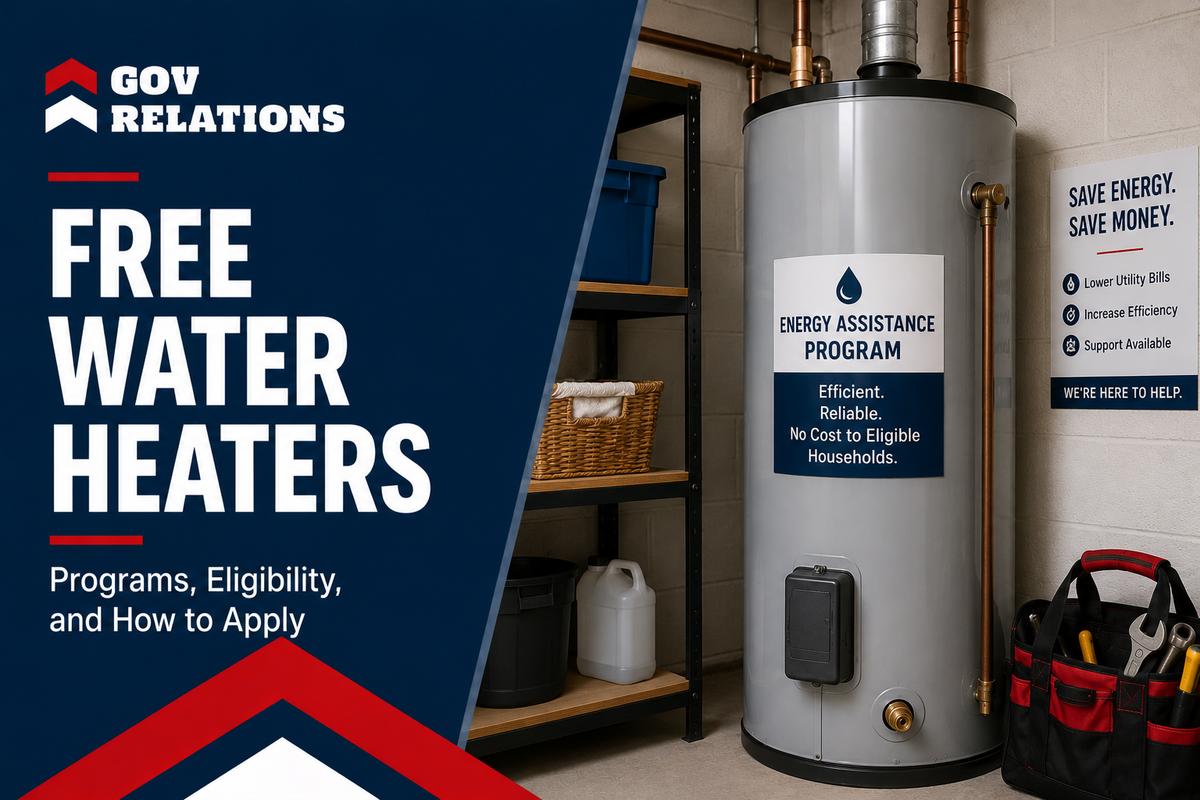
Free water heaters for low-income families are available through several federal, state, and utility programs that pay the full cost of repair or replacement when your current unit is broken, unsafe, or wasting energy. The two largest are the Weatherization Assistance Program (WAP) and the Low Income Home Energy Assistance Program (LIHEAP), and most states and utilities run their own versions.
Water heating is the second-largest energy expense in most homes, costing about $400 to $600 a year, according to the New York State Energy Research and Development Authority. A replacement runs $1,500 to $4,000, which is out of reach for many households. This guide explains which programs exist, the 2026 income limits, exactly how to apply, and how to avoid the scams that target people searching for this help..
Key Takeaways
- Programs exist nationwide: WAP and LIHEAP fund free water heater repair or replacement for income-qualified homeowners and renters in every state.
- Income limit is the main gate: WAP serves households at or below 200% of the Federal Poverty Guidelines; LIHEAP uses 150% of the guidelines or 60% of state median income.
- Benefits enrollment shortcuts the process: If you receive SNAP, SSI, MedicaidA joint federal and state program that helps with medical costs for some people with limited income ..., or TANF, you usually qualify automatically without proving income separately.
- The new unit is fully covered: A licensed contractor installs the water heater at no cost to you, and an inspector checks the work afterward for safety.
- Upgrades save real money: WAP households save an average of $372 a year, and heat pump water heaters can cut water heating electricity use by up to 75%.
- Scams are common: No legitimate program charges a fee, sends door-to-door salespeople, or offers benefits you never applied for.
Do You Qualify for a Free Water Heater?
You qualify if your household income falls at or below the program limit for your state, or if at least one person in your home already receives a qualifying public benefit. Both homeowners and renters can apply, though renters need written landlord permission before installation.
Most programs offer two paths to eligibility. The first is income, measured against the Federal Poverty Guidelines (FPG) or the State Median Income (SMI). The second is categorical eligibility, which means you are automatically approved if you participate in certain assistance programs. The second path is faster because it skips separate income verificationDocumentation proving the income levels of the beneficiaries, often required for grants targeting lo....
You are usually approved automatically if anyone in your household receives:
- Supplemental Nutrition Assistance Program (SNAP)A federal aid program that provides food-purchasing assistance for low- and no-income individuals an..., also called food stamps or CalFresh
- Supplemental Security Income (SSI)
- Medicaid or Medi-Cal
- Temporary Assistance for Needy Families (TANF)A federal assistance program that provides temporary financial assistance to low-income families wit... or CalWORKs
- Women, Infants, and Children (WIC)
- National School Lunch Program (NSLP)A federally assisted meal program operating in public and nonprofit private schools and residential ...
Priority is given by law to the households most at risk: adults aged 60 and older, people with disabilities, and families with young children.
What Are the 2026 Income Limits by Household Size?
For the 2025 to 2026 program year, WAP serves households at or below 200% of the Federal Poverty Guidelines, and some state utility programs, such as California's, go up to 250%. The table below shows the annual gross income ceilings so you can check your household before you apply.
| Household Size | 100% Federal Poverty Guideline | WAP Limit (200% FPG) | California ESA Limit (250% FPG) |
|---|---|---|---|
| 1 | $15,060 | $30,120 | $39,125 |
| 2 | $20,440 | $40,880 | $52,875 |
| 3 | $25,820 | $51,640 | $66,625 |
| 4 | $31,200 | $62,400 | $80,375 |
| 5 | $36,580 | $73,160 | $94,125 |
| 6 | $41,960 | $83,920 | $107,875 |
| 7 | $47,340 | $94,680 | $121,675 |
| 8 | $52,720 | $105,440 | $135,375 |
| Each additional person | +$5,380 | +$10,760 | +$13,750 |
Limits vary by state because each state sets its own threshold within the federal range. Check the figure your state uses through your local agency, which you can find through the Community Action Partnership locator.
Which Federal Programs Replace Water Heaters at No Cost?
Two federal programs cover water heaters: the Weatherization Assistance Program for long-term energy efficiencyRequirements for projects that promote energy conservation and efficiency., and the Low Income Home Energy Assistance Program for emergencies. Neither sends you cash. Both fund local agencies that do the work for free.
The Weatherization Assistance Program (WAP)
Run by the U.S. Department of Energy, WAP is the largest residential energy efficiency program in the country. It has served more than 7.2 million families since 1976 and weatherizes about 32,000 homes a year, according to the U.S. Department of Energy. WAP fully replaces a water heater when the existing one is inefficient, broken, or a safety hazard such as a carbon monoxide risk. On average, weatherized households save $372 or more every year on energy bills.
The Low Income Home Energy Assistance Program (LIHEAP)
LIHEAP, run by the U.S. Department of Health and Human Services, is best known for paying part of your heating and cooling bills. It also funds crisis repairs and weatherization, which can include an emergency water heater replacement. Federal LIHEAP funds for fiscal year 2026 were fully released in April 2026, so the program is active now.
One note on funding: the federal budgetA detailed financial plan outlining the projected costs of the project, including personnel, equipme... for these programs is set each year, and proposals to cut them surface from time to time. As of 2026 both WAP and LIHEAP are funded and open, but because money is limited and given out first-come, first-served, applying early matters.
| Feature | WAP | LIHEAP | Best For |
|---|---|---|---|
| Run by | U.S. Department of Energy | U.S. Department of Health & Human Services | Knowing who oversees the program |
| Main focus | Permanent energy efficiency and home safety | Bill help plus emergency crisis repairs | Matching the program to your need |
| Water heater coverage | Full replacement of inefficient or unsafe units | Emergency repair or replacement during a crisis | A failing or hazardous unit |
| Typical benefit | Average savings of $372 or more per year | Direct bill credit plus fast crisis response | Long-term savings vs. urgent help |
State and Utility Programs Worth Checking
Many states and utility companiesEnergy and water companies that provide funding for community projects and sustainability initiative... run their own Energy Savings Assistance (ESA) programs, paid for by ratepayers and state clean energy funds. These often cover 100% of the cost and installation of a new high-efficiency unit, including heat pump and tankless models. Contact your gas or electric provider directly to ask what they offer.
- Pacific Gas and Electric (PG&E): Free heat pump water heater upgrades or repairs for qualified renters and homeowners in California.
- Southern California Edison (SCE): Full cost and installation of ultra-efficient heat pump water heaters for income-qualified customers.
- SoCalGas: Free tankless water heaters, water heater blankets, pipe insulation, and low-flow aerators.
- NYSERDA EmPower+ (New York): No-cost heat pump water heater installation for income-eligible New Yorkers.
- Alabama Power: A free electric tank water heater, or a $500 rebate for switching from gas to electric.
- Mass Save (Massachusetts): Fully subsidized heat pump water heater installations for income-qualified residents.
How to Apply for a Free Water Heater, Step by Step
Applying takes five steps, from finding your local agency to the final inspection. Because funding runs out, complete each step quickly and submit a full application the first time. Missing paperwork is the leading reason applications stall.
- Find your local program. For WAP and LIHEAP, call the National Energy Assistance Referral hotline at 1-866-674-6327 or use the Community Action Partnership locator. For utility programs, call your electric or gas company.
- Gather your documents. Collect photo ID and Social Security cards for everyone in the home, proof of income for the last 30 to 90 days, recent gas and electric bills, proof of housing (lease, mortgage, or property tax bill), and any benefit awardA general term for funds provided to an individual or organization to support a specific purpose or ... letters.
- Submit your application. Apply online, by mail, or in person, depending on your agency. Renters must include written landlord permission, since the program will install permanent equipment.
- Complete the home energy auditA systematic examination of financial records and project activities to ensure compliance with grant.... After income approval, a certified auditor visits to test for air leaks and inspect your water heater for efficiency and safety, then writes a scope of work.
- Get the free installation and inspection. A licensed contractor installs the new unit at no cost, and an independent inspector confirms the work meets safety standards.
Documents you will need before Step 1:
- Government-issued photo ID and Social Security cards for all household members
- Proof of income: pay stubs, Social Security or pension letters, or tax returns
- Your most recent gas and electric bills
- Proof of housing: lease (renters) or mortgage or property tax statement (homeowners)
- Award letters for SNAP, Medicaid, SSI, or TANF if you receive them
Heat Pump vs. Tankless: Which Free Upgrade Is Better?
If a program replaces your unit, you may be offered a heat pump or a tankless model instead of a standard tank. A heat pump water heater is usually the bigger money-saver, while a tankless unit saves space and lasts longer. The table compares the two so you can ask for the right one.
| Factor | Heat Pump Water Heater | Tankless Water Heater |
|---|---|---|
| How it works | Moves heat from the surrounding air into the water | Heats water instantly as it flows through the unit |
| Efficiency | Up to 75% less electricity than standard electric models | 24% to 34% more efficient than a standard tank |
| Annual savings | $330 to $350 per year for the average home | Lower standby losses; savings depend on usage |
| Lifespan | Around 10 to 15 years | About 20 years, double a standard tank |
| Best fit | Garages or basements with at least 1,000 cubic feet of air | Smaller homes that want to free up floor space |
A heat pump water heater can run at up to 400% efficiency, which is why the ENERGY STAR program highlights it as a top efficiency upgrade. Tankless models, by contrast, last about 20 years compared with 6 to 10 years for a traditional tank, according to the U.S. Department of Energy.
Common Terms You Will See During the Process
These are the terms that show up most often on applications and during the home audit. Knowing them ahead of time makes the paperwork faster.
Energy burden: The share of your income spent on energy. The national average for low-income households is 6%, three times the 2% paid by other households, and one in four low-income families spends more than 15%.
Federal Poverty Guidelines (FPG): The income figures the government updates yearly that most programs use to set eligibility. WAP uses 200% of these guidelines.
Categorical eligibility: Automatic approval based on already receiving a benefit such as SNAP or SSI, instead of proving income separately.
Weatherization: Permanent improvements that lower energy use, such as insulation, air sealing, and water heater replacement.
Split incentive: The common renter problem where a landlord has little reason to pay for upgrades because the tenant pays the energy bills.
Common Roadblocks and How to Get Past Them
Two problems stop more applicants than anything else: renting and waitlists. In our experience helping readers, both are solvable with the right approach. More than 52% of low-income households rent, so the renter issue is widespread.
If you rent, your landlord must approve the work. The way through is to frame it as a free, permanent upgrade. The property gets a brand-new water heater that raises its value, at zero cost to the owner. WAP and California's ESA program both work directly with landlords to make this happen.
If you hit a waitlist, apply during spring or autumn when demand is lower, and make sure your application is 100% complete so it is not pushed to the back of the line. Older adults, people with disabilities, and families with young children move up the list first.
Scam Warning: How to Spot a Fake Free Water Heater Offer
People searching for home repair help are a frequent target for fraud. A simple rule protects you: a real program never asks for payment and never pressures you. As the U.S. government's official guide puts it plainly, the federal government does not offer free money to individuals to repair homes, and ads claiming otherwise are often scams.
Use these checks before you trust any offer:
- Refuse door-to-door sales. WAP, LIHEAP, and major utilities never run unsolicited door-to-door visits. If someone knocks claiming to represent them, do not let them in.
- Never sign on the spot. Scammers push one-time deals and swap contract terms. Ask for a business card and research the company on your own first.
- Verify credentials. Authorized contractors wear program uniforms and carry photo ID with a badge number and a verificationThe process of confirming the accuracy and authenticity of project activities, data, and reports. phone number. Call your utility to confirm before letting anyone inside.
- Guard your information. Never give your Social Security number, bank details, or account numbers to an unsolicited caller or visitor. Real programs collect this only through a secure application.
- Verify any program by dialing 211 or visiting 211.org, which connects you to verified local assistance.
Start With Your Local Energy Assistance Office
A broken or unsafe water heater does not always have to become a $1,500 to $4,000 emergency. WAP, LIHEAP, state energy offices, and utility assistance programs may cover repair, replacement, weatherization, or efficiency upgrades for households that meet income or benefit-based rules. The key is to apply through the official local agency, not through an ad or unsolicited offer.
Start by calling the National Energy Assistance Referral hotline at 1-866-674-6327, contacting your state WAP or LIHEAP office, or dialing 211 to find verified local help. Gather your ID, income proof, utility bills, housing documents, and benefit letters before you apply so your application does not stall.
Need help with more than water heating? Read Gov-Relations’ guide to charities that help with bills to find additional support for utilities, housing costs, and other urgent household expenses.
Frequently Asked Questions
Can renters get a free water heater, or only homeowners?
Renters can qualify for the same programs as homeowners. The difference is that your landlord must give written permission before installation, because the program installs permanent equipment. Programs like WAP work directly with landlords to approve the upgrade.
How long does it take to get a free water heater?
Timelines vary by state and demand. Income approval can take a few weeks, followed by the energy audit and scheduling the installation. Funding is first-come, first-served, so applying early and submitting a complete application is the fastest path.
Do I have to pay anything for the new unit or installation?
No. Through WAP, LIHEAP, and utility ESA programs, the water heater and its installation are fully covered for eligible households. Any person or website asking for a fee to apply or install is not part of the official program.
What if I make slightly too much for WAP?
Check your state's utility ESA program, since some use higher limits. California's program, for example, goes up to 250% of the Federal Poverty Guidelines for 2025 to 2026, well above WAP's 200% ceiling. Limits also differ state to state.
Will applying affect my other benefits?
No. Getting a free water heater through these energy programs does not reduce SNAP, SSI, Medicaid, or other benefits. In fact, already receiving those benefits often qualifies you automatically through categorical eligibility.
What happens if my application is denied?
Ask the agency why. Denials are often caused by missing documents or an income figure just over the line. You can reapply with complete paperwork, or try a different program such as your utility's ESA, which may use a higher income limit.