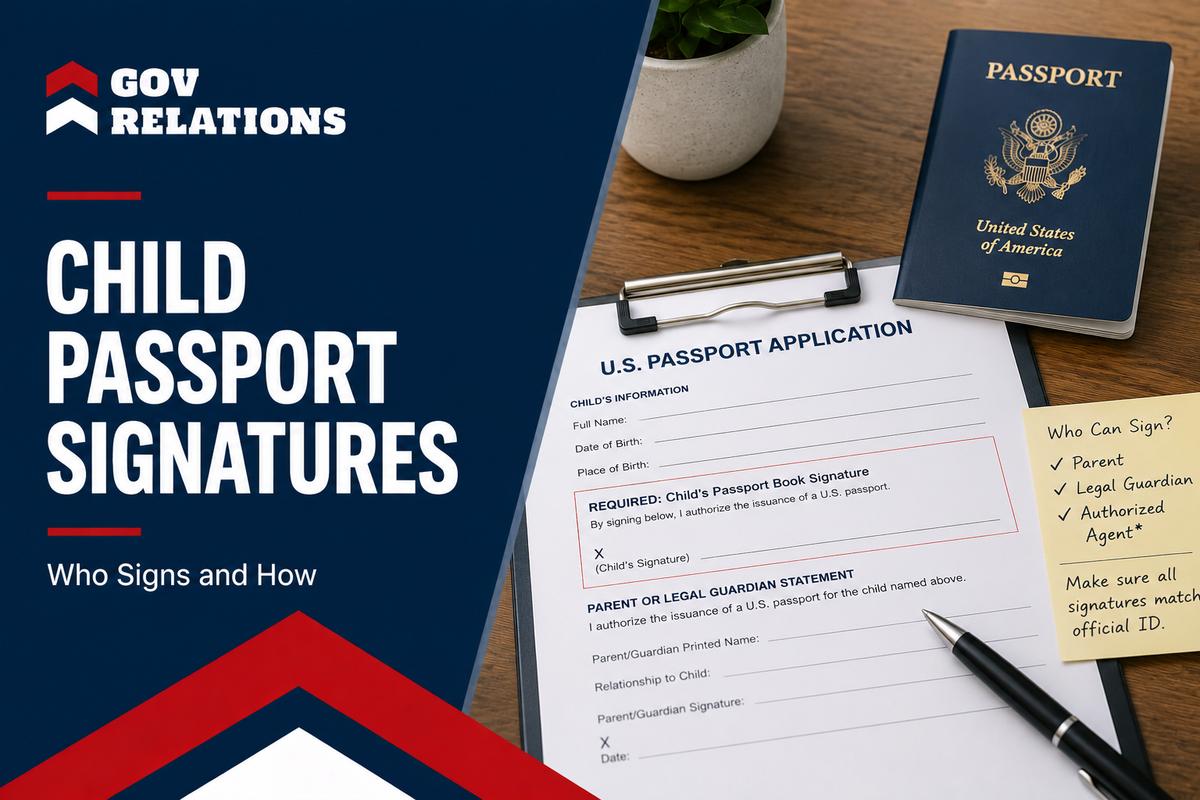
If your child is under 16, you sign their US passport for them: print the child's full name on the signature line, sign your own name beside it, and note your relationship, such as mother or father. At age 16, the child signs the passport personally.
The hard part is that the rules flip once you cross a border. The minor passport signature requirement that keeps a US passport valid will invalidate a Canadian or British one. In fiscal year 2025, the State Department issued a record 27.3 million US passports, and a large share went to children whose parents had to get this detail exactly right. This guide explains who signs, where, and in what ink, across the US and five other countries, plus the consent rules and the scams that target parents.
Key Takeaways
- US under 16: A parent prints the child's name, signs below it, and notes the relationship, using blue or black ink on the signature line.
- US age 16 and up: The teen signs the passport personally and receives a 10-year adult document instead of the 5-year child version.
- Two-parent consent: US law requires both parents to consent for a child under 16, in person or through a notarized Form DS-3053.
- Rules differ by country: Australia expects a signature at 10 and Italy at 12, so the minor passport signature rule depends on where the document is issued.
- Watch for fraud: The only official US passport site ends in .gov; any site charging a fee to validate a child's passport is a scam.
Who Signs a Minor's Passport in the United States?
In the United States, who signs depends on the child's age. For a child under 16, a parent or legal guardian signs on the child's behalf. At 16, the applicantThe individual or organization submitting the grant proposal and responsible for implementing the pr... signs their own passport and is treated as an adult for the signature, even though parental consent rules still apply during the application.
For a child under 16, the State Department sets a specific format. On the signature line beside the photo, you print the child's full name, sign your own name next to it, and write your relationship to the child, such as mother, father, or guardian. The State Department's own guidance confirms this three-part format. Use blue or black ink, and keep all writing on the signature line. Marking anywhere else on the data page can void the document.
A child passport carries a shorter life than an adult one. A passport for a child under 16 is valid for five years and cannot be renewed, so each new book means a fresh in-person application, as the State Department explains for under-16 applicants. The child must appear in person every time, even for a replacement.
At 16 and 17, the rules shift toward adulthood. These applicants receive a 10-year passport and must sign their own books. They still have to show parental awareness during the application. Per the guidance for 16 and 17-year-olds, a parent can establish this by accompanying the teen, signing the DS-11 form, providing a signed note with a copy of their ID, or paying the fee with a check in the parent's name.
How Do Minor Passport Signature Rules Compare by Country?
The table below sets the six jurisdictions side by side so you can see at a glance who signs, whether a parent may sign the book, what consent is required, and how long a child passport lasts. The single most important column is the third one, because it is the rule parents most often get wrong.
| Country | Child signs at | Can a parent sign the passport? | Consent required | Child passport validity |
|---|---|---|---|---|
| United States | 16+ | Yes, under 16 (print name, sign, note relationship) | Both parents, in person or via notarized DS-3053 | 5 yrs under 16; 10 yrs at 16-17 |
| United Kingdom | 12+ | No | One parent on the form; countersignatory needed | 5 yrs under 16; 10 yrs at 16-17 |
| Canada | 16+ (11-15 encouraged) | No, strictly prohibited | All custodial parents sign the form | 5 yrs under 16 |
| Australia | 10+ | No | All adults with parental responsibility | 5 yrs under 16; 10 yrs at 16-17 |
| Germany | 10+ | No | Both parents apply in person | 6 yrs for children under 24 |
| Italy | 12+ | No | Both parents; notarized if a parent is non-EU | 3 yrs under age 3; 5 yrs ages 3-17 |
Sources: national passport authorities for each country, compiled June 2026.
How to Sign a US Minor's Passport Correctly, Step by Step
When your child's US passport arrives, and the child is under 16, sign it before the first trip. The process takes under a minute, but the order and placement matter. Follow these six steps exactly.
- Open the passport to the signature page beside the photo and data page.
- Print the child's full legal name on the signature line.
- Sign your own name next to the child's printed name.
- Write your relationship to the child: mother, father, or guardian.
- Use blue or black ink only, and keep every mark on the signature line.
- Do not let a child under 16 sign, and do not write anywhere else on the data page.
Before you reach the signature stage, you have to clear the application itself. Gather these items for an in-person DS-11 appointment for a child under 16:
- A completed Form DS-11, signed in front of the acceptance agent, not in advance.
- The child's citizenship evidence, such as a US birth certificate, plus a photocopy.
- Proof of the parent-child relationship, often the long-form birth certificate listing parents.
- One compliant passport photo.
- Both parents' photo IDs, with a front-and-back photocopy of each.
Key Passport Terms Every Parent Should Know
Passport offices lean on form numbers and acronyms that mean little to a first-time applicant. Here is what the most common ones stand for, defined in plain language.
- DS-11: The application formA standardized document that applicants must complete and submit as part of the grant proposal, ofte... for a first-time or child passport. It must be completed and signed in person at an acceptance facility.
- DS-3053 (Statement of Consent): A notarized form a non-applying parent submits when they cannot attend the appointment for a child under 16.
- DS-5525 (Statement of Special Family Circumstances): Used when the applying parent cannot locate or contact the other parent.
- DS-3077: The form a parent files to enroll a child in the alert program described below.
- CPIAP (Children's Passport Issuance Alert Program): A free program that alerts a parent if anyone applies for their child's US passport.
- Countersignatory (UK) and Guarantor (Australia): An independent adult who verifies a child's identity on the application.
- ICAO (International Civil Aviation Organization): The United Nations agency that sets global passport standards but leaves the signing age to each country.
What Parental Consent Do You Need for a Child's Passport?
US law requires both parents or legal guardians to consent before a passport is issued to a child under 16. The rule exists to prevent international parental child abduction, so officials want clear proof that both parents agree. Both should appear in person with the child. When one cannot, the law provides documented alternatives.
If only one parent can attend, the absent parent usually submits a notarized Form DS-3053. The consent must be dated within 90 days and include a photocopy of the ID shown to the notary. A 2024 State Department rule added flexibility: the non-applying parent may now sign the consent before a passport specialist at a public passport agency counter, not only before a notary. This change appeared in the agency's July 2024 Federal RegisterA daily publication that provides official information on federal laws, regulations, and funding opp... rule and removes a cost and step for many families.
Some parents have sole authority and do not need the other parent's consent. Acceptable proof includes a birth certificate naming only the applying parent, a court order granting sole custody, or a death certificate for the other parent. When a parent cannot be found, Form DS-5525 covers the special circumstances.
Parents worried about abduction can add a safeguard. The Children's Passport Issuance Alert Program notifies an enrolled parent if someone files a US passport application for their child, and the enrollment lasts until the child turns 18. One limit is worth knowing: the program covers only US passports and cannot stop a foreign consulate from issuing a passport to a dual-national child.
The Signature Mistake That Costs Families a Trip
The error we see most often is a well-meaning parent signing a Canadian or British child's passport because the US rule trained them to sign. The instinct is reasonable. The result is not. A border officer or airline agent can treat that signature as an alteration, refuse to accept the book, and deny boarding on the spot.
The cost is real. The family has to apply and pay for a replacement passport, then wait for it. In 2026, routine U.S. processing runs about four to six weeks, and mailing can add up to two more weeks, so families should plan for roughly six to eight weeks unless the State Department posts longer delays. A single wrong signature can erase a planned trip and the money spent on it. The fix is simple: before you sign anything, confirm the rule for the country that issued the passport, not the country you live in.
Watch Out for Passport Scams That Target Parents
Parents searching for passport help online are a frequent target for fraud. Scam sites copy government logos, charge fees for free steps, and pressure you to act fast. Here is how to tell the real process from a fake one before you hand over money or personal data.
- The official US site ends in .gov. Travel.state.gov is the genuine source. A site using the State Department name on a .com or .org address is not the government.
- The government never charges a separate fee to sign or validate a passport. Signing a child's book is something you do for free at home. No one should charge for it.
- Be cautious with third-party expediters. Some are legitimate, but others charge high fees for tasks you can complete yourself, and a few are outright fraud.
- Never pay by gift card or wire transfer, and never share a full Social Security number in response to an unsolicited text or email about a passport.
If you spot a fraudulent passport offer, report it to the Federal Trade Commission at ReportFraud.ftc.gov. Reporting it helps protect the next parent who searches for the same help.
Get the Signature Right the First Time
As of 2026, with US passport demand at a record 27.3 million documents a year, getting the minor passport signature right on the first try matters more than ever. The core rules are short: in the US, a parent signs for a child under 16 using the print-sign-relationship format in blue or black ink, while teens 16 and up sign themselves. In Canada, the UK, Australia, Germany, and Italy, a parent must leave the line blank, because signing it can void the book.
Before any international trip with a child, confirm the rule for the country that issued the passport, prepare two-parent consent where it is required, and carry a notarized travel consent letter when one parent travels alone.
If you are also preparing government paperwork for a child or family move, read our guide to the difference between a mailing address and permanent address so your passport, benefits, tax, and ID records go to the right place.
Frequently Asked Questions
Does a child under 16 need to sign their US passport?
No. A parent or guardian signs for a child under 16 by printing the child's full name on the signature line, signing beside it, and noting the relationship. The child signs personally only at age 16 or older.
Can a parent sign a child's passport in Canada or the UK?
No. Canada and the UK prohibit a parent from signing a child's passport. A parental signature damages the book, makes it invalid, and forces the family to apply and pay for a replacement before traveling.
What ink should I use to sign my child's US passport?
Use blue or black ink only. Sign on the signature line beside the photo, print the child's full name, add your own signature, and write your relationship. Avoid marking anywhere else on the data page.
Do both parents need to consent for a minor's passport?
Yes, for a child under 16 in the US. Both parents or guardians consent in person, or the absent parent submits a notarized Form DS-3053 dated within 90 days, along with a copy of their photo ID.
What happens if a minor's passport is signed incorrectly?
An incorrectly signed passport can be treated as altered or invalid. The child may be denied boarding or entry, and the family usually has to apply and pay for a new passport before the trip.
How long is a child's passport valid?
A US passport for a child under 16 is valid for five years and cannot be renewed. Each new passport needs a fresh in-person application. At 16, the passport becomes a 10-year adult document.