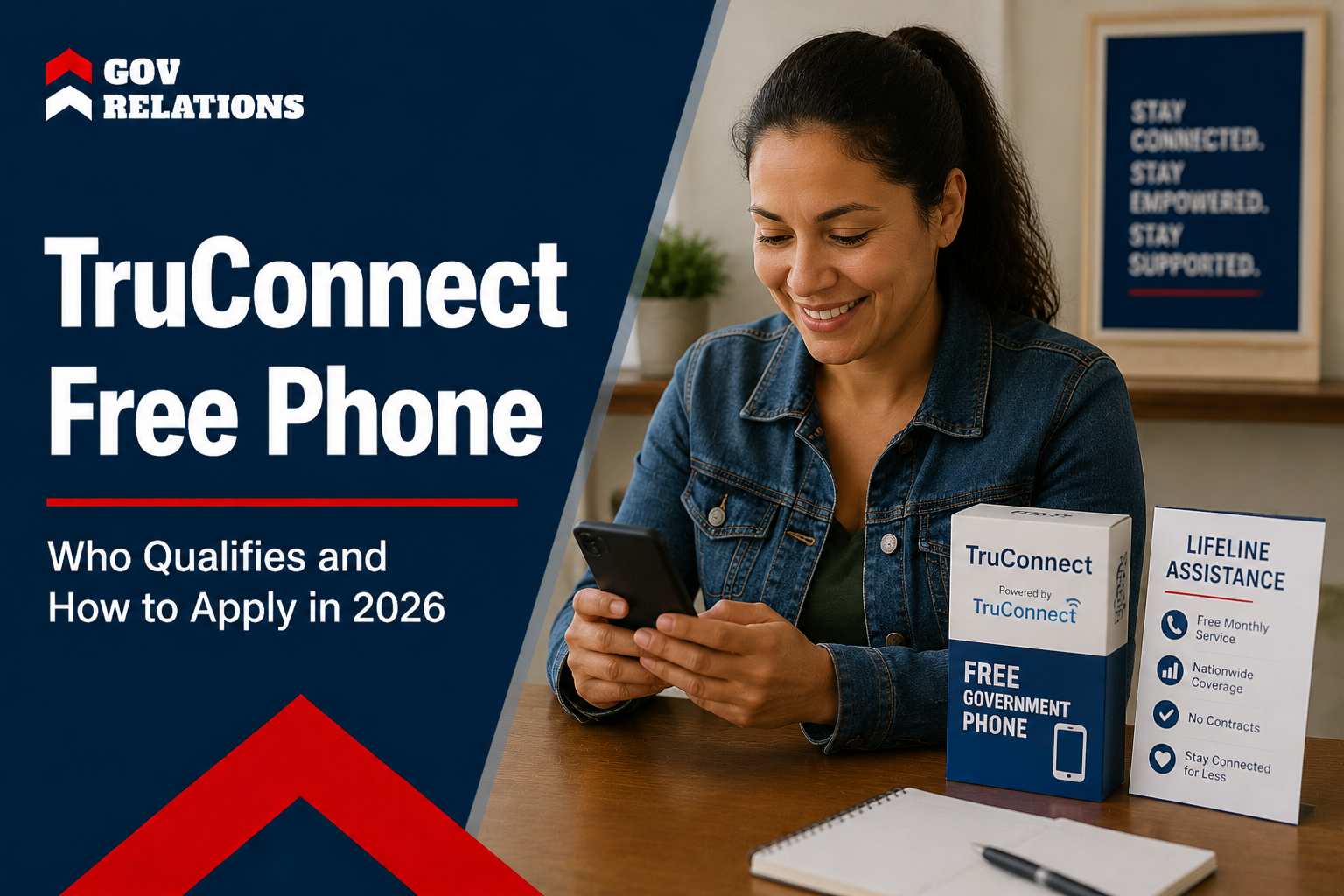
A TruConnect free government phone is a no-cost wireless plan offered through the federal Lifeline program, which gives qualifying low-income households unlimited talk and text, monthly high-speed data, and a free smartphone with no monthly bill. If you receive SNAP, MedicaidA joint federal and state program that helps with medical costs for some people with limited income ..., or SSI, or your income falls below the program limit, you likely qualify. TruConnect runs this service in more than 40 states and holds a 4-star rating across over 36,000 Trustpilot reviews.
This guide explains who qualifies, what you get, how to apply step by step, and how to spot the scams that target people searching for free phones. The federal Lifeline program is what makes the phone free, and you can check your eligibility for free through the official Lifeline National Verifier before you apply.
Key Takeaways
- Free through Lifeline: A TruConnect free government phone costs nothing per month and includes a free entry-level Android smartphone for approved applicants.
- Eligibility is income or program based: You qualify if your household income is at or below 135% of the Federal Poverty Guidelines or you receive SNAP, Medicaid, or SSI.
- What you get: Standard Lifeline plans include unlimited talk and text, 4.5 GB to 6 GB of monthly data, and free calling to more than 200 countries.
- It runs on T-Mobile: TruConnect leases the T-Mobile network, with Verizon as a backup in some regions, so coverage matches those carriers in your area.
- Tribal lands get more: Residents of federally recognized Tribal lands receive an enhanced plan with 10 GB of monthly high-speed data at no cost.
- A mixed service record: TruConnect scores 4 stars on Trustpilot but 1.16 out of 5 on the Better Business Bureau, with most complaints about support and suspensions.
- Scams are common: No real Lifeline phone ever requires a fee or a credit card, and legitimate applications run through TruConnect or a .gov site only.
Is TruConnect a Free Government Phone Program?
TruConnect is a private wireless company that takes part in the federal Lifeline program, and Lifeline is the government benefit that makes the phone free. TruConnect itself is not a government agency. It is one of several approved providers that deliver the subsidized service to households that qualify.
Lifeline is a federal benefit managed by the FCC (Federal Communications Commission) and the USAC (Universal Service Administrative Company). It lowers the cost of phone or internet service for eligible low-income consumers. TruConnect operates as an MVNO (Mobile Virtual Network Operator), which means it does not own cell towers. It buys network capacity from a larger carrier and resells service under its own brand.
The company was launched in its current form in 2011 by twin brothers Matthew and Nathan Johnson, who serve as co-CEOs. Its roots go back to 2006, when the brothers acquired Telscape Communications, a provider serving Southern California's Hispanic community. TruConnect is bootstrapped and self-funded, having raised no outside venture capitalInvestment provided to early-stage, high-potential growth startup companies in exchange for equity., yet it reported $158 million in annual recurring revenue by late 2024 and employs roughly 381 people from its Los Angeles headquarters. It is the only major privately held, family-owned Lifeline provider in the country.
Do You Qualify for a TruConnect Free Government Phone?
You qualify for a TruConnect free government phone if your household income is at or below 135% of the Federal Poverty Guidelines, or if you take part in a qualifying assistance program. These are the standard Lifeline rules set by the FCC, and they are the same no matter which Lifeline provider you choose.
You may qualify if any of the following apply to your household:
- Your household income is at or below 135% of the Federal Poverty Guidelines.
- You receive SNAP (Supplemental Nutrition Assistance Program), formerly known as food stamps.
- You receive Medicaid.
- You receive SSI (Supplemental Security Income).
- You receive Federal Public Housing Assistance, including Section 8.
- You receive the Veterans Pension or Survivors Pension benefit.
- You take part in a qualifying Tribal program, such as Tribal TANF or the Food Distribution Program on Indian Reservations.
The Lifeline benefit is limited to one per household, not one per person. If someone in your home already gets a Lifeline phone or internet discount, a second person at the same address generally cannot get a separate benefit. You can confirm your status and apply through the official Lifeline National Verifier, which is the system that checks eligibility for every Lifeline provider.
If you live on federally recognized Tribal land, you may qualify for the Enhanced Tribal Lifeline benefit, which raises your monthly high-speed data to 10 GB alongside unlimited talk, text, hotspot use, and a free smartphone.
What Do TruConnect's Free Phone Plans Include?
A standard TruConnect Lifeline plan includes unlimited nationwide talk and text, between 4.5 GB and 6 GB of high-speed data per month depending on your state, free calling to more than 200 countries, mobile hotspot access, and a free Android smartphone on approval. There is no monthly bill for the Lifeline plan.
If you do not qualify for the subsidyFinancial assistance granted by a government to support a specific economic activity or sector, redu..., TruConnect also sells prepaid plans with no credit check, no contract, and no activation fee. The table below compares the free Lifeline options with the paid prepaid plans.
| Plan | Monthly Cost | High-Speed Data | Talk & Text | Key Features |
|---|---|---|---|---|
| Standard Lifeline | $0 | 4.5 GB to 6 GB | Unlimited | Free Android phone, mobile hotspot, calling to 200+ countries |
| Tribal Lifeline | $0 | 10 GB | Unlimited | Free phone, hotspot, international calling |
| Prepaid (no subsidy) | $25 | 100 MB to 1 GB | Unlimited | Hotspot, international calling to 200+ countries |
| Prepaid (no subsidy) | $30 | 10 GB | Unlimited | Hotspot, international calling, free BYOD SIM card |
| Prepaid (no subsidy) | $35 | 500 MB to 5 GB | Unlimited | Hotspot, 5G access, international calling |
The free international calling is the feature most people overlook. Calling more than 200 countries, including Mexico, India, China, and parts of Central America, is bundled at no extra charge. For families who call relatives abroad, that single feature can save more than the cost of a paid plan elsewhere.
How Does TruConnect Compare to Other Lifeline Providers?
TruConnect competes with Assurance Wireless, SafeLink Wireless, and AirTalk Wireless for Lifeline customers. The right choice depends on your location and how you use your phone, because each provider runs on a different network and offers a different data amount. The provider comparison below lays out the main differences side by side.
| Feature | TruConnect | Assurance | SafeLink | AirTalk |
|---|---|---|---|---|
| Primary Network | T-Mobile | T-Mobile | Verizon | T-Mobile |
| Standard Data | 4.5–6 GB (state) | 6 GB | Varies by state | 10 GB+ |
| 5G Access | Yes | Yes | Yes | Yes |
| International Calls | Free to 200+ countries | Extra charge | Limited | Select countries |
| BYOD Support | Strong (GSM unlocked) | Moderate | Strong (Verizon/GSM) | Strong |
| Best Suited For | Urban/suburban, international calling | Nationwide reliability | Rural (Verizon footprint) | Data-heavy users |
Assurance Wireless is owned by T-Mobile and is the largest nationwide Lifeline brand, with reliable, straightforward plans. TruConnect's edge over Assurance is free international calling, which Assurance charges extra for.
SafeLink runs on Verizon, which makes it the stronger pick in rural areas where T-Mobile coverage is thin. TruConnect fits metro and suburban areas with solid T-Mobile 5G better than it fits remote regions. AirTalk tends to offer the largest data buckets, often 10 GB or more, so heavy data users may prefer it.
How to Apply for a TruConnect Free Government Phone: Step by Step
Applying takes most people under 30 minutes if their documents are ready. The process below works whether you take the free phone or bring your own device.
- Check your eligibility. Confirm you qualify by income or program through the Lifeline National Verifier before you start an application.
- Gather your documents. Have proof ready: a benefit award letter for SNAP, Medicaid, or SSI, or recent income documents such as a pay stub or tax return.
- Apply on TruConnect's site. Enter your information, choose your state plan, and submit your eligibility proof through the online application.
- Choose your phone option. Accept the free Android phone, or select Bring Your Own Device and request a SIM card if you want to keep your current unlocked phone.
- Activate and confirm. Once approved, activate the SIM or device, test your service, and note your plan's monthly data limit.
If your application is denied, the most common reasons are mismatched personal details or an expired benefit letter. Recheck your information against your official documents, update anything out of date, and reapply. You also have the right to appeal a National Verifier denial, and you can apply with a different Lifeline provider if TruConnect does not serve your area.
How Good Is TruConnect's Network and Coverage?
TruConnect coverage is the T-Mobile network coverage in your area, because TruConnect is an MVNO that leases T-Mobile capacity, with Verizon as a secondary partner in some regions. Before you apply, check that T-Mobile has strong 4G LTE or 5G service at your home address and the places you spend the most time.
TruConnect markets 5G access, and you can reach 5G speeds where they exist, but only with a 5G-capable phone. The free phones handed out at enrollment are usually entry-level 4G LTE models, so a 5G plan does not guarantee a 5G experience on a free device. If 5G matters to you, bring your own 5G phone.
Two limits are worth knowing in advance. During heavy network congestion, T-Mobile deprioritizes MVNO traffic, so your speeds can dip below what a direct T-Mobile customer sees. And once you use up your monthly high-speed data, your speed is throttled to roughly 128 kbps to 256 kbps rather than cut off, which is slow but still enough for basic texting and email.
What Happened to the ACP Benefit?
The ACP (Affordable Connectivity Program) ended on June 1, 2024 after Congress did not renew its funding. ACP had given eligible households a $30 monthly broadband discount, or $75 on Tribal lands. Its closure affected TruConnect customers who had stacked ACP on top of Lifeline for larger data and subsidized tablets.
After the wind-down, TruConnect moved its ACP-only subscribers onto subsidized Lifeline plans or low-cost prepaid options so they would not lose service entirely. The company also petitioned the FCC for expanded Lifeline certifications in several states to take on displaced ACP users. As of 2026, Lifeline remains the active federal phone and internet subsidy, and it is the program behind every free TruConnect phone today.
TruConnect Reviews: What Customers Actually Say
TruConnect reviews are sharply divided. The company holds a 4-star Trustpilot rating from more than 36,000 reviews, yet its Better Business Bureau profile shows 1.16 out of 5 stars from 118 reviews while keeping an A+ accreditation. That gap is common among Lifeline providers, where thin margins strain customer support.
When we reviewed the feedback across both platforms, a clear pattern emerged. Happy customers praised the quick online enrollment, the value of free international calling, and how easy it was to activate an unlocked GSM phone with a TruConnect SIM. These are real strengths for budget-conscious households.
The recurring complaints fall into four groups:
- Support bottlenecks: Long hold times and difficulty reaching a live agent who can solve technical problems.
- Automated suspensions: Fraud filters tied to the carrier sometimes flag normal group texting as spam and abruptly suspend accounts.
- Aggressive field sales: Door-to-door agents, in some cases inside senior living facilities, have drawn complaints and even local no-trespass orders.
- Entry-level hardware: The free phones are basic devices with limited speed and storage, so heavier users are better off bringing their own phone.
The honest read is this: TruConnect delivers real value on price and international calling, but you should set realistic expectations on support speed and device quality. For many low-income households, the tradeoff is worth it. For someone who needs reliable phone-based customer service, it is a genuine consideration.
Key Terms to Know Before You Apply
A few terms come up again and again in free phone applications. Here is what each one means in plain language:
Lifeline: The federal program that subsidizes phone and internet service for qualifying low-income households. It is the benefit, not the provider.
MVNO (Mobile Virtual Network Operator): A wireless brand that resells service on a larger carrier's network instead of owning its own towers. TruConnect is an MVNO on T-Mobile.
National Verifier: The official USAC system that confirms whether you are eligible for Lifeline. Every provider uses it.
BYOD (Bring Your Own Device): Using your existing unlocked phone with a new provider's SIM card instead of taking the free phone.
Deprioritization: When the network is busy, MVNO traffic is served after the host carrier's own customers, which can slow your speed temporarily.
Throttling: A deliberate speed reduction, usually after you use up your high-speed data for the month. Service continues, just slower.
Scam Warning: How to Spot a Fake Free Government Phone Offer
Fraudulent offers target people searching for free government phones, so know the red flags before you hand over any personal information. Here is how to tell a real Lifeline offer from a scam:
- The real program is always free. Any website or person charging a fee to submit your Lifeline application is not part of the official program.
- Apply only through TruConnect or a .gov site. Eligibility runs through the official Lifeline National Verifier. A look-alike site that uses the program name is not the real thing.
- No one will cold-call you with benefits. The government and providers do not phone, text, or email to offer you a phone you never applied for. Unsolicited offers are a warning sign.
- Never give a credit card to receive benefits. A free government phone requires no payment. Any request for a card number to claim assistance is fraud.
- Be careful with door-to-door agents. Verify any field representative independently before sharing your Social Security number or transferring an existing benefit.
If you receive an unsolicited free phone offer, do not respond and do not click any links. Report it to the Federal Trade Commission at ReportFraud.ftc.gov.
Stay Connected With the Right Lifeline Phone Plan
A TruConnect free government phone is a real way for low-income households to stay connected at no monthly cost, with unlimited talk and text, monthly data, and free international calling through the federal Lifeline program. As of 2026, with the ACP ended, Lifeline is the active subsidy, and TruConnect remains one of the larger independent providers delivering it. Set realistic expectations on support speed and the free device, and the value is strong for the right user.
Before applying, confirm your eligibility through the official Lifeline National Verifier, check TruConnect’s current plan details for your state, and decide whether you want the free entry-level phone or a BYOD SIM for your own unlocked device.
For more help comparing similar options, read Gov-Relations’ guide to SafetyNet Wireless and the Free Government Cell Phone Program.
Frequently Asked Questions
Is the TruConnect phone really free?
Yes. If you qualify for Lifeline, the standard TruConnect plan has no monthly bill and includes a free Android smartphone on approval. The phone and the service are paid for by the federal Lifeline subsidy, not by you.
What network does TruConnect use?
TruConnect runs on the T-Mobile nationwide network, with Verizon as a secondary partner in some regions. Your real coverage is whatever T-Mobile offers at your address, so check the T-Mobile map for your ZIP code before applying.
Can I keep my own phone and number?
Yes. TruConnect supports Bring Your Own Device for unlocked GSM phones, and you can request a SIM card instead of the free phone. In most cases you can also port your existing number when you sign up.
What happens when I use up my high-speed data?
Your service is not cut off. Once you pass your monthly high-speed limit, your speed is throttled to roughly 128 kbps to 256 kbps for the rest of the cycle. That is slow but usable for texting, email, and light browsing.
Can I have TruConnect and another Lifeline benefit at the same time?
No. Lifeline allows one benefit per household, not one per person. If your home already has a Lifeline phone or internet discount, you generally cannot stack a second one through TruConnect or any other provider.
Is TruConnect available in my state?
TruConnect offers Lifeline service in more than 40 states, and the exact data amount varies by state. Check the plan page for your state, and confirm T-Mobile has coverage where you live before you apply.