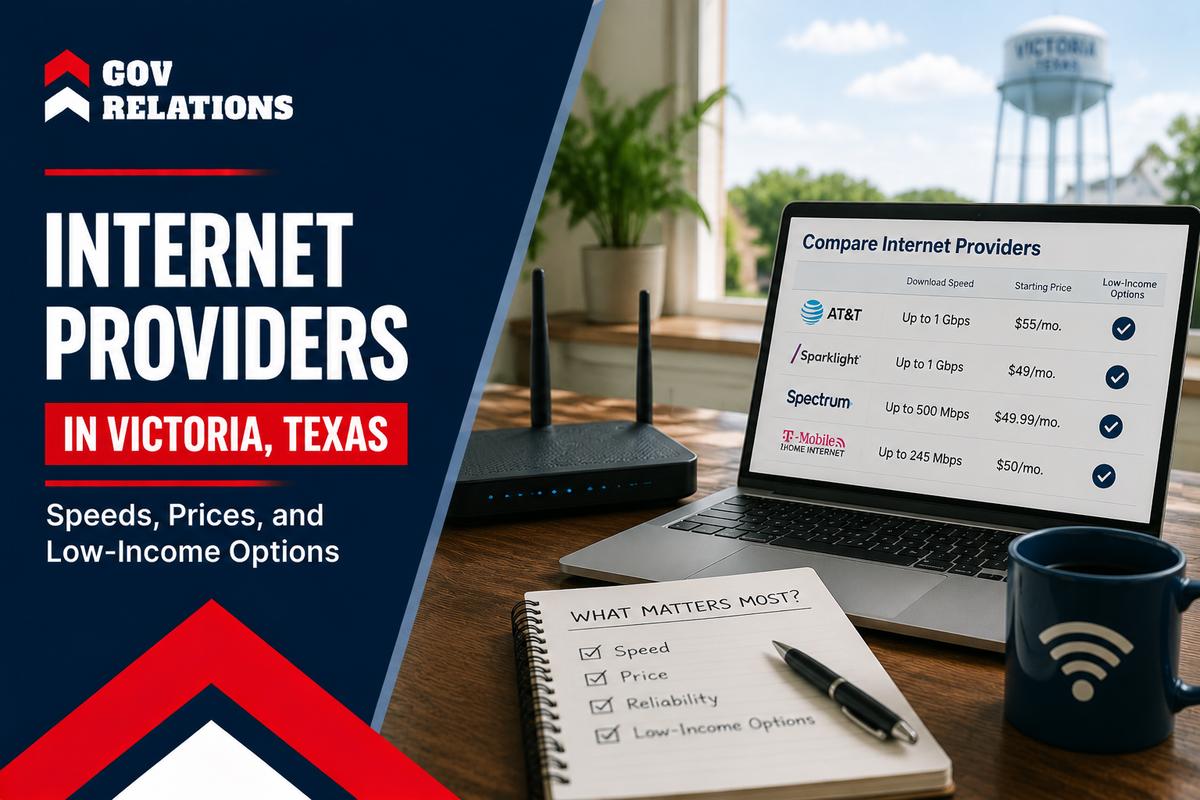
The leading internet providers in Victoria, Texas, are AT&T Fiber, Optimum, Sparklight, and Spectrum for wired service, with T-Mobile 5G Home Internet and satellite options like Starlink covering the rural parts of Victoria County where cable and fiber have not yet reached. Nearly every address in the city has at least one high-speed choice.
Which provider fits you depends on your exact street address, the speeds you need, and your monthly budgetA detailed financial plan outlining the projected costs of the project, including personnel, equipme.... About 78% of Victoria now has fiber coverage, according to BroadbandNow. This guide compares each major provider by speed and price, then covers the government and provider programs that lower your bill if money is tight.
Key Takeaways
- Fastest speeds: AT&T Fiber and Sparklight reach multi-gigabit service in Victoria, with AT&T Fiber plans topping out near 5 Gbps for heavy users.
- Lowest starting price: Optimum advertises fiber-powered internet from $25 per month with a 5-year price lock, no data caps, and no annual contract.
- Coverage split: Internet providers in Victoria, Texas, deliver roughly 78% fiber, 21% cable, and near-total fixed wireless and satellite coverage across the county.
- The ACP has ended: The federal Affordable Connectivity Program stopped on June 1, 2024, so any 2026 offer for a “$30 ACP credit” is out of date.
- Lifeline still helps: Qualifying Victoria households can take up to $9.25 per month off internet through the federal Lifeline program, plus a small Texas state discount.
- Discounted plans exist: AT&T Access, Optimum Advantage, and Spectrum Internet Assist offer internet from about $15 to $30 per month for households that qualify.
- Scam guard: No real government internet program charges a fee, asks for a credit card, or promises a free plan through an unsolicited text.
What Internet Providers Serve Victoria, Texas?
Victoria has at least a dozen internet providers across four connection types: fiber, cable, fixed wireless, and satellite. The largest wired providers are AT&T, Optimum, Sparklight, and Spectrum. T-Mobile 5G Home Internet and satellite services fill the gaps for homes outside the cable and fiber footprint. Your real choices depend on your street address.
The City of Victoria has partnered with providers to expand fiber across public easements, which is one reason fiber now reaches close to 78% of the city, according to the City of Victoria broadband office. That push means more households can get gigabit speeds than could just a few years ago.
AT&T Fiber
AT&T runs the fastest widely available network in Victoria. AT&T Fiber offers symmetrical speeds (the same upload and download rates), which matter for video calls, remote work, and uploading large files. Plans start around $35 per month after discounts and reach up to 5 Gbps in fiber neighborhoods. AT&T does not cap data or require an annual contract. Where fiber has not arrived, AT&T still sells slower DSL service, so check your address before you assume fiber is available.
Optimum
Optimum is the budget pick for most Victoria households. Optimum cable reaches close to 80% of the city, and its fiber footprint keeps growing. Advertised pricing starts at $25 per month, with a 5-year price lock, unlimited data, and a contract buyout offer of up to $500 for customers switching from another provider. Speeds run up to 1 Gbps on most Optimum plans in Victoria.
Sparklight
Sparklight (formerly Cable One) sells both cable and fiber internet in Victoria. Its 1 Gigabit plan runs about $39.95 per month, and the company has been rolling out multi-gigabit fiber to parts of the area. Sparklight does not impose data caps on its main plans. Some customers report uneven service during peak evening hours, so it is worth reading recent local reviews before you sign up.
Spectrum
Spectrum, operated by Charter, offers cable internet across much of Victoria, with speeds from 100 Mbps up to 1 Gbps (1,000 Mbps). Introductory pricing runs from about $30 to $60 per month for the first year. Spectrum includes a free modem and no data caps, though its promotional rate rises after 12 months, so budget for the higher second-year price.
T-Mobile 5G Home Internet and Satellite
For homes where cable and fiber do not reach, two options cover nearly every address in Victoria County. T-Mobile 5G Home Internet runs over the cellular network at a flat rate around $50 per month, with typical speeds between 87 and 415 Mbps and no professional installation. Satellite providers (Starlink, HughesNet, and Viasat) reach 100% of the county. Starlink offers the lowest delay and highest speeds of the three, though its equipment costs more up front.
Local Cooperatives: Infinium and VTX1
Two local providers serve Victoria and the surrounding Crossroads region with a community focus. Infinium, the broadband arm of Victoria Electric Cooperative (VEC), offers fiber-to-the-home and fixed wireless with transparent pricing and local support. VTX1 Companies, which acquired the local provider TISD, offers fiber in select neighborhoods plus high-speed fixed wireless, with a staffed office on Cameron Street in Victoria. Both are worth a direct call, because cooperative pricing and coverage change by neighborhood and are not always listed on national comparison sites.
Which Internet Provider in Victoria Offers the Best Value?
Value depends on what you need. For the fastest speeds, AT&T Fiber leads. For the lowest starting price, Optimum wins at $25 per month. For rural addresses with no wired service, T-Mobile 5G or Starlink are the practical choices. The table below compares the main options side by side.
| Provider | Connection Type | Max Download Speed | Starting Price | Data Caps | Annual Contract |
|---|---|---|---|---|---|
| AT&T | Fiber / DSL | Up to 5 Gbps | About $35/mo | None | No |
| Optimum | Cable / Fiber | Up to 1 Gbps | About $25/mo | None | No |
| Sparklight | Cable / Fiber | 1 Gbps and up | About $40/mo | None | No |
| Spectrum | Cable | Up to 1 Gbps | About $30/mo | None | No |
| T-Mobile | 5G Fixed Wireless | 87 to 415 Mbps | About $50/mo | None | No |
| Satellite (Starlink) | Satellite | Varies by plan | Higher equipment cost | Varies | Varies |
Prices shown are promotional starting rates and can change by address and over time. Always confirm the current price and the rate after any promotional period before you sign up. Data verified against provider pages and BroadbandNow's Victoria provider data as of July 2026.
Government and Low-Income Internet Help in Victoria
Yes, Victoria households with a low income can lower their internet bill in 2026 through two paths: the federal Lifeline discount and provider low-income plans like AT&T Access, Optimum Advantage, and Spectrum Internet Assist. One program you may have heard of, the ACP, has ended, so the sections below focus only on help that still exists.
The ACP Has Ended (Read This First)
The Affordable Connectivity Program (ACP) was a federal benefit that gave low-income households up to $30 per month off internet. It ended on June 1, 2024, after Congress did not renew its funding, according to the Federal Communications Commission (FCC). If a website or ad in 2026 tells you to apply for the $30 ACP internet credit, the page is out of date. There is no ACP to apply for right now. Some members of Congress have introduced bills to bring it back, but none have passed as of mid-2026.
The Lifeline Program: Up to $9.25 Off Every Month
Lifeline is the main federal program that still helps with internet and phone costs. It gives eligible households a discount of up to $9.25 per month (up to $34.25 on qualifying Tribal lands) on internet, phone, or a bundle, according to the FCC. The discount attaches to a plan from a participating provider, so you can apply it to internet service from a company that takes Lifeline.
You qualify for Lifeline if your household income is at or below 135% of the Federal Poverty Guidelines (FPL), or if you or someone in your home takes part in a qualifying program. For 2026, the income path means about $21,546 or less for one person, or $44,550 or less for a family of four. Qualifying programs include SNAP (Supplemental Nutrition Assistance Program), MedicaidA joint federal and state program that helps with medical costs for some people with limited income ..., SSI (Supplemental Security Income), Federal Public Housing Assistance, and the Veterans Pension or Survivors benefit.
The Texas State Discount
Texas adds a state discount on top of the federal Lifeline benefit. The state portion is up to about $3.50 per month, and Texas residents qualify at up to 150% of the Federal Poverty Guidelines, which is slightly higher than the federal 135% cap. Texas runs its own application process through the Public Utility Commission of Texas, so Victoria residents apply a little differently than people in most other states. The step-by-step section below covers exactly how.
Provider Low-Income Plans in Victoria
Three providers that serve Victoria offer their own discounted plans, separate from Lifeline. You can often apply the Lifeline discount on top of one of these. The table shows the current options.
| Program / Plan | Monthly Cost | Speed | Who Qualifies |
|---|---|---|---|
| Federal Lifeline | Up to $9.25 off | Applies to any plan | 135% FPL, or SNAP / Medicaid / SSI and other programs |
| Texas State Discount | Up to about $3.50 off | Phone or internet | 150% FPL, or qualifying assistance programs |
| AT&T Access | From $30/mo | Up to 100 Mbps | Program participation or income at or below 200% FPL |
| Optimum Advantage | $14.99/mo | Up to 50 Mbps | Qualifying low-income households |
| Spectrum Internet Assist | $25/mo ($15 for some) | 50 Mbps | SSI or National School Lunch Program |
You usually cannot combine two provider low-income plans, but you can apply the Lifeline discount to one of them, which lowers the cost further. Confirm current pricing on the provider's site, since these rates change.
Families with a student in the National School Lunch Program (NSLP)A federally assisted meal program operating in public and nonprofit private schools and residential ... can also look at T-Mobile's Project 10Million, which offers a free mobile hotspot and a set amount of free data each year for eligible school-age children. It is a separate program from home internet, but it helps students get online for schoolwork at no cost.
How to Apply for the Lifeline Internet Discount in Texas
In Texas, applying for Lifeline takes two parts: get approved through the state and federal system, then choose a participating internet provider. Here are the steps.
- Check that you qualify. Confirm your household income is at or below 135% of the Federal Poverty Guidelines, or that you take part in a qualifying program like SNAP, Medicaid, or SSI.
- Gather your documents. Have proof of program participation (an award letterAn official notification from the grantor indicating that the grant has been approved and outlining ... or benefits statement) or proof of income (recent pay stubs or a tax return) ready.
- Apply through Texas. Texas residents apply through the Public Utility Commission of Texas at the state Lifeline site, or by calling the Texas Low Income Discount Administrator at 1-866-454-8387.
- Wait for approval. The system checks your eligibility, often within minutes if your program participation is already on file. If it cannot verify you automatically, you submit your documents.
- Pick a participating provider. Once approved, contact an internet company in Victoria that accepts Lifeline and ask them to apply your discount to your plan.
- Recertify each year. Lifeline requires you to confirm your eligibility once a year to keep the discount. Mark your calendar so you do not lose it.
You can start the federal side of the process at LifelineSupport.org, the official application system run by the Universal Service Administrative Company (USAC).
Internet Terms You Should Know Before You Choose
A few terms come up on every provider's site. Knowing them helps you compare plans without guessing.
- Mbps (megabits per second): A measure of internet speed. Streaming HD video needs about 5 to 10 Mbps per screen; 100 Mbps handles a small household comfortably.
- Gbps (gigabits per second): 1 Gbps equals 1,000 Mbps. Gigabit plans suit large households, heavy gaming, or many connected devices at once.
- Fiber: Internet delivered over fiber-optic lines. It offers the fastest and most reliable speeds, often with matching upload and download rates.
- Cable: Internet delivered over the same lines as cable TV. It is widely available and fast for downloads, but upload speeds are usually lower than fiber.
- Fixed wireless: Internet is beamed from a nearby tower to an antenna at your home. It is common in rural areas without cable or fiber.
- Data cap: A monthly limit on how much data you can use. All the main Victoria providers listed here offer plans with no data cap.
- Symmetrical speed: When upload and download speeds match. Fiber plans are usually symmetrical, which helps with video calls and uploading files.
What We Have Seen Help Victoria Readers Most
In our experience helping readers sort through internet options, the biggest wins do not come from chasing the fastest plan. They come from matching the plan to the household and using every discount available.
A common example: a single parent in Victoria on SNAP assumes fast internet is out of reach at $60 or more per month. In reality, that household can often combine a provider low-income plan (say, Optimum Advantage at $14.99 per month) with the Lifeline discount, bringing the cost down to a level that fits a tight budget. The 50 Mbps that the plan provides is enough for a child's schoolwork, a parent's job applications, and a telehealth visit at the same time.
The lesson we repeat most: check your eligibility before you check the speed charts. Many Victoria households qualify for help they never applied for, simply because no one told them the discount existed or that the ACP ending did not close every door.
How to Spot Fake Internet Assistance Offers
Scammers target people searching for cheap or free internet, because they know the audience is under financial pressure. Before you hand over any information, here is how to tell a real program from a fake one.
- Real programs never charge a fee to apply. Lifeline and every legitimate low-income plan are free to apply for. Anyone charging a processing fee is running a scam.
- The government will not text or call you out of the blue to offer free internet you did not apply for. Unsolicited offers claiming to be from a federal program are fraudulent.
- No real program asks for your credit card to receive free service. A request for card details to claim a benefit is a red flag every time.
- Official Lifeline information lives on .gov and USAC sites. Apply through LifelineSupport.org or your provider directly, not through a lookalike site that copies the program name.
- “$30 ACP credit” offers are outdated or fake in 2026. The ACP ended in 2024. Any active-sounding ACP signup page is either stale or a trap.
If you receive a suspicious internet assistance offer, do not click any links in the message. Report it to the Federal Trade Commission at ReportFraud.ftc.gov.
Compare Your Address and Claim Every Available Discount
Choosing internet in Victoria comes down to three questions: what is available at your address, what speed your household needs, and what you can afford. For most Victoria homes in 2026, AT&T Fiber and Optimum cover the first two questions well, while Lifeline and provider low-income plans answer the third for households on a tight budget.
Start by checking availability at your exact address, then check whether you qualify for a discount before you commit to a plan. Many Victoria households leave money on the table simply because they never checked.
To see the full range of programs that can lower your tech expenses, visit our guide to government assistance programs that provide free laptops for students to find every benefit you may already qualify for.
Frequently Asked Questions
What is the fastest internet provider in Victoria, Texas?
AT&T Fiber is the fastest widely available provider in Victoria, with plans reaching up to 5 Gbps in fiber neighborhoods. Sparklight also offers multi-gigabit fiber in parts of the city. Both deliver far more speed than a typical household needs, so most people do well with a 300 Mbps to 1 Gbps plan.
What is the cheapest internet provider in Victoria, Texas?
Optimum advertises the lowest starting price at $25 per month for a fiber-powered plan, with a 5-year price lock and no data caps. For households that qualify by income, providers offer low-income plans like Optimum Advantage ($14.99 per month) or Spectrum Internet Assist ($25 per month, or $15 for some) that cost even less.
Is there government help to pay for internet in Victoria?
Yes. The federal Lifeline program gives eligible low-income households up to $9.25 per month off internet, and Texas adds a small state discount on top. You qualify by income (at or below 135% of the Federal Poverty Guidelines) or by taking part in a program like SNAP, Medicaid, or SSI.
Did the ACP internet discount end?
Yes. The Affordable Connectivity Program (ACP), which gave up to $30 per month off internet, ended on June 1, 2024, when its funding ran out. As of mid-2026, it is not accepting applications. Any site telling you to apply for an ACP credit is out of date. Use Lifeline or a low-income provider plan instead.
How do I apply for Lifeline internet in Texas?
Texas residents apply through the Public Utility Commission of Texas or by calling the Texas Low Income Discount Administrator at 1-866-454-8387. Once approved, you pick an internet provider in Victoria that accepts Lifeline and ask them to apply the discount. You then recertify once a year to keep it.
Are free government internet offers in Victoria real or scams?
Some are real, but many are scams. Real programs like Lifeline never charge a fee, never ask for a credit card to claim a benefit, and never contact you out of the blue with an unrequested offer. Apply only through official .gov sites or directly with your provider, and report suspicious offers to the FTC.