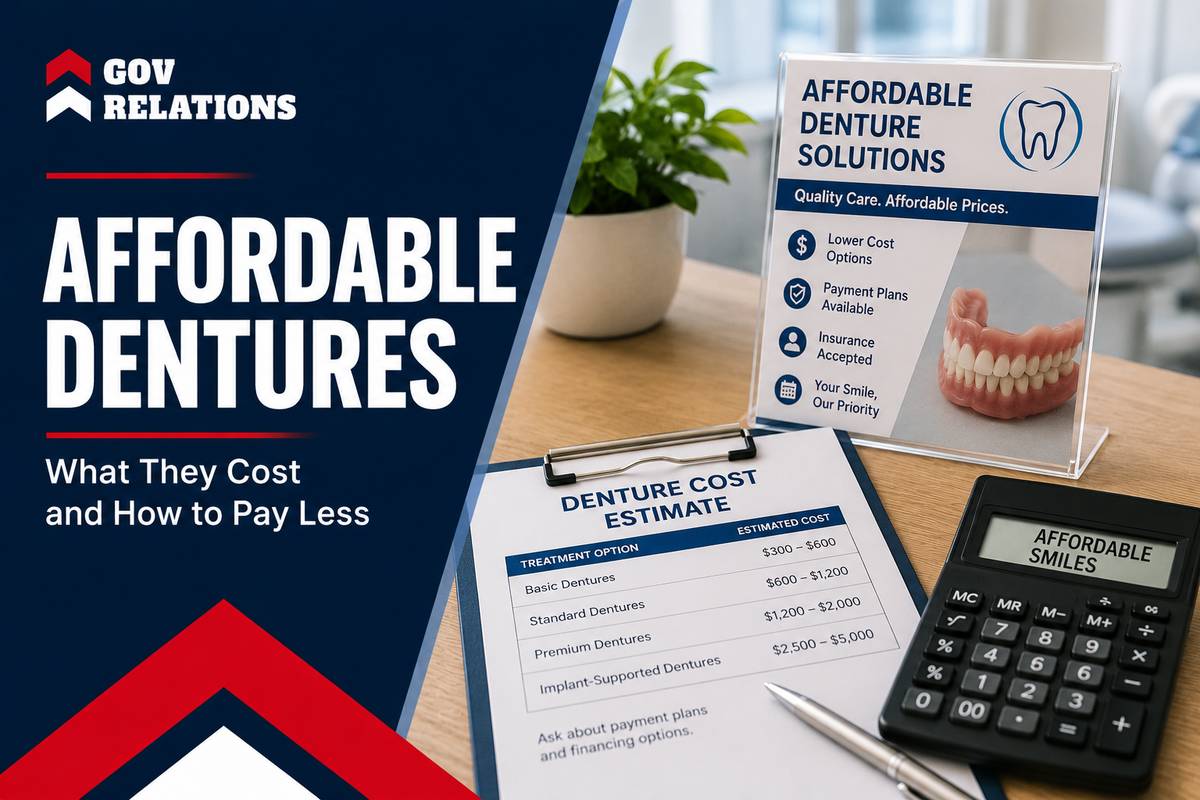
A price list for affordable dentures in the United States starts around $400 per arch for a basic economy set and reaches $6,514 for a premium full set, according to a 2023–2024 national cost study run for CareCredit. Most people pay somewhere in the middle. The national average for a traditional full set is $1,968. Your final cost depends on the denture material, whether you need teeth pulled first, and where you live.
This guide breaks the full price list down by tier, shows the hidden costs that push the total higher, and points you to the government and nonprofit programs that can cover part or all of it.
Key Takeaways
- Economy sets start near $400 per arch: On a 2026 price list for affordable dentures, a basic acrylic set runs about $400 to $500 per arch, denture only.
- The national average full set is $1,968: A traditional removable full set averages $1,968 for cash-pay patients, based on a 2024 national cost study of all 50 states.
- Premium sets reach $6,514: High-end and digitally made dentures average $6,514 and can pass $12,000 for the most customized full-set options.
- Hidden costs add $500 to $2,000: Exams, X-rays, extractions, and relines are billed separately and often double a low advertised starting price.
- MedicaidA joint federal and state program that helps with medical costs for some people with limited income ... covers dentures in more than half of states: Adult denture coverage is optional and varies by state, usually limited to one set per arch every 5 to 10 years.
- Dental schools cut costs 50 to 72 percent: Supervised student clinics offer the same dentures at a fraction of private-practice fees, though visits take longer.
- Medicare pays nothing for routine dentures: Original Medicare covers no denture costs, so beneficiariesIndividuals or groups who directly benefit from the project's activities and outcomes. rely on Medicare Advantage, Medicaid, or low-cost programs.
How Much Do Affordable Dentures Cost in 2026?
Affordable dentures in 2026 range from about $400 per arch for a basic economy set to $2,100 or more per arch for digital premium dentures. Full-set national averages run from $452 for low-cost removable dentures to $6,514 for premium, based on CareCredit’s 2024 cost study. Prices are almost always quoted per arch, so a full upper-and-lower set costs roughly double the per-arch figure.
Here is the price list by material tier, quoted per arch:
| Tier | Typical material | What you get | Price per arch (2026) |
|---|---|---|---|
| Economy / Basic | Acrylic resin | Standard fit, basic look, stock teeth | $400–$500 |
| Standard / EconomyPlus | Enhanced acrylic | Better fit, improved stain resistance | $850–$1,250 |
| Premium | High-grade acrylic, sometimes metal-reinforced | Custom look, better durability | $1,250–$1,700 |
| Digital / Ultra-Premium | Digitally designed and milled | Precision fit, fastest delivery, top aesthetics | $2,100+ |
Those tier prices come from advertised chain pricing. For context, the largest denture chain lists an Economy denture from $400 per arch, and another major provider lists a basic denture near $499 per arch with a paid savings membership. The next table shows the national full-set averages for cash-pay patients, which already count both arches:
| Denture type (full set unless noted) | Average cost | Typical range |
|---|---|---|
| Low-cost removable | $452 | $348–$883 |
| Traditional removable | $1,968 | $1,520–$3,648 |
| Immediate (temporary) | $2,178 | $1,707–$3,540 |
| Premium | $6,514 | $5,000–$12,438 |
| Partial, flexible nylon | $1,761 | $1,360–$3,451 |
| Partial, cast metal | $2,229 | $1,728–$4,203 |
| Partial, resin-based | $1,738 | $1,333–$3,283 |
One budgeting mistake trips up almost everyone: reading a per-arch price as a full-set price. A denture advertised "starting at $499" is one plate, upper or lower. Replacing your whole mouth roughly doubles that before any extractions. Always ask whether a quote is per arch or per set before you compare two offers.
What Makes One Denture Cost More Than Another?
Five things drive the price of dentures: the denture type, the material, your location, the provider you choose, and how much prep work your mouth needs. The location gap alone is large. A traditional full set averages $2,867 in Hawaii but $1,676 in Oklahoma, based on the same national study. Urban clinics also tend to charge more than rural ones because their overhead is higher.
The provider you pick changes the price as much as the material does:
| Provider type | Cost level | Notes |
|---|---|---|
| Specialized low-cost chains | Lowest | High volume, streamlined process, on-site labs |
| General dentists | Mid-range | Diverse services; may outsource fabrication |
| Prosthodontists | Higher | Specialist training; often premium fees |
| Dental schools | Lowest | Student care under faculty supervision; longer visits |
| Community health centers | Lowest (sliding scale) | Income-based fees; federally funded |
Case complexity is the last big variable. A patient with good bone structure and no teeth to remove pays the base price. A patient with significant bone loss, several extractions, or a medical condition pays more because the treatment may add bone grafting, surgical extractions, or extra visits.
Full, Partial, or Implant-Retained Dentures: Which Costs What?
Full dentures replace every tooth in an arch and cost the least. Partials replace a few teeth and clip onto the ones you keep. Implant-retained dentures attach to surgically placed posts and cost the most. The table below compares all four options side by side so you can match a type to your budgetA detailed financial plan outlining the projected costs of the project, including personnel, equipme....
| Denture type | How it works | Cost (2026) | Best for |
|---|---|---|---|
| Full (conventional) | Replaces all teeth in an arch; rests on the gums | $452–$1,968 full set | Missing all teeth in an arch |
| Partial | Replaces some teeth; clasps to remaining teeth | $1,738–$2,229 avg | Some healthy teeth remain |
| Immediate | Placed the same day teeth are removed | $2,178 full set | Do not want a gap while healing |
| Snap-in implant | Removable denture snaps onto 2–4 implants | $5,995–$13,297 per arch | Want stability, can have surgery |
| Fixed implant | Permanent; anchored to 4–6 implants | $12,995–$19,900+ per arch | Want a permanent solution |
Implant-retained options cost far more because they require surgery, titanium posts, and months of healing, but they hold better and slow the bone loss that removable dentures cannot.
The Hidden Costs a Denture Price List Leaves Out
The advertised price rarely matches the final bill. Exams, X-rays, extractions, and relines are billed on top of the denture and can add $500 to $2,000. A low economy quote usually covers one arch and the denture only, nothing else. These are the line items that turn a $499 headline into a four-figure total:
| Service | Average cost | Notes |
|---|---|---|
| Routine dental exam | $203 | Range $50–$350 |
| Panoramic X-ray | $200 | Range $157–$343 |
| Full-mouth X-ray series | $226 | Range $175–$428 |
| Simple extraction (per tooth) | $177 | Range $137–$335 |
| Surgical extraction (per tooth) | $363 | Range $281–$702 |
| Chairside reline | $350+ | Usually needed every 1–2 years |
| Laboratory reline | $500 | Takes longer, more durable |
| Denture repair | $100–$300 | Depends on the damage |
Put together, the extras add up fast. A traditional full set ($1,968) plus an exam and panoramic X-ray ($403) plus four simple extractions ($708) reaches about $3,079. Swap in surgical extractions and the total climbs to roughly $3,823. Budget for these before you sign anything.
How to Lower Your Denture Costs: 8 Ways That Work
You have more options than the sticker price suggests. These eight steps, in rough order of savings, can cut the cost of dentures without cutting quality:
- Compare at least three providers. Prices vary widely within the same city. Ask each one for a written, itemized estimate.
- Ask about cash discounts and specials. Many clinics offer new-patient deals or cash-pay pricing that they do not advertise. Ask directly.
- Use a dental school clinic. Supervised student care runs 50 to 72 percent below private fees. One school charges $1,275 for a full set versus a $4,600 local benchmark.
- Check a Federally Qualified Health Center (FQHC). These federally funded clinics charge on a sliding scale based on your income, and they serve you whether or not you have insurance.
- Apply for Medicaid dental. If your state covers adult dentures, Medicaid can cover most of the cost. Coverage rules are covered in the next section.
- Pay with pre-tax dollars. A Health Savings Account (HSA) or Flexible Spending Account (FSA) lets you pay for dentures with pre-tax money, lowering the real cost by your tax rate.
- Join a dental savings plan. These membership plans cost about $80 to $200 a year and take 10 to 60 percent off standard fees. They are not insurance and have no annual maximum.
- Budget for maintenance. Plan for relines ($350 to $500) and adjustments (about $100 per visit) across the denture’s 10-year life so upkeep never blindsides you.
Does Medicaid or Medicare Cover Dentures?
Medicare does not cover routine dentures. Medicaid covers them in more than half of U.S. states, but the rules differ everywhere. Whether you qualify comes down to your state, your income, and whether the dentures are documented as medically necessary. Start with the program that fits your situation below.
Medicare
Original Medicare (Parts A and B) pays nothing toward routine dentures, adjustments, or repairs, according to Medicare.gov. Narrow exceptions apply only when dental care is tied to a covered medical treatment, such as a procedure before an organ transplant or cancer treatment. Medicare Advantage (Part C) plans may include limited denture coverage, often one set every 5 years, with annual caps of $1,000 to $2,000. Check your specific plan documents.
Medicaid
Adult dental is an optional Medicaid benefit, so coverage is decided state by state, according to Medicaid.gov. More than 30 states cover full or partial dentures for adults. Where they do, the common rules are one denture per arch every 5 to 10 years, annual dental caps of $1,000 to $2,500, and prior authorization. Some states cover emergency dental only. Children under 21 are covered in every state under EPSDT (Early and Periodic Screening, Diagnostic and Treatment).
You may qualify for Medicaid denture coverage if:
- You meet your state’s Medicaid income limits.
- Your state includes adult dental benefits, not emergency-only coverage.
- Your dentist documents the dentures as medically necessary and gets prior authorization.
To confirm what your state covers, contact your state Medicaid office directly. Rules change often, so verify before you plan treatment.
Marketplace Health Plans
Under the ACA (Affordable Care Act), adult dental is not an essential health benefit, so Marketplace medical plans are not required to include it. You can buy a separate dental plan through the Marketplace, though many impose a 6 to 12 month waiting period before covering major services like dentures.
Low-Cost and Free Denture Programs
If you are uninsured or your state Medicaid plan will not cover dentures, several programs still can. These pathways serve low-income, elderly, disabled, and other qualifying adults at little or no cost.
- Dental school clinics: Students treat patients under faculty supervision at 50 to 72 percent below private fees. Find an accredited school through the American Dental Association (ADA).
- Federally Qualified Health Centers: Funded by the Health Resources and Services Administration (HRSA), these clinics use income-based sliding-scale fees. Search the HRSA health center finder to locate one near you.
- Dental Lifeline Network: Provides free or reduced-cost care, including dentures, for people who are disabled, elderly, or medically fragile.
- Give Back a Smile: Offers free dental restoration, including dentures, for survivors of domestic and sexual violence.
- Local 211 and community clinics: Dial 211 or call your local dental society for lists of free and low-cost clinics in your area.
Denture Price List Terms, Explained
A denture quote is full of terms that change what you pay. Here is what each one means in plain language:
- Per arch: The price for one plate, either the upper or the lower. A full set is two arches, so roughly double the per-arch price.
- Full (complete) denture: Replaces all teeth in an arch and rests on the gums, held by suction and adhesive.
- Partial denture: Replaces some missing teeth and clasps onto the natural teeth you still have.
- Immediate denture: A temporary denture is placed the same day your teeth are pulled, so you are never without teeth while you heal.
- Reline: Reshaping the denture base so it fits your gums again after the bone shrinks. Most people need one every 1 to 2 years.
- Implant-retained (overdenture): A denture that snaps onto or is fixed to dental implants placed in the jawbone for extra stability.
- Osseointegration: The 3 to 6 month period during which an implant fuses to the jawbone before the final denture is attached.
- FQHC: A Federally Qualified Health Center, a federally funded clinic that charges based on your income.
What a Realistic Denture Budget Looks Like
In our experience helping readers plan for dental care, the sticker price is almost never the real number. A legitimate denture quote covers the impressions, the custom denture, the fitting visits, and early adjustments, which Delta Dental confirms is standard. What it usually leaves out are the exams, X-rays, and extractions billed separately. The scenarios below use national averages to show where the total actually lands.
| Scenario | What it includes | Estimated total |
|---|---|---|
| Full set, no extractions | Exam + X-ray + traditional full set | $2,371 |
| Full set, 4 simple extractions | Exam + X-ray + 4 extractions + full set | $3,079 |
| Full set, 4 surgical extractions | Exam + X-ray + 4 surgical extractions + full set | $3,823 |
| Economy chain set | 2 economy arches + minor extractions | $800–$1,200 |
| Dental school full set | Complete upper and lower dentures | $1,275 |
The takeaway: a healthy mouth with no extractions can land near $2,400, while a mouth that needs surgical extractions can pass $3,800 at private-practice prices. The same case at a dental school or community clinic can cost half as much or less. Get an itemized treatment plan so you can see every line before you commit.
Scam Warning: How to Spot Fake Denture Grant and Discount Offers
People searching for cheap dentures and "free dental grants" are a common target for fraud. Before you hand over money or personal details, run any offer through these four checks:
- Real programs never charge a fee to apply for a grant. Any site charging you to submit a "dental grant" application is not a real program.
- Official application sites end in .gov. A URL that uses a program name but does not end in .gov is not a government website.
- No agency calls, texts, or emails offering dentures you never applied for. Unsolicited "you qualify for free dentures" messages are a scam.
- No real program asks for a credit card to release free dentures. Any offer that requires payment to claim assistance is fraudulent.
If you receive an unsolicited offer, do not click any links and report it to the Federal Trade Commission (FTC) at ReportFraud.ftc.gov.
Your Next Step Toward Affordable Dentures
As of 2026, a price list for affordable dentures runs from about $400 per arch for an economy set to more than $19,000 for a full-mouth implant solution, with the average full set landing near $1,968 before extras. The number that matters is your number, and it depends on your state, your provider, and how much prep work your mouth needs.
Your next step: get written, itemized estimates from at least three providers, check whether your state Medicaid program covers dentures, and review every program that can lower the bill in our guide to dental grants and assistance programs.
Frequently Asked Questions
Does dental insurance cover dentures?
Most private dental plans treat dentures as major restorative care and pay about 40 to 50 percent, up to an annual maximum of $1,000 to $2,000. Many plans add a 6 to 12 month waiting period and cover replacement only once every 5 years. Ask for a pre-treatment estimate before you start.
What is the cheapest way to get dentures?
The lowest-cost routes are dental school clinics (50 to 72 percent below private fees), Federally Qualified Health Centers with income-based pricing, and Medicaid if your state covers adult dentures. Economy dentures from low-cost chains start near $400 per arch, though extractions and X-rays cost extra.
How much do dentures cost with Medicaid?
It depends on your state. Where Medicaid covers adult dentures, you may pay little or nothing beyond a small co-pay, though many states cap annual dental benefits at $1,000 to $2,500 and limit replacement to once every 5 to 10 years. Contact your state Medicaid office to confirm your coverage.
Are cheap economy dentures worth it?
Economy dentures restore basic chewing and appearance at the lowest price, but they use stock teeth and a standard fit, so they can feel less natural and may need more adjustments. For a temporary or first set, they are a reasonable starting point. Confirm exactly what the price includes before you commit.
How often do dentures need to be replaced or relined?
Full dentures last about 10 years and partials at least 5 years with good care. Because the jawbone shrinks after tooth loss, most people need a reline every 1 to 2 years ($350 to $500) to keep the fit comfortable. Build that ongoing cost into your budget.
What is the average cost of a full set of dentures in 2026?
A traditional removable full set averages $1,968 for cash-pay patients in 2026, with low-cost sets near $452 and premium sets averaging $6,514. Your total will be higher once exams, X-rays, and any extractions are added.