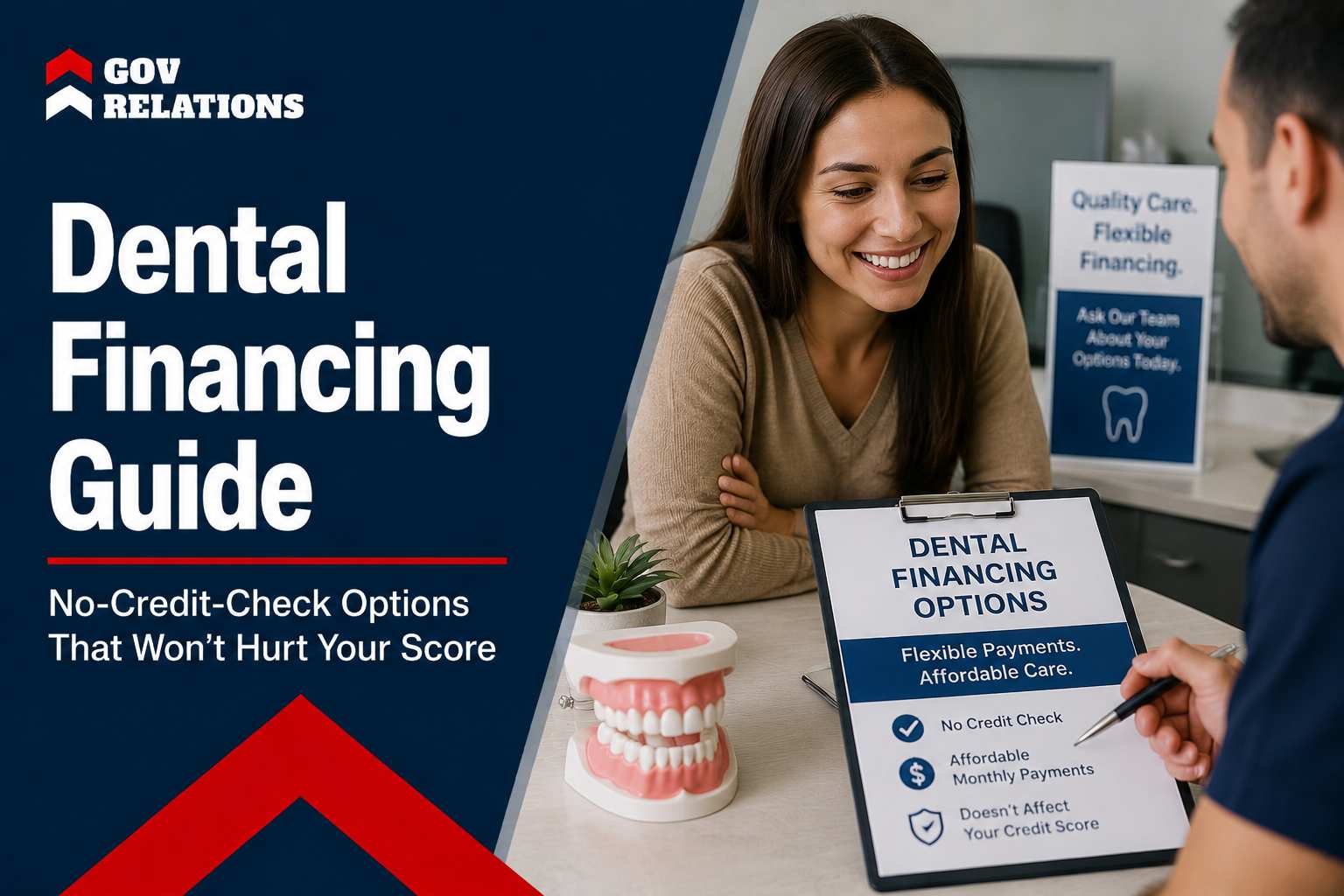
Dental financing with no credit check lets you pay for dental treatment in monthly installments without a hard credit inquiry standing in your way. Most of these programs run a soft credit check or use income and a down payment instead, so applying does not lower your credit score, and approval is possible even with thin or poor credit.
This matters because dental care is expensive and millions of people have no coverage at all. About 72 million US adults (27%) have no dental insurance, according to the CareQuest Institute for Oral Health. When a crown, root canal, or implant costs more than a paycheck, financing is often the difference between getting care and going without.
This guide explains what “no credit check” really means, who qualifies, how the main providers compare, the exact steps to apply, and the free programs worth checking first.
Key Takeaways
- No credit check means a soft check: Dental financing with no credit check usually relies on a soft credit pull that does not affect your credit score.
- Approval rates are high: Lenders like Cherry and Sunbit approve roughly 87% to 90% of applicants by weighing income and history, not just a credit score.
- Two main paths exist: You can use an in-house plan run by the dental office or a third-party lender such as Cherry, Sunbit, CareCredit, or American First Finance.
- The coverage gap is large: About 72 million US adults have no dental insurance, which pushes many toward financing for crowns, root canals, and implants.
- “No credit check” and “no credit needed” differ: No credit check skips the credit pull entirely, while no credit needed still checks credit but does not require a good score.
- New 2025 laws add protections: Illinois now limits how and when a dental office can sign patients up for third-party financing. California also has longstanding rules on how dental offices offer and process third-party credit.
- Free help may come first: Dental grants, MedicaidA joint federal and state program that helps with medical costs for some people with limited income ..., CHIP, and dental schools can reduce or erase the bill before you ever take on a payment plan.
What Does “No Credit Check” Dental Financing Actually Mean?
No credit check dental financing means a lender decides whether to approve you without running a hard credit inquiry that lowers your score. Most providers use a soft credit check for pre-qualification, and some skip credit entirely in favor of income verificationDocumentation proving the income levels of the beneficiaries, often required for grants targeting lo... or a down payment. Either way, simply applying will not hurt your credit.
The difference between a hard and a soft credit check is the whole point. A hard inquiry happens during a formal loanA sum of money borrowed that is expected to be paid back with interest. application, can lower your score by a few points, and stays on your credit report for up to two years, according to Equifax. A soft inquiry is used for pre-qualification, does not affect your score, and may not even appear on your report.
There is also a wording trap worth knowing. “No credit check” means your credit is never pulled. “No credit needed” means the lender still checks your credit, but a low score will not automatically disqualify you. Several lenders use the second phrase, so read the fine print before you assume your credit will not be touched.
Who Qualifies for Dental Financing With No Credit Check?
Most adults qualify for at least one no credit check dental financing option. Because these programs look at income, banking history, and ability to repay rather than a credit score alone, approval rates are high. Cherry reports approving up to 90% of applicants, and Sunbit approves roughly 87%, with decisions often returned in under a minute.
You may qualify if:
- You are at least 18 and can show steady income or a bank account in good standing.
- You can cover any required down payment, which some plans waive entirely.
- You are financing an eligible procedure such as an implant, crown, root canal, denture, or emergency extraction.
A past bankruptcy, a thin credit file, or a low score does not automatically rule you out. Lenders that advertise no credit check or no credit needed are built for this exact situation. The tradeoff is that lower-credit applicants often see higher interest rates or shorter terms, so the monthly payment matters more than the approval itself.
In-House vs Third-Party Dental Financing: Which Should You Choose?
In-house financing is usually cheaper and easier to qualify for but must be repaid quickly, while third-party financing offers longer terms and larger amounts but may carry interest. The right choice depends on how much you need, how fast you can repay, and whether your dentist offers an in-house plan at all.
Here is how the two approaches compare:
| Feature | In-House (Dental Office) | Third-Party Lender |
|---|---|---|
| Credit check | Soft inquiry | Soft check for most; some none |
| Typical amount | Smaller, set by the office | $50 to $50,000 by lender |
| Repayment term | Short, often 3 to 6 months | 3 to 72 months |
| Interest | Frequently 0% | 0% promos up to about 36% APR |
| Approval speed | Same visit | Seconds to minutes |
| Who carries the risk | The dental office | The lender |
| Best for | Smaller bills, fast payoff | Larger procedures, longer payoff |
Among third-party lenders, terms vary widely. APR (Annual Percentage Rate) is the yearly cost of borrowing, including interest and fees. The table below shows how the major providers compare based on their published terms. Confirm current details directly with each provider, since terms change.
| Provider | Financing Range | Credit Check | Approval Rate | Typical Terms |
|---|---|---|---|---|
| Cherry | Up to $50,000 | Soft check | Up to ~90% | 6 weeks to 60 months; 0% APR for qualifying patients |
| Sunbit | $50 to $20,000 | Soft check | ~87% | 3 to 72 months |
| CareCredit | Varies by procedure | Soft check to pre-qualify | Subject to final approval | Deferred-interest periods of 6, 12, 18, or 24 months |
| American First Finance | $300 to $5,000 | No credit needed | Considers more than credit score | Flexible, often with early-payoff options |
| iCare Financial | Set by the practice | No credit check | Instant for all patients | 0% interest options, monthly payments |
How Much Does Dental Work Cost Without Insurance?
Without insurance, common dental procedures range from a few hundred dollars to tens of thousands. A single tooth implant averages $2,143 and can run from $1,646 to $4,175 depending on the provider and location, according to CareCredit. Larger restorations cost far more.
Here is what major procedures typically cost out of pocket:
- Single dental implant: about $2,143 on average, up to $4,175
- All-on-4 implants: around $15,176
- Full mouth implants: $20,000 to $35,000 per arch
These costs land hard because patients pay so much of the dental bill themselves. Out-of-pocket spending makes up 38.9% of all dental costs in the US, nearly four times the 10.4% share for general health care, according to ValuePenguin.
Payment flexibility changes behavior. Research shows 76% of consumers are more likely to proceed with treatment when a payment plan is available, and 62% prefer monthly payments, according to industry data compiled by Etactics. For most people, the question is not whether to get the care but how to spread the cost.
How to Apply for Dental Financing With No Credit Check: 5 Steps
Applying for dental financing through a soft-check provider is built for speed. Most applications take only a few minutes from your phone in the dental office. Follow these five steps:
- Get a treatment plan and written estimate. Your dentist provides the recommended procedures and a good-faith cost estimate so you know exactly how much to finance.
- Ask which financing options the office offers. The financial coordinator can explain in-house plans and which third-party lenders, such as Cherry, Sunbit, or CareCredit, the practice works with.
- Pre-qualify with a soft credit check. Provide basic information like your name, address, and income, then agree to a soft pull. This step does not affect your credit score.
- Review the terms carefully. Check the APR, the monthly payment, the total cost over the full term, and whether a 0% offer is true zero interest or deferred interest.
- Sign and start treatment. Once you choose a plan and sign, the lender pays the practice, and you begin care. In some states you may need to complete the application yourself rather than have staff do it for you.
Key Terms to Know Before You Sign
Dental financing comes with vocabulary that affects what you pay. Here are the terms that matter most:
- Soft credit check: a review of your credit used for pre-qualification that does not affect your credit score.
- Hard credit check: a formal inquiry that can lower your score slightly and stays on your report for up to two years.
- APR (Annual Percentage Rate): the yearly cost of borrowing, including interest and fees, expressed as a percentage.
- Deferred interest: a promotional 0% period where, if you do not pay the full balance before it ends, interest is charged retroactively from day one. This is the most common trap.
- BNPL (Buy Now, Pay Later): short-term installment financing, often split into a handful of payments, used by providers like Cherry and Sunbit.
- In-house plan: a payment arrangement directly with the dental office rather than an outside lender, often interest-free but short-term.
What the Law Says: 2025 and 2026 Protections for Dental Borrowers
Dental financing is more regulated now than it was a few years ago. As of 2026, two states have added rules that protect patients from high-pressure financing, and federal law already requires clear cost disclosures.
In Illinois, a law (HB 4891) that took effect January 1, 2025, bars dental staff from filling out or submitting third-party financing applications on a patient’s behalf, and from handing patients a branded device, URL, or QR code to apply. Offices also cannot pitch financing to a patient who is under anesthesia, sedation, or nitrous oxide, or who is still in the treatment chair, according to legal analysis from McDermott Will & Emery. Patients must receive a written notice, in at least 14-point font, stating that the application is a credit card, line of credit, or loan, and not a payment plan with the dental office.
California has enacted similar consumer protections around dental credit cards, setting rules for how and when financing can be offered so patients have a clear chance to review the terms before committing. Other states are weighing comparable measures.
At the federal level, the Truth in Lending Act (TILA), enforced through Regulation Z, requires lenders to disclose the APR, finance charges, and total cost before you sign. A payment plan that runs beyond a few installments or charges interest generally makes the provider a “creditor” that must follow these rules, as the American Dental Association explains.
The reason these protections exist is straightforward. Melissa Burroughs, Senior Director of Public Policy at the CareQuest Institute, has said oral health care is too expensive and out of reach for too many families. Financing helps close that gap, but only when the terms are clear and the patient is not under pressure to sign.
Scam Warning: How to Spot Fake Dental Financing and Grant Offers
People searching for affordable dental care are a frequent target for fraud. Before you apply, here is how to tell a legitimate offer from a scam:
- Guaranteed approval with no information is a red flag. A real lender needs at least your name, income, and identification.
- Any upfront fee to apply for financing or a grantA sum of money given by a government or other organization for a particular purpose, usually without... is a warning sign. Legitimate financing does not charge you just to submit an application.
- A “free grant” that asks for your bank login or card number to release funds is fraudulent. Real grants never work that way.
- Pressure to sign immediately, especially while you are sedated or in the chair, is now restricted by law in some states for good reason. Take the paperwork home.
- Unsolicited calls, texts, or emails offering dental funding you never applied for should be ignored.
If you spot one of these, do not click any links or share information. Report it to the Federal Trade Commission at ReportFraud.ftc.gov.
Free and Low-Cost Alternatives to Check First
Before you finance anything, check whether you qualify for help that costs nothing. Financing is useful, but it is still debt. These options can lower or erase the bill first:
- Dental grants: programs like the Cosmetic Dentistry Grant and Donated Dental Services cover part or all of treatment for qualifying patients.
- Medicaid and CHIP: all 50 states cover children’s dental care, and adult dental coverage varies by state.
- Dental schools: supervised students provide care at a fraction of private-practice prices.
- Community health centers: federally funded clinics offer care on a sliding scale based on income.
- Charitable clinics: nonprofits and volunteer dentists provide free or low-cost treatment to people who qualify.
Compare the Total Cost Before You Commit
Dental financing with no credit check makes essential care reachable for the millions of Americans without dental insurance. As of 2026, soft-check providers like Cherry, Sunbit, and CareCredit, along with in-house dental plans, can break a $2,000 implant or a $15,000 restoration into payments you can manage, without a hard inquiry on your credit. The key is reading the terms, watching for deferred interest, and confirming the offer is legitimate before you sign.
Before you borrow, take five minutes to see whether free help covers your need. Start with our guide to dental assistance programs to find out what you may qualify for at no cost, then compare financing only for the balance that remains.
Frequently Asked Questions
Does dental financing with no credit check affect my credit score?
No, in most cases. These programs use a soft credit check for pre-qualification, which does not affect your score and may not appear on your report. Some plans skip credit entirely. A hard inquiry only happens if you move to a financing product that requires one, and the lender should tell you first.
Can I get dental financing with bad credit or no credit?
Yes. Lenders that advertise no credit check or no credit needed are designed for thin files, low scores, and past bankruptcy. They weigh income, banking history, and ability to repay instead of a credit score alone. Approval rates reach roughly 87% to 90% at providers like Sunbit and Cherry, though lower-credit applicants may see higher rates.
What is the difference between “no credit check” and “no credit needed”?
No credit check means the lender never pulls your credit at all. No credit needed means the lender does check your credit, but a low score will not automatically disqualify you. The distinction matters because no credit needed offers can still produce a soft or hard inquiry, so always confirm how your credit will be used.
What happens if I am denied dental financing?
A denial reflects a lender’s criteria, not your need for care. You still have options: apply with a different lender, ask the office about an in-house payment plan, request a smaller amount, phase the treatment over time, or check free programs like dental grants, Medicaid, and dental schools. Many patients approved nowhere on the first try qualify elsewhere.
What dental procedures can I finance with no credit check?
Most procedures qualify, including dental implants, crowns, root canals, dentures, bridges, fillings, extractions, orthodontics, and cosmetic work. Emergency care is commonly financed too. Financing ranges run from $50 to $50,000 depending on the lender, so both small fillings and full-mouth restorations can be covered.