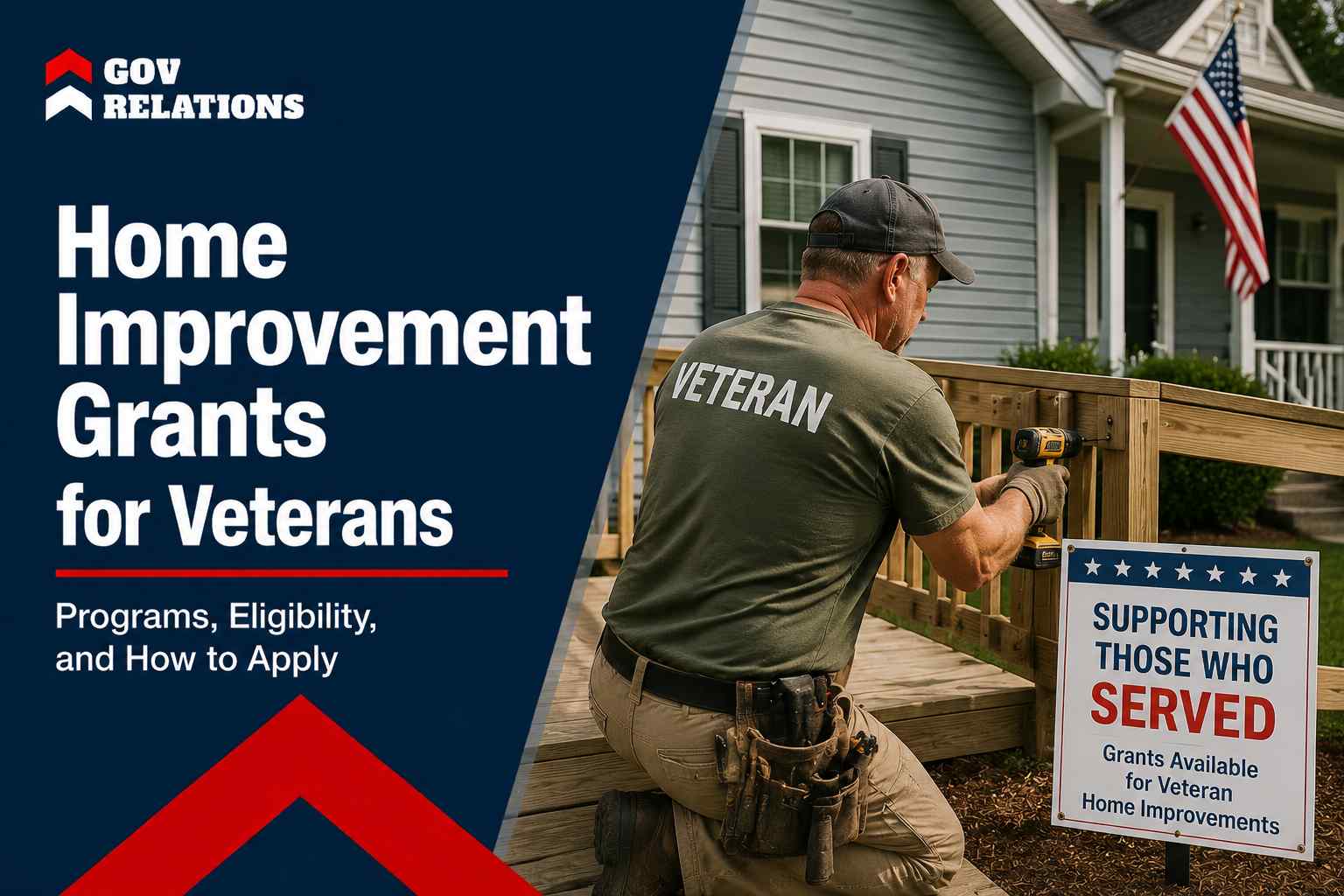
Low-income veterans can get home improvement grants worth up to $126,526 in 2026, and most of these programs never have to be paid back. The largest grants come from the Department of Veterans Affairs (VA) for veterans with service-connected disabilities, while the USDA helps rural veterans and several national nonprofits repair veterans' homes at no cost. If you served and your home needs safety repairs or accessibility changes you cannot afford, you have more options than most people realize.
This guide also fits alongside home repair assistance for people with disabilities, since many veteran grants are tied to a disability rating. The need is real. According to Rebuilding Together, about 1.5 million veterans live below the federal poverty line, and roughly 61 percent of those veterans have a disability. Below, you will find every major grantA sum of money given by a government or other organization for a particular purpose, usually without..., who qualifies, how much it pays, and the exact steps to apply.
Key Takeaways
- Largest VA grant: The Specially Adapted Housing (SAH) grant pays up to $126,526 in fiscal year 2026 for veterans with severe service-connected disabilities.
- Smaller VA option: The Special Home Adaptation (SHA) grant pays up to $25,350 in 2026 for targeted accessibility changes like roll-in showers and widened doors.
- Medical alterations: The VA HISA grant covers up to $6,800 for medically necessary changes and works for both service-connected and non-service-connected disabilities.
- Rural veterans: USDA Section 504 offers grants up to $10,000 for homeowners age 62 and older, plus 1 percent loans up to $40,000.
- No-cost nonprofits: Rebuilding Together, Habitat for Humanity, Homes For Our Troops, and Homes for Veterans repair or rebuild veterans' homes for free.
- Grants are not loans: Most home improvement grants for low-income veterans never require repayment, though USDA grants have a 3-year resale condition.
What Home Improvement Grants Can Low-Income Veterans Get?
Low-income veterans can access two types of help: federal grants from the VA and USDA, and free repair services from national nonprofits. Federal grants are tied to specific eligibility rules, usually a service-connected disability or a very low income in a rural area. Nonprofit programs fill the gaps for veterans who do not meet those rules but still need a safe, accessible home.
Most of these programs grew out of a clear need. Over 38 percent of post-9/11 veterans come home with a service-connected disability, which often means a home has to be adapted for a wheelchair, a walker, or limited mobility. These are not cosmetic upgrades. They are the ramps, roll-in showers, and widened doorways that let a veteran live independently.
The grants below are organized from the largest federal benefit to the free nonprofit services. Read the eligibility line for each one first. If you do not qualify for the VA grants, skip ahead to the nonprofit section, because those programs serve veterans who are turned away elsewhere.
VA Disability Housing Grants: SAH and SHA
The VA offers two disability housing grants that help veterans buy, build, or change a home to fit a service-connected disability. The Specially Adapted Housing (SAH) grant is the larger of the two, and the Special Home Adaptation (SHA) grant covers smaller accessibility changes. You apply for both with the same form, and the VA decides which one fits your situation.
Specially Adapted Housing (SAH) grant. The SAH grant pays up to $126,526 in fiscal year 2026 for veterans who plan to live in their home permanently. The Federal RegisterA daily publication that provides official information on federal laws, regulations, and funding opp... confirms the amount rose 3.87 percent for 2026, effective October 1, 2025. It is meant for severe disabilities such as the loss of more than one limb, blindness in both eyes, or certain severe burns. You can use the grant up to six times over your lifetime, up to the cumulative cap.
Special Home Adaptation (SHA) grant. The SHA grant pays up to $25,350 in 2026 for veterans with specific service-connected disabilities, including the loss of use of both hands, certain severe burns, or certain respiratory injuries. Like the SAH grant, it can be used up to six times across your lifetime. The VA disability housing grants page lists the full qualifying conditions and the current amounts.
You qualify for an SAH or SHA grant if the VA rates you with a qualifying permanent and total service-connected disability and you own or will own the home. There is one more option worth knowing: if you are staying temporarily in a family member's home, the Temporary Residence Adaptation (TRA) grant can cover up to $50,961 (for SAH-eligible veterans) or $9,100 (for SHA-eligible veterans) to adapt that home.
The VA HISA Grant for Medically Necessary Changes
The Home Improvements and Structural Alterations (HISA) grant pays for medically necessary changes to a veteran's primary home. Unlike SAH and SHA, the HISA grant covers both service-connected and non-service-connected disabilities, which makes it the most widely available VA option for home repairs tied to a medical need.
HISA pays a lifetime benefit of $6,800 for veterans with a service-connected disability, or with a non-service-connected disability if the veteran has a service-connected disability rated at least 50 percent. Veterans who fall outside that tier can receive $2,000. Eligible work includes building entrance ramps, widening doorways, installing roll-in showers, lowering counters, and improving plumbing or electrical systems needed for home medical equipment.
The HISA grant does not cover everything. It will not pay for exterior decking, spas, walkways to detached buildings, or new construction. You can read the full rules on the VA Prosthetic and Sensory Aids Service HISA page, which administers the program.
USDA Section 504 Home Repair Program for Rural Veterans
Veterans who live in rural areas can use the USDA Section 504 Home Repair ProgramA program by the U.S. Department of Agriculture that provides loans to very-low-income homeowners to..., also called the Single Family Housing Repair Loans and Grants program. It offers very-low-income homeowners 1 percent loans to repair or modernize a home, and separate grants for elderly homeowners to remove health and safety hazards.
You qualify for a USDA Section 504 grant if you own and live in the home, cannot get affordable credit elsewhere, earn at or below 50 percent of your county's area median income, live in an eligible rural area, and are age 62 or older. The age 62 rule applies to the grant only. Younger veterans can still apply for the 1 percent loanA sum of money borrowed that is expected to be paid back with interest..
The maximum grant is $10,000, or $15,000 if you are repairing a home damaged in a presidentially declared disaster area. Loans run up to $40,000, and a loan and grant can be combined for up to $50,000 in total assistance ($55,000 in disaster areas). One condition to plan for: a USDA grant must be repaid if you sell the home within three years. Full details are on the USDA Rural Development Section 504 page.
How Do the Main Veteran Home Repair Grants Compare?
Each grant serves a different veteran. The table below compares the four main federal and nonprofit paths side by side so you can spot which one fits your situation before you spend time on an application.
| Program | Maximum Amount | Who It Is For | Key Requirement |
|---|---|---|---|
| SAH (VA) | $126,526 (FY 2026) | Veterans with severe service-connected disabilities | Permanent residence; qualifying disability such as loss of multiple limbs |
| SHA (VA) | $25,350 (FY 2026) | Veterans with specific service-connected disabilities | Qualifying disability such as loss of hands or severe burns |
| HISA (VA) | $6,800 or $2,000 | Veterans needing medically necessary home changes | Service-connected or non-service-connected disability; amount depends on rating |
| Section 504 (USDA) | $10,000 grant; $40,000 loan | Very-low-income rural homeowners age 62+ | Rural area; age 62 or older for the grant portion |
| Nonprofit programs | Free services | Low-income and disabled veteran homeowners | Varies by local affiliate and program |
4 Nonprofits That Repair Veterans' Homes for Free
If you do not qualify for a federal grant, or you need help faster than a government timelineA schedule outlining the key activities, milestones, and deadlines throughout the project's duration... allows, these national nonprofits repair and rebuild veterans' homes at no cost. Each one works through local affiliates, so availability depends on where you live.
- Rebuilding Together, Veterans at Home. This program provides no-cost home modifications and repairs that improve safety, increase independence, and help veterans age in place. Since 2010, Rebuilding Together has completed over 13,000 rebuild projects for veterans nationwide.
- Habitat for Humanity, Repair Corps. Funded in part by The Home Depot Foundation, Habitat's Repair Corps uses volunteer teams for critical repairs. Work can include installing furnaces, building exterior ramps, replacing windows, adding insulation, and updating plumbing and electrical systems.
- Homes For Our Troops. This top-rated charity builds and donates specially adapted custom homes for severely injured post-9/11 veterans at no cost. Homes For Our Troops has built over 439 mortgage-free, barrier-free homes nationwide.
- Homes for Veterans. This nonprofit funds and installs barrier-free renovations for disabled veteran homeowners at no cost, including wheelchair ramps, accessible bathrooms, ADA-compliant kitchen adaptations, and elevator installations.
How to Apply for Veteran Home Improvement Grants
The application path depends on the program, but the early steps are the same. Follow this order to avoid wasting time on a program you do not qualify for.
- Confirm your disability rating. For SAH, SHA, and HISA, your VA service-connected disability rating decides your eligibility. Check your rating in your VA.gov account before you apply.
- Apply for VA grants with VA Form 26-4555. The same form starts both the SAH and SHA application. The VA reviews it and tells you which grant fits your disability.
- Contact the right office for HISA. HISA applications go through your VA medical center's Prosthetic and Sensory Aids Service, with a prescription or medical justification for the work.
- Check rural eligibility for USDA. Use the USDA property eligibility tool to confirm your address is in a rural area, then contact your local USDA Rural DevelopmentCriteria focused on improving the quality of life and economic well-being of people living in rural ... office to begin the Section 504 intake.
- Reach out to a local nonprofit affiliate. For Rebuilding Together, Habitat for Humanity, Homes For Our Troops, or Homes for Veterans, apply through the local affiliate that serves your area.
- Gather your documents. Most programs ask for proof of ownership, proof of income, your VA disability documentation, and a description of the repairs you need.
Key Terms Veterans Should Know Before Applying
A few terms come up across every application. Understanding them helps you read eligibility rules without guessing.
- Service-connected disability: a disability the VA has officially linked to your military service, with an assigned rating that determines benefit eligibility.
- Permanent and total disability: a VA rating meaning your service-connected condition is both total (100 percent) and not expected to improve, which the SAH and SHA grants often require.
- Very-low-income: for USDA Section 504, a household income at or below 50 percent of the area median income for your county.
- Barrier-free or accessible: home features that remove physical obstacles for a person with a disability, such as ramps, roll-in showers, and widened doorways.
- Grant versus loan: a grant does not have to be repaid, while a loan does. Most veteran home improvement grants are true grants, with the USDA 3-year resale rule as the main exception.
Scam Warning: How to Spot Fake Veteran Grant Offers
The federal government does not hand out free money to individuals without strict eligibility rules and a real application. Any website or ad promising free government money for your home with no requirements is almost always a scam, a point the USA.gov home repair guide makes directly. Here is how to protect yourself:
- Real programs are free to apply for. If a site charges a fee to submit your VA or USDA application, it is not the official program.
- Official applications use .gov sites. VA grants go through VA.gov and USDA grants go through rd.usda.gov. Any other URL using a program name is not the government.
- The government will not cold-call you with benefits. Unsolicited calls, texts, or emails offering you a grant you never applied for are a warning sign.
- No real grant asks for a credit card to release funds. Any offer that requires payment to claim assistance is fraudulent.
If you receive a suspicious offer, do not click any links in the message. Report it to the Federal Trade Commission at ReportFraud.ftc.gov.
What Veterans Tell Us Trips Up Applications
In our experience helping readers compare these programs, the most common mistake is assuming one grant rules out another. It does not. A veteran can use the HISA grant for a medically necessary bathroom change and still apply for an SAH grant for larger structural work, because they cover different needs.
The second mistake is giving up after a denial. USDA Section 504 in particular has long wait times and limited funding, so a slow response is not a rejection. If a federal program stalls, a local nonprofit affiliate is often the faster path, especially for urgent safety repairs. Apply to more than one program at the same time rather than waiting on a single answer.
Home Improvement Grants for Veterans: What to Do Next in 2026
As of 2026, low-income veterans have a clear set of options for home repairs: VA grants up to $126,526 for service-connected disabilities, the HISA grant for medically necessary changes, USDA Section 504 for rural homeowners, and free repairs from four national nonprofits. The right one depends on your disability rating, your income, and where you live.
Start by confirming your VA disability rating, then apply to every program you qualify for at once rather than waiting on a single answer. For more programs that pair with these grants, explore our housing assistance programs and our home repair assistance guides. Your home should be safe and accessible, and these programs exist to make that happen.
Frequently Asked Questions
Do home improvement grants for veterans have to be repaid?
Most do not. The VA SAH, SHA, and HISA grants are true grants with no repayment. The USDA Section 504 grant is the main exception: it must be repaid if you sell the home within three years of receiving the funds.
Can a veteran use the SAH and HISA grants together?
Yes. The grants cover different needs, so they can be combined. SAH funds major structural adaptation or a home purchase, while HISA covers smaller, medically necessary changes. Apply for each separately through its own office.
How many times can you use the VA SAH grant?
You can use the SAH grant up to six times over your lifetime, up to the cumulative cap of $126,526 for fiscal year 2026. The total across all uses cannot exceed that amount, but you do not have to use it all at once.
What if I do not qualify for any VA grant?
National nonprofits serve veterans who do not meet VA grant rules. Rebuilding Together, Habitat for Humanity Repair Corps, Homes For Our Troops, and Homes for Veterans repair or rebuild homes at no cost, working through local affiliates based on where you live.
Are there free cars or other benefits for disabled veterans too?
Yes. Beyond home repairs, the VA and several nonprofits offer transportation help. You can read our guide to free cars for veterans and disabled veterans and browse other veteran benefits for programs you may also qualify for.