A car assistance program helps low-income families, veterans, single parents, and people with disabilities get a reliable vehicle through free donated cars, low-interest loans, repair grants, or purchase vouchers. Most of these programs are run by nonprofits, state agenciesState-level government departments that offer funding for local projects, programs, and initiatives ..., or federal departments, and none of the legitimate ones charge a fee to apply.
Reliable transportation often decides whether you can keep a job. The Federal Reserve Bank of Richmond reports that just over 95% of U.S. workers live in a household with access to at least one car, yet car ownership drops sharply as income falls. If your car broke down or you never had one, a car assistance program can close that gap.
This guide explains what these programs offer, who qualifies, how to apply step by step, and how to spot the scams that target people searching for free cars for low-income families.
| Key TakeawaysFree cars are real: Nonprofits like 1-800-Charity Cars and Good News Garage give donated vehicles to qualifying families, veterans, and single parents at no cost.Income is the main rule: Most car assistance programs require household income at or below 200% to 300% of the Federal Poverty Level.Veterans receive the most: The VA automobile allowance pays up to $27,074.99 toward a specially equipped vehicle for veterans with qualifying service-connected disabilities.Repairs count too: State and county programs pay for car repairs, emissions fixes, and adaptive equipment, not only full vehicle purchases.No legitimate program charges a fee: Any website that asks for payment to submit a free car application is a scam you should report.Waiting lists are common: Free donated-car programs often have long waitlists, so apply to several at once and keep your documents ready. |
What Is a Car Assistance Program?
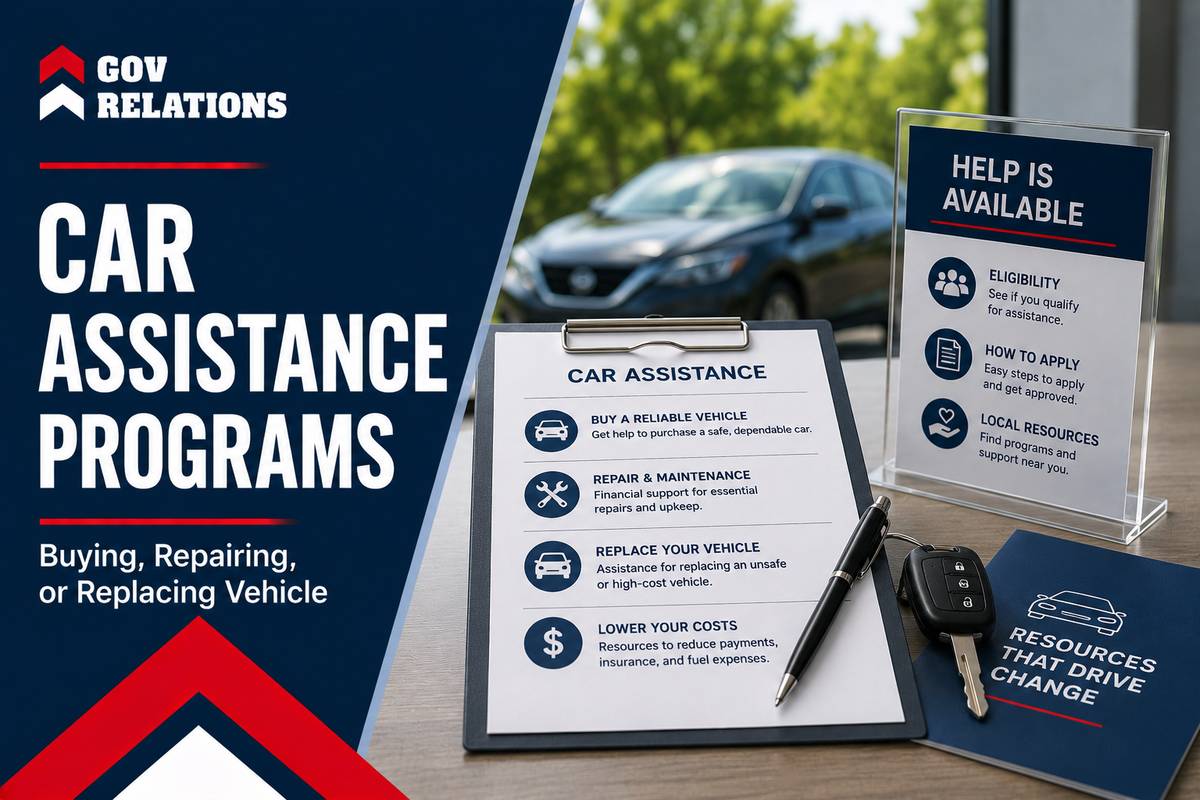
A car assistance program is any government, nonprofit, or charity effort that helps people who cannot afford a vehicle get one, repair one, or modify one. Help comes in four main forms: free donated cars, low-interest car loans, repair or emissions grants, and purchase vouchers worth a set dollar amount.
These programs exist because a car is a work tool, not a luxury, for millions of Americans. The Federal Reserve Bank of Richmond found that more than two-thirds of U.S. workers drive alone to their jobs, and in a 2022 South Carolina survey nearly 20% of people who could work but were not working named transportation as the barrier. Car assistance programs step in to remove that barrier.
A few quick definitions so nothing on this page trips you up:
- Federal Poverty Level (FPL): the income line the government uses to decide who qualifies for assistance. Many car programs set their cutoff at 200% or 300% of the FPL.
- TANF (Temporary Assistance for Needy Families): a federal block grantA lump sum of money granted by the federal government to a state or local authority to support broad... that many states use to fund car purchases, repairs, or insurance for working parents.
- Adaptive equipment: modifications like hand controls, wheelchair lifts, or lowered floors that make a vehicle drivable for someone with a disability.
Who Qualifies for Car Assistance Programs?
You qualify for most car assistance programs if your household income is at or below 200% to 300% of the Federal Poverty Level, you hold a valid driver's license, and you can show a genuine need for a vehicle tied to work, medical care, or childcare. Requirements vary by program, but these conditions appear again and again.
You are likely eligible if you meet these common conditions:
- Income: at or below 200% to 300% of the FPL, which works out to roughly $64,000 a year for a family of four in 2025, though the exact figure updates annually.
- Residency: legal U.S. residency, plus residency in the specific state or county for local programs.
- Valid driver's license: almost every program requires one, since you are expected to legally drive the vehicle.
- Demonstrated need: a job, a job offer, medical appointments, or a move from public assistance into work.
- Financial responsibility: the ability to cover insurance, registration, and maintenance once the car is yours.
Some programs add their own targeting. Veterans programs require military service, single-mother programs require dependent children, and disability programs require documentation of the condition that calls for adaptive equipment.
Types of Car Assistance Programs: Which One Fits Your Situation?
The four main types of car assistance programs are federal and government-funded programs, nonprofit and charity programs, state and local programs, and disability or veteran programs. Each serves a different situation, and many people qualify for more than one at the same time.
| Program Type | What You Get | Best For | Typical Income Limit | Example |
|---|---|---|---|---|
| Federal / Government-Funded | Grants for purchase, repair, or insurance through state agencies | Families on public assistance, people in job programs | Varies by state (often 200% FPL or below) | TANF-funded car aid |
| Nonprofit / Charity | Free donated cars or cars sold for a nominal fee | Low-income families, domestic violence survivors, veterans | 200% FPL or below | 1-800-Charity Cars, Good News Garage |
| State / Local | Used vehicles, repair grants, emissions repair help | Residents of a specific state or county | 150% to 225% FPL (varies) | Maryland TAP, Hennepin County repair program |
| Disability / Veteran | Purchase allowance plus adaptive equipment grants | Veterans and people with disabilities | Service or disability based | VA automobile allowance |
A few standouts inside these categories:
- 1-800-Charity Cars gives free donated vehicles to U.S. residents 18 and older who hold a valid license and have household income at or below 200% of the FPL.
- Good News Garage has donated more than 5,500 cars since 1996 across Vermont and Massachusetts, working with state agencies to find recipients.
- Vehicles for Change sells donated cars for about $950 with a low-interest, 12-month loanA sum of money borrowed that is expected to be paid back with interest. around $90 a month, and each car carries a six-month or 6,000-mile warranty. This model helps you build credit while you gain transportation.
- California clean-vehicle financing through the state Air Resources Board offers grants up to $7,500 for low-income buyers of plug-in hybrid, battery electric, or fuel cell vehicles, with eligibility set at or below 300% of the FPL.
If your car runs but needs work, the repair-focused programs matter most. State and county help with free car repair assistance programs can cover full repairs, partial grants, or emissions fixes, and the United Way 211 helpline is the fastest way to find repair help in your zip code. Readers in California can also review state programs that help you get a car for clean-vehicle rebates and discounted pricing.
How to Apply for a Car Assistance Program: Step by Step
To apply for a car assistance program, identify the programs you qualify for, gather your income and residency documents, complete each application, and prepare for a possible interview and waiting list. The process is similar across most programs, so doing it once prepares you for several.
Follow these steps:
- Find programs that match your situation. Start with your state's TANF office, your local Community Action Agency, and national charities. Apply to more than one, since waitlists are common.
- Gather your documents. You will usually need proof of income (pay stubs or tax returns), proof of residency (a utility bill), identification (driver's license and Social Security card), and proof of need (a job offer letter or medical appointment records).
- Complete each application in full. Most forms are online or available at a local social services office. Accurate information speeds up approval.
- Write a clear needs statementA section of the grant proposal that describes the problem or need the project aims to address, prov.... Many charity programs ask why you need the car. Be specific: name the job, the shift, or the medical care the vehicle makes possible.
- Prepare for an interview or assessment. Some programs verify your situation before approving a vehicle.
- Complete any required training. Purchase and loan programs sometimes require a short financial literacy or car-care workshopA training session or meeting organized to provide applicants with information and skills needed to ....
- Plan for the waitlist and pickup. Free donated-car programs can take weeks or months. Once approved, pick up the car promptly and budgetA detailed financial plan outlining the projected costs of the project, including personnel, equipme... for insurance, registration, and upkeep.
Car Assistance for Veterans, Single Parents, and People With Disabilities
Veterans, single parents, and people with disabilities have dedicated car assistance programs beyond the general ones. These programs recognize specific barriers, from service-connected injuries to solo parenting, and they often provide the most funding.
Veterans. The U.S. Department of Veterans Affairs pays a one-time automobile allowance of up to $27,074.99 toward a specially equipped vehicle for veterans with qualifying service-connected disabilities, and it pays the seller directly. Adaptive equipment grants are separate and can be used on up to two vehicles in a four-year period. Progressive's Keys to Progress program also gives refurbished vehicles to veterans each year, with eligibility set at income below 250% of the federal poverty guidelines and a clean driving record.
Single parents. Wheels from the Heart provides reliable vehicles to single mothers, and programs like Hands of the Carpenter in Colorado offer discounted repairs and vehicle placement for working single mothers. Many local charities run single-parent car programs because balancing work and childcare without a car is close to impossible.
People with disabilities. Beyond the VA, state Vocational Rehabilitation programs fund vehicle modifications when a car is needed for employment, and nonprofits offer grants for wheelchair-accessible vans and adaptive driving equipment. Lack of transportation is a real barrier here: the U.S. Bureau of Labor Statistics found that 10.3% of people with a disability who were not employed cited transportation as an obstacle. If your need is disability-specific, our sister resource at disabilityhelp.org covers benefit claims and adaptive equipment in more depth.
How to Spot a Car Assistance Program Scam
A car assistance program scam is any offer that charges you a fee, guarantees a free car in exchange for payment, or contacts you out of the blue about benefits you never applied for. Legitimate programs never ask for money to submit an application.
Here is how to tell a real program from a fake one:
- Real programs are free to apply for. Any site charging a fee to submit your free car application is not part of the official program.
- Official government pages end in .gov. A URL that uses a program's name but ends in .com or .net is not a government website.
- The government does not call, text, or email to offer you a car you never applied for. Unsolicited outreach promising a free vehicle is a scam.
- No legitimate program asks for your credit card to release a free car. Any request for payment to claim a vehicle is fraud.
If you receive an unsolicited free-car offer, do not click any links in the message. Report it to the Federal Trade Commission at ReportFraud.ftc.gov. Taking thirty seconds to verify a program protects both your money and your identity.
What We See Across These Programs
In reviewing car assistance programs across all 50 states, one pattern stands out. The people who succeed apply to several programs at once and keep a single folder of documents ready to submit. A veteran might combine a VA allowance with an adaptive equipment grantFinancial support for the purchase of equipment and technology needed to carry out specific projects.... A single mother might pair a donated car from a local charity with a state repair grantA sum of money given by a government or other organization for a particular purpose, usually without... a year later. The programs are built to stack, and the readers who treat them that way get on the road faster than those who wait on one list.
The other lesson is timing. Free donated-car programs run on the supply of donated vehicles, so approval can take months. Repair and voucher programs often move faster because they do not depend on a car being donated first. If you need transportation this month, start with repair assistance and voucher programs while your name sits on the donated-car lists.
Your Next Step
A car assistance program can turn a missed shift into a steady paycheck and a missed appointment into consistent care. As of 2026, the strongest approach is to apply to several programs at once: a nonprofit donated-car program, a state or county repair grant, and, if you served, the VA automobile allowance. Keep your income and residency documents in one folder so you can apply quickly as spots open.
Your next step is to review the full list of programs and eligibility rules in our guide to free cars for low-income families, pick the two or three you qualify for, and start your applications today. The help is there, it is yours by right, and the sooner you apply, the sooner you are back on the road.
Frequently Asked Questions
Can you really get a free car from the government?
Not directly. The federal government does not hand out free cars, but it funds programs through TANF and Vocational Rehabilitation that states and nonprofits use to provide donated cars, repair grants, and purchase vouchers. Charities like 1-800-Charity Cars give actual free vehicles to qualifying applicants.
What income do you need to qualify for a car assistance program?
Most car assistance programs set their income limit at 200% to 300% of the Federal Poverty Level. For a family of four in 2025, 200% of the FPL is roughly $64,000, though the exact cutoff changes each year and varies by program. Always check the specific program's current limit.
How long does it take to get a car through these programs?
It depends on the program type. Free donated-car programs often have waitlists of several weeks to several months because they rely on donated vehicles. Repair grants and purchase vouchers usually move faster. Applying to more than one program at a time shortens your overall wait.
Does TANF help you buy a car?
Yes, in many states. TANF (Temporary Assistance for Needy Families) is a federal block grant, and states decide how to use part of it. Several states offer TANF-funded grants for car purchase, repair, or insurance to help parents keep working. Contact your state TANF office to confirm what is available where you live.
Can veterans get help buying a car?
Yes. Veterans with qualifying service-connected disabilities can receive a one-time VA automobile allowance of up to $27,074.99 toward a specially equipped vehicle, plus separate adaptive equipment grants. Programs like Progressive's Keys to Progress also donate refurbished vehicles to veterans each year.
Are free government car programs a scam?
The programs themselves are real, but scammers imitate them. A legitimate car assistance program never charges a fee to apply and never contacts you unprompted to offer a vehicle. If a site asks for payment or your credit card to release a free car, it is a scam. Report it at ReportFraud.ftc.gov.