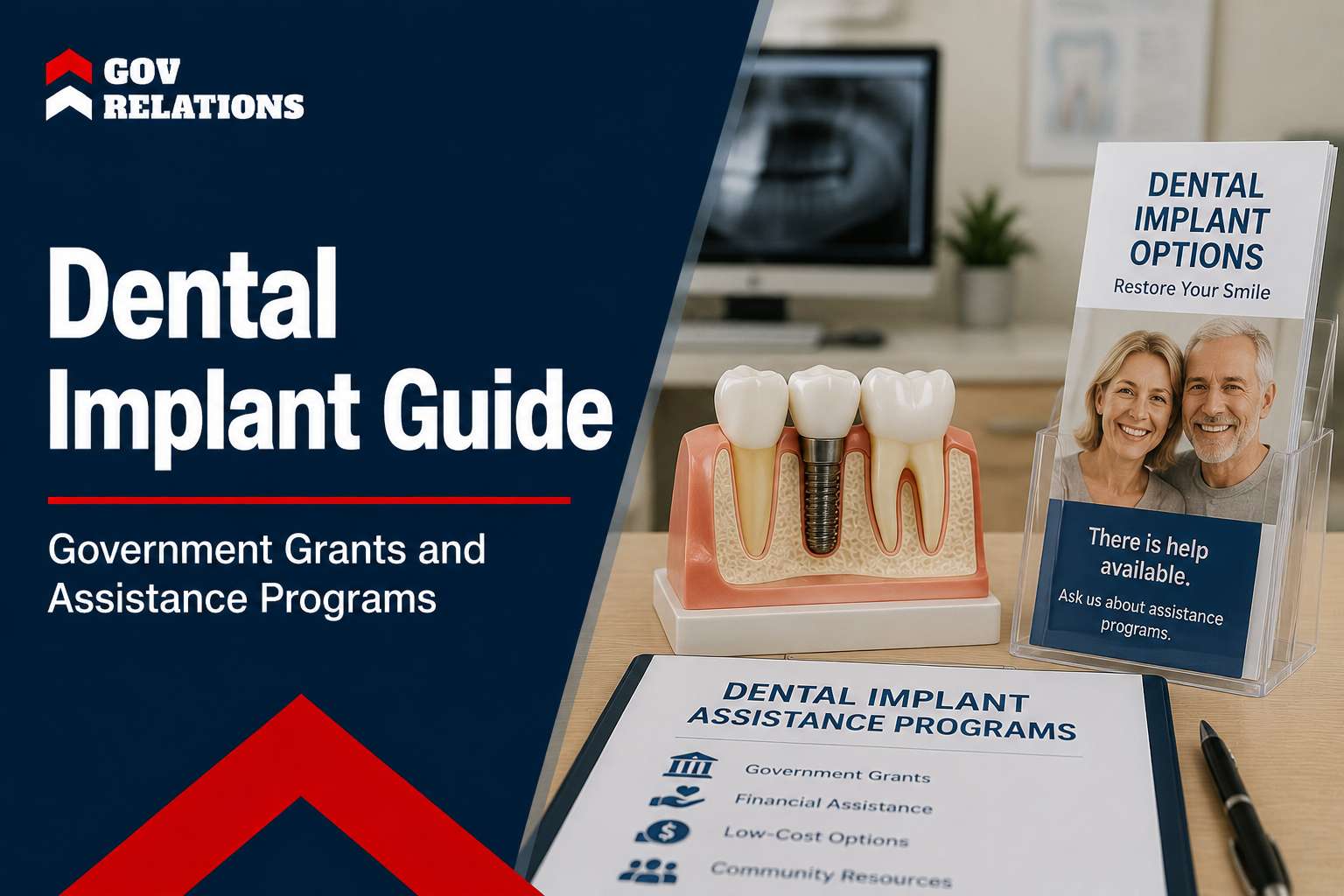
Free government grants for dental implants do not exist as a single federal program that pays for the procedure. No agency mails a check or covers an implant just because you ask. Real financial help does exist, though, through MedicaidA joint federal and state program that helps with medical costs for some people with limited income ... in certain states, some Medicare Advantage plans, Department of Veterans Affairs (VA) benefits for qualifying veterans, and nonprofit charities.
A single implant averages $2,143, and a full-mouth restoration can climb toward $90,000, which is why so many people search for free help. This guide explains where the myth comes from, which programs genuinely pay, how to qualify, and how to spot the scams that target this exact search.
Key Takeaways
- No direct federal grantA sum of money given by a government or other organization for a particular purpose, usually without... exists: Free government grants for dental implants are not a single federal program, and no agency pays for an individual procedure on request.
- Medicaid helps in some states: As of 2025, 38 states and Washington, D.C. offer enhanced adult dental benefits, though implant coverage stays rare and tied to medical necessity.
- Medicare Advantage may pay: Original Medicare excludes implants, but 97% of 2025 Medicare Advantage plans included some dental benefit, and a few cover implants.
- Veterans face narrow rules: The VA covers implants for select veterans, yet the ADA Foundation reports that 82% of enrolled veterans are ineligible for VA dental benefits.
- Charities fill real gaps: Charities may provide donated treatment or provider-sponsored assistance.
- Scams target this search: Fake free implant offers ask for upfront fees or personal data, so verify every program against an official source before you apply.
Do Free Government Grants for Dental Implants Actually Exist?
No. The federal government does not run a grant fund that pays for individual dental implants. Implants are usually classified as elective or cosmetic care rather than essential medical treatment, so they fall outside most public health funding. That single fact is the most important thing to understand before you spend time or money.
The confusion comes from advertising. Many sites that promise free dental implants or government dental grants are marketing campaigns, and some are bait-and-switch schemes that collect a consultationA meeting or discussion with the grantor or other experts to seek advice and clarification on the ap... fee or your personal information without delivering care. The word grant gets used loosely to pull in searchers who need help fast.
Here is the better way to think about it. There is no grant that hands you an implant, but there is a network of public programs, charities, and reduced-cost options that, stacked together, can cover most or all of the cost for the right patient. We have seen readers move from a $5,000 quote to a few hundred dollars by combining Medicaid approval, a dental school, and a payment plan. The rest of this guide maps those real paths.
How Much Do Dental Implants Cost in 2026?
A single dental implant in the United States typically costs $3,000 to $6,000 in 2026 when you include the implant post, the abutment, and the crown. National averages reported across large clinic datasets land near $4,200 per implant. The implant screw itself is only a fraction of that total. Surgery, lab work, and the crown make up the rest.
Costs rise sharply for bigger cases. Replacing several teeth runs from $3,000 to $15,000, and a full-mouth restoration ranges from roughly $14,000 per arch to as high as $90,000 for complex full reconstruction. Where you live matters too. California, New York, and Hawaii sit well above the national average, while Alabama, Arkansas, and Mississippi sit below it.
These numbers explain the demand for free help. For someone on a fixed income, a $4,200 bill is not a stretch goal; it is a closed door. The programs below exist to open it.
Which Government Programs Help Pay for Dental Implants?
Three federal-linked programs can help pay for implants: Medicaid, Medicare Advantage, and VA dental benefits. None covers implants automatically. Each has its own eligibility test, and implants are almost always approved only when a dentist documents medical necessity rather than cosmetic preference. The table below compares them at a glance.
| Program | Who It Covers | Implant Coverage | Key Catch |
|---|---|---|---|
| Medicaid | Low-income adults and children; rules set state by state | Rare; only when medically necessary in select states | Needs prior authorization and a Medicaid dentist |
| Medicare Advantage | Adults 65+ and some younger people with disabilities | Sometimes, via a dental allowance or major-service benefit | Annual caps near $1,300; often 50% coinsurance |
| VA Dental Benefits | Veterans in specific eligibility classes | Yes, full care for qualifying veterans | 82% of enrolled veterans are ineligible |
Medicaid and Dental Implants
You may qualify for Medicaid help with implants if your income meets your state limit and a dentist proves the implant is medically necessary. Under federal law, states must provide full dental benefits to children under 21 through the Early and Periodic Screening, Diagnostic, and Treatment (EPSDT) benefit. Adult dental coverage is optional, so it varies a lot. See the official Medicaid dental care overview for the federal baseline.
Medical necessity is the gatekeeper for adults. Examples include jaw reconstruction after trauma, disease, or radiation treatment. A standard request to replace a missing tooth for appearance alone is usually denied. When a state does approve implants, it requires prior authorization, meaning your dentist must get the green light before treatment begins.
Medicare and Dental Implants
Original Medicare (Parts A and B) does not cover routine dental care, including cleanings, extractions, dentures, or implants. The official Medicare dental page confirms it pays only for dental work tied directly to a covered medical procedure, such as an exam before an organ transplant. It will not pay for the implant itself.
Medicare Advantage (Part C) is the better path. According to KFF, most of 2025 Medicare Advantage plans offered some dental, vision, or hearing benefit. Some plans cover implants when medically necessary, and others give an annual dental allowance you can apply to the cost. Watch the limits: annual caps often sit near $1,300, and major services can carry 50% coinsurance, so a single implant can use up your whole yearly benefit fast.
VA Dental Benefits for Veterans
The VA provides full dental care, including implants, to veterans in specific eligibility classes, such as those with a service-connected dental disability, former prisoners of war, or those rated 100% disabled from a service-connected condition. Eligibility is tight: the ADA Foundation reports that 82% of veterans enrolled in VA health care are ineligible for VA dental benefits. Check your status on the VA dental care page.
If you do not qualify for free care, the VA Dental Insurance Program (VADIP) lets eligible veterans and dependents buy discounted private dental insurance through Delta Dental or MetLife, which may pay part of restorative work like implants.
Medicaid Coverage for Dental Implants by State
Adult Medicaid dental benefits expanded steadily through 2025. As reported by the American Dental Association, 38 states and Washington, D.C. now offer enhanced adult dental benefits, and 18 states have expanded benefits since 2021 with none cutting back. Even so, only about 11 states and D.C. provide the most extensive benefits, and implant coverage remains the exception, not the rule.
A handful of states have written implants into their Medicaid dental rules under specific conditions. The table below shows real examples as of 2026.
| State | What Medicaid May Cover for Implants |
|---|---|
| New York | Since January 31, 2024, covers single tooth implants and related services when medically necessary, with the prior physician-letter requirement removed. |
| Minnesota | Covers pre-surgical services, implant placement, implant-supported prosthetics, and abutment-supported crowns, subject to service limits and prior authorization. |
| Florida | Certain Medicaid Managed Care plans cover surgical placement and maintenance of the implant body, abutment, and crown. |
| California | The Medi-Cal Dental Program offers limited implant coverage, usually requiring strict prior authorization based on medical necessity. |
Rules change often, so confirm your own state before you plan treatment. You can check current adult dental benefits with the CareQuest Medicaid Adult Dental Coverage Checker, and for New York specifics, the New York State Medicaid dental benefits page lists what is covered.
How to Apply for Implant Help Through Medicaid: Step by Step
Applying through Medicaid takes more steps than other programs because you must prove medical necessity. Follow this order to avoid the delays that get applications denied.
- Confirm your Medicaid eligibility first. Check income and household limits for your state. If you are not enrolled, apply through your state Medicaid office before anything else.
- Find a Medicaid-enrolled dentist. Only a provider who accepts Medicaid can submit the request. Nationally, about 41% of dentists participate, so call ahead to confirm.
- Get a medical-necessity evaluation. Ask the dentist to document why an implant is medically required, for example after trauma, disease, or radiation, not for appearance.
- Submit the prior authorization request. Your dentist sends the documentation to Medicaid for approval before any treatment starts. Treatment done first is rarely reimbursed.
- Gather your documents. Have your Medicaid ID, photo ID, proof of income, and any medical records or referrals ready to speed the review.
- Plan for the decision. Approvals can take weeks. If denied, ask for the written reason, then file an appeal or explore the charity and reduced-cost options below.
Nonprofit and Charity Programs That Cover Dental Implants
When public programs fall short, charities can step in. These organizations provide free or heavily discounted implant care to people who meet their criteria. Demand is high, and waitlists can be long, so apply early and to more than one.
Dental Lifeline Network
The Dental Lifeline Network (DLN) runs the Donated Dental Services program, which has used volunteer dentists and labs to treat patients since 1975. You may qualify if you are over 65, permanently disabled, or medically fragile with no other way to afford care. DLN notes that implants and complex plans sometimes exceed what volunteers can provide, and waitlists are long, so set expectations accordingly.
Give Back a Smile
The American Academy of Cosmetic Dentistry Charitable Foundation runs Give Back a Smile, which restores the smiles of adults who lost or damaged front teeth through domestic or sexual violence. Since 1999, volunteer dentists have donated more than $18 million in services, including implants, to survivors. If your tooth loss came from an assault, this program is built for your situation.
Osseointegration Foundation Charitable Grant
The Osseointegration Foundation offers charitable prvovider-sumbitted grants of up to $10,000 to improve quality of life for people who need dental implants. The catch is on the provider side: the dentist applying must be a member of the Academy of Osseointegration, and the approved plan must relieve you of all financial responsibility for the procedure. Ask your implant specialist whether they can submit on your behalf.
Veteran-Specific Charities
Veterans who do not qualify for VA dental care still have options. The AAID Foundation's Smile, Veteran program and the ADA Foundation's Give Veterans A Smile initiative connect underserved veterans with volunteer dentists for pro bono implant treatment and oral health care.
Affordable Alternatives If You Do Not Qualify
Not everyone fits a program. If Medicaid, Medicare Advantage, VA, and charities all rule you out, these four routes cut the cost without any grant at all.
- Dental schools. University dental clinics provide implants at prices roughly 50% to 70% below private practices. Supervised students and residents do the work, so expect longer appointments and possible waitlists.
- Clinical trials. The National Institute of Dental and Craniofacial Research and universities test new implant methods, and participants may receive free or low-cost implants. Search active studies at ClinicalTrials.gov.
- Federally Qualified Health Centers. These community clinics charge on a sliding scale based on income. Some larger centers offer advanced care or referrals for reduced-cost specialty work.
- Financing and tax-advantaged accounts. Healthcare credit lines like CareCredit, in-house payment plans, and pre-tax HSA or FSA dollars all lower the real cost of care you pay out of pocket.
To find a sliding-scale clinic near you, use the federal HRSA health center locator, and for trials and low-cost dental care, see the NIDCR finding dental care resource.
Key Terms You Will See on Every Application
Implant paperwork is full of words that decide whether you get approved. Here is what each one means:
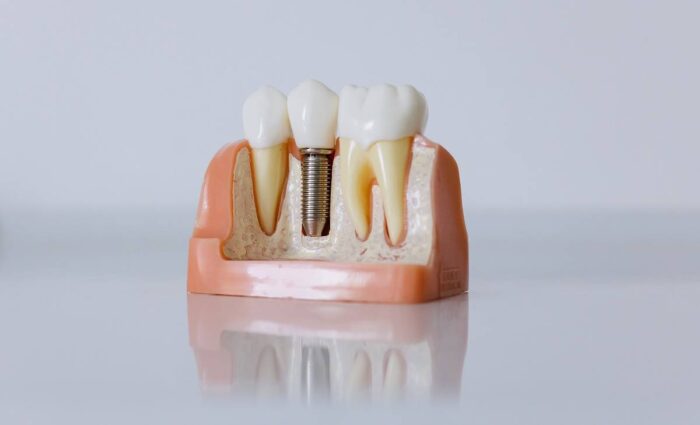
- Implant post: The titanium or ceramic screw placed in the jawbone that acts as the artificial tooth root.
- Abutment: The small connector piece that joins the implant post to the visible crown.
- Crown: The visible, tooth-shaped cap that sits on top and does the chewing and smiling.
- Medically necessary: A standard that treatment is required for health, not appearance. It is the test most adult Medicaid implant approvals turn on.
- Prior authorization: Approval a program must give before treatment starts. Skipping it usually means the program will not pay.
- EPSDT: The Early and Periodic Screening, Diagnostic, and Treatment benefit that guarantees full dental coverage for children under 21 on Medicaid.
How to Spot a Free Dental Implant Grant Scam
This search attracts fraud because scammers know people are desperate and short on time. Before you hand over a dollar or a document, run every free dental implant offer through these four checks. They are the difference between real help and a costly trap.
- A real program is free to apply for. Any site or caller charging a fee to submit your application or to release your grant is not legitimate.
- Official applications use .gov addresses. A URL that uses a program name but ends in .com or .net, however official it looks, is not the government.
- Government agencies do not cold-call with benefits. Any unsolicited call, text, or email offering implant grants you never applied for is a scam.
- No real program needs your card number to give you money. A request for a credit card to claim free care is always fraudulent.
If you get an unsolicited free implant offer, do not respond and do not click any link. Report it to the Federal Trade Commission at ReportFraud.ftc.gov.
What We See Work in Practice
In our experience helping readers fund dental work, almost no one gets an implant paid for by a single source. The wins come from stacking. A reader in a Medicaid expansion state gets a medically necessary case approved for the surgical placement, then turns to a dental school for the crown to cut the remaining bill, then spreads the last few hundred dollars across an in-house payment plan.
The pattern that fails is the opposite: waiting for one free grant to appear, paying a fee to a site that promised it, and losing weeks. Treat the search as building a plan from several real dental programs, not finding one magic check. Apply to a charity and check your Medicaid status in the same week, because both move slowly and running them in parallel saves you a month.
Build a Real Dental Implant Assistance Plan
Free government grants for dental implants are mostly a myth, but real help is not. As of 2026, your strongest paths are Medicaid in a state that covers medically necessary implants, a Medicare Advantage plan with a dental allowance, VA benefits if you qualify, and charities like the Dental Lifeline Network and the Osseointegration Foundation. If none fit, dental schools and sliding-scale health centers bring the price within reach.
Start here today: confirm your Medicaid status, then call one Medicaid-enrolled dentist to ask whether your case can be documented as medically necessary. While you wait, browse the full range of dental grants for individuals. Learn about each program, who qualifies, and how to apply and apply to at least one charity in the same week. The fastest results come from running several real options at once, not waiting for a single grant that does not exist.
Frequently Asked Questions
Are there any truly free government grants for dental implants?
No single federal grant pays for dental implants directly. Free or low-cost implants come instead from state Medicaid in medically necessary cases, some Medicare Advantage plans, VA benefits for qualifying veterans, and nonprofit charities like the Dental Lifeline Network.
Does Medicaid cover dental implants?
Sometimes. Medicaid covers implants only in certain states and only when a dentist documents medical necessity, such as jaw reconstruction after trauma or disease. It requires prior authorization and a Medicaid-enrolled provider. Cosmetic implant requests are typically denied.
Will Medicare pay for my dental implants?
Original Medicare does not cover implants. Medicare Advantage plans may help, since nearly all 2025 plans included some dental benefit. Some plans cover only preventive services, many exclude implants, and others impose annual dollar limits, coinsurance, provider networks, or prior authorization. Check the plan’s Evidence of Coverage before assuming an implant is covered.
How can veterans get free dental implants?
Veterans in specific eligibility classes can get full implant care through the VA, though 82% of enrolled veterans are ineligible. Others can use VADIP discounted insurance or charity programs like Smile, Veteran and Give Veterans A Smile.
What is the cheapest way to get dental implants without a grant?
Dental schools offer the largest savings, usually 50% to 70% below private practice prices. Federally Qualified Health Centers charge on a sliding scale by income, and clinical trials may provide implants free in exchange for participation.

- National Institute of Dental and Craniofacial Research. "Funding." NIDCR, 2021, www.nidcr.nih.gov/grants-funding/funded-research/funding-to-academic-institutions/fy2021
- "Action for Dental Health." American Dental Association, 2023, www.ada.org/en/resources/community-initiatives/action-for-dental-health
- Glick, Michael, et al. "A Global Perspective on the Costs of Inadequate Access to Oral Health Care." Journal of Dental Research, vol. 95, no. 8, 2016, pp. 821-827, www.ncbi.nlm.nih.gov/pmc/articles/PMC8757822/